How to Choose Math Toys: A Parent’s Guide to Building Number Sense Through Play
Mathematics is often perceived as a daunting subject, but for young children, it can be as natural as building blocks or counting stars. The key lies in introducing mathematical concepts through play. Math toys are powerful tools that transform abstract ideas like addition, geometry, and logic into hands-on, tangible experiences. However, with an overwhelming array of options—from counting bears to coding robots—parents and educators often struggle to select the right ones. Choosing the right math toy is not about finding the most expensive or the trendiest gadget; it is about understanding your child’s developmental stage, learning style, and the specific mathematical skills you wish to nurture. This comprehensive guide will walk you through the essential factors to consider when selecting math toys that are both educational and genuinely engaging.
1. Understand Your Child’s Developmental Stage
The first and most critical step in choosing a math toy is to match it with your child’s cognitive and motor abilities. A toy that is too advanced will frustrate a child, while one that is too simple will bore them. Mathematics learning progresses in distinct phases, and toys should support the child’s current stage of mathematical reasoning.
For toddlers (ages 1–3), the focus should be on sensory exploration and early number recognition. At this age, children are developing object permanence and basic counting skills. Ideal math toys include stacking rings, shape sorters, and simple counting puzzles. These toys introduce concepts like size comparison, one-to-one correspondence (placing one ring on one peg), and shape identification. Look for toys with bright colors, different textures, and large, easy-to-grasp pieces.
Preschoolers (ages 3–5) are ready for more structured activities. They begin to understand numbers as symbols and can count up to 20 or more. They also start grasping concepts like “more” and “less,” simple addition through combining sets, and basic patterns. Good choices include magnetic number sets, bead sequencing laces, simple board games that involve dice, and pattern blocks. These toys encourage children to count, compare quantities, and recognize repeating sequences.
For early elementary children (ages 6–8), mathematical thinking becomes more abstract. They learn addition and subtraction, multiplication tables, fractions, and basic geometry. At this stage, math toys should challenge them to solve problems and think logically. Options include math bingo games, fraction circles, multiplication flashcards with visual aids, and simple puzzle-based coding toys like robot mice. These toys promote strategic thinking and reinforce classroom learning in a playful context.
Older children (ages 9+) can handle complex reasoning, including algebra, ratio, and spatial visualization. They benefit from construction sets like geometric building kits, brain-teaser puzzles (e.g., tangrams or Rubik’s cubes), and strategy board games like “Settlers of Catan” or “Math Dice.” These toys require planning, deduction, and mental arithmetic, making them excellent for deepening mathematical fluency.
2. Identify the Specific Mathematical Skills You Want to Target
Math is not a single skill; it encompasses number sense, geometry, measurement, logic, and data analysis. Different toys excel at developing different competencies. Before purchasing, ask yourself: What mathematical gap or interest does my child currently have? If your child struggles with counting, choose toys that emphasize quantity and numeral pairing. If they love building, focus on geometric and spatial toys.
Number Sense and Arithmetic: For building a solid foundation in counting, addition, and subtraction, look for toys that involve tokens, number lines, and abacuses. The classic “100-Bead Abacus” or “Counting Bears with Sorting Cups” are timeless choices. These toys allow children to physically move objects, reinforcing the concept that numbers represent discrete quantities. Board games like “Sum Swamp” or “Zingo! Number Bingo” turn arithmetic into a social, competitive activity.
Geometry and Spatial Awareness: Children who enjoy puzzles, drawing, or building will thrive with geometric toys. Pattern blocks, geoboards, and magnetic tiles (e.g., Magna-Tiles) help children explore symmetry, area, and angles. For older children, 3D construction sets like “K’NEX” or “Tegu Blocks” teach volume, balance, and structural integrity. These toys develop the spatial reasoning that is crucial for advanced mathematics and STEM careers.
Logic, Patterns, and Problem-Solving: Mathematical thinking is as much about logic as it is about numbers. Logic puzzles, such as “Rush Hour” (a sliding car puzzle) or “ThinkFun’s Chocolate Fix,” teach deductive reasoning and trial-and-error. Pattern-based toys like “Lacing Cards” or “Wooden Pattern Boards” help children recognize sequences and predict outcomes. Coding toys, such as “Botley 2.0” or “Learning Resources’ Code & Go Robot Mouse,” introduce sequential logic and algorithmic thinking—both of which are mathematical in nature.
Measurement and Comparison: Toys that involve rulers, scales, and thermometers (e.g., toy balances or measuring cups) allow children to explore length, weight, and volume. A simple balance scale with different weights can teach concepts of equality and inequality (“Which side is heavier?”). For younger children, nesting cups or stacking towers naturally introduce seriation (ordering by size).
3. Consider the Type of Play and Learning Style
Not all children learn the same way. Some are visual learners, others are kinesthetic, and some prefer social or solitary play. A math toy must align with your child’s preferred mode of interaction to be effective. Observe how your child plays: Do they enjoy moving around? Do they like quiet, focused activities? Do they prefer working with others or alone?
Kinesthetic (Hands-On) Learners: These children need to touch, move, and manipulate objects to understand concepts. They thrive with building sets, counting manipulatives, and tactile puzzles. Toys like “Wooden Math Multiplication Board” or “Montessori Number Rods” are excellent because they involve physical action. Avoid digital-only toys for these children; they need real-world objects to anchor their learning.
Visual Learners: Children who learn best through seeing will benefit from colorful charts, flash cards, and toys that use visual patterns. Magnetic number lines, geometric stickers, and math-themed posters can reinforce concepts. For example, “Wrap-ups” (a self-checking math tool) uses visual matching. Visual learners also appreciate toys that incorporate bright colors and clear diagrams.
Auditory Learners: Though less common in math, some children respond to rhythm and verbal repetition. Toys that include songs, chants, or spoken instructions (e.g., electronic counting toys that say numbers aloud) can help. Board games that require verbal counting or reciting multiplication tables also suit these learners. However, avoid over-reliance on battery-operated toys; quiet, focused interaction often yields deeper understanding.
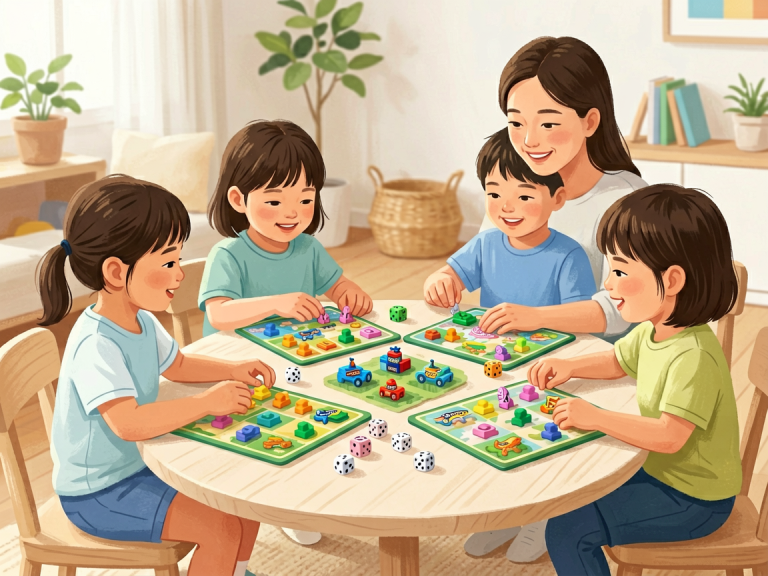
Social Learners: Many children learn best in a group setting. Math toys that are designed for two or more players, such as card games (“UNO” is great for number recognition and strategy), board games, or cooperative puzzles, encourage discussion and peer teaching. Games like “Dino Math Tracks” or “Money Bags” turn math into a social event, which can reduce anxiety and increase motivation.
4. Evaluate Quality, Safety, and Longevity
A good math toy is an investment. It should be durable, safe, and able to grow with the child. Avoid cheap plastic toys that break easily or have small parts that could be choking hazards for young children. Look for toys made from natural materials like wood, which are long-lasting and have a pleasing tactile quality. For electronic toys, check that they have volume control and that the batteries are securely enclosed.
Another key consideration is open-endedness. The best math toys are not limited to one purpose. For example, a set of wooden blocks can be used for counting, sorting, building, pattern-making, and later for exploring area and perimeter. Similarly, a deck of cards can teach number comparison, addition, probability, and even negative numbers. Open-ended toys offer repeated value as the child’s mathematical understanding deepens. Avoid toys that only teach one specific fact or skill, as they will quickly become obsolete.
Additionally, check for age recommendations on the packaging, but use them as guidelines, not strict rules. A four-year-old with advanced fine motor skills may enjoy a toy labeled for age 5, while a six-year-old with delays might benefit from a simpler toy. Observe your child’s actual abilities and interests rather than relying solely on the suggested age.
5. Integrate Real-World Context and Your Child’s Interests
Mathematics is all around us, and the best math toys connect to real-life experiences. A toy cash register teaches money math and change-making. A play kitchen with measuring spoons teaches volume and fractions. A calendar toy teaches sequencing and time. When a child sees that math is relevant to their daily life—like counting steps, sharing snacks, or timing races—they become more motivated to learn.
Furthermore, choose toys that align with your child’s existing passions. If your child loves dinosaurs, get a counting dinosaur set. If they are fascinated by outer space, look for a math game featuring rockets and planets. When a toy taps into a child’s intrinsic interests, the mathematical learning becomes almost effortless. For example, a child who adores construction will eagerly use geometric shapes to build bridges, learning about angles and stability without realizing it.
6. Avoid Overwhelm: Less Is More
It is easy to fall into the trap of buying too many math toys, believing that more variety equals more learning. In reality, children benefit more from deep, repeated engagement with a few high-quality toys than from scattered interactions with many. A single set of pattern blocks used in different ways—making designs, sorting by color, finding symmetry—can teach far more than ten different toys used once. Before buying a new toy, ask yourself: Does this offer something genuinely different from what we already have? Can it be used in multiple ways?
Also, resist the urge to turn playtime into formal lessons. The magic of math toys lies in their ability to make learning incidental. Let your child explore freely, ask questions, and make mistakes. Intervene gently by asking open-ended questions like, “How many blocks do you think we need to make this tower taller?” or “Can you find a way to arrange these shapes so they have the same number of corners?” This kind of guided play fosters curiosity and a growth mindset.
Conclusion
Choosing the right math toys is a thoughtful process that goes beyond browsing store shelves. By considering your child’s developmental stage, targeting specific skills, respecting their learning style, prioritizing quality, and connecting to their interests, you can curate a collection of toys that will serve as powerful learning tools. Remember, the ultimate goal is not to accelerate achievement but to cultivate a positive, confident relationship with mathematics. When children associate math with fun, collaboration, and discovery, they build a foundation that will support them for a lifetime. So the next time you see a set of counting bears or a geometry puzzle, think not just about the toy itself, but about the mathematical adventure it can unlock.