The Power of Play: How Math Toys for Toddlers Build Early Numerical Foundations
Word Count: 1,124
—
1. Why Math Toys Matter in Early Childhood
The toddler years—roughly ages 1 to 3—are a period of explosive cognitive growth. During this window, children’s brains form neural connections at a rate faster than any other time in life. While many parents focus on language development, social skills, or physical milestones, the foundation for mathematical thinking is also being laid. This is where math toys for toddlers come into play—not as a substitute for formal instruction, but as a natural, joyful way to introduce concepts like quantity, pattern, shape, and order.
Research in developmental psychology consistently shows that early numerical knowledge is a strong predictor of later academic achievement in mathematics. Yet many adults assume that math is too abstract for a two-year-old. In reality, toddlers are already making sense of numbers through everyday experiences: they notice when one cookie is missing, they compare the sizes of blocks, and they recognize the rhythm in a nursery rhyme. Math toys simply channel this innate curiosity into structured, hands-on exploration.
For instance, a simple stacking ring toy teaches a toddler about seriation—ordering objects by size. A set of nesting cups introduces concepts of volume and spatial relationships. These toys are not labeled “math” in the store, but their design inherently encourages counting, comparing, and problem-solving. Moreover, because toddlers learn best through sensory and motor activities, math toys that require touching, moving, and manipulating objects are far more effective than flashcards or worksheets. The key is that play is the child’s “work,” and a well-designed math toy makes that work feel like pure fun.
—
2. Types of Math Toys That Engage Young Minds
The category of math toys for toddlers is surprisingly broad, ranging from classic wooden puzzles to modern electronic gadgets. The most effective toys, however, share a common thread: they invite open-ended exploration while subtly reinforcing mathematical principles. Below are several categories that parents and educators should consider.
Counting and Number Recognition Toys
These toys typically feature numerals, dots, or objects that encourage one-to-one correspondence. Examples include bead counters, number puzzle boards, and chunky number magnets. A toddler might not yet say “five,” but when she places five plastic animals into a five-compartment tray, she is internalizing the concept of cardinality—that the last number counted represents the total quantity.
Shape Sorters and Geometric Puzzles
Shape sorters are a classic for a reason. When a toddler tries to fit a triangle block into a triangular hole, she is exploring geometry and spatial reasoning. More advanced versions include sets of 2D and 3D shapes, tangram puzzles, or pattern blocks. These toys help children recognize that shapes have specific properties—for instance, a square has four equal sides, while a rectangle has two long and two short sides.
Sorting and Patterning Sets
Sorting toys often come with colorful counters, buttons, or animals that can be grouped by color, size, or type. Some sets include activity cards that show a repeating pattern, such as red-blue-red-blue. These activities build the foundation for algebra by teaching toddlers to recognize, extend, and create patterns.
Measurement and Comparison Tools
Even simple measuring cups, balance scales, or stacking blocks help toddlers grasp concepts like “bigger,” “smaller,” “heavier,” and “lighter.” A balance scale, for example, allows a child to see that three small blocks equal the weight of one large block. This is a tangible introduction to equivalence and comparison.
Digital Math Toys (Used With Caution)
While screen time for toddlers should be limited, some well-designed apps and electronic toys can supplement hands-on play. For example, a tablet app that asks a child to drag the correct number of apples into a basket can reinforce counting skills. However, physical manipulation remains superior for brain development, so digital tools should be treated as an occasional extra, never a primary resource.
—
3. Selecting the Right Math Toys for Different Ages and Stages
Not all math toys are appropriate for every toddler. A toy that delights a 2-year-old might frustrate a 1-year-old, or bore a 3-year-old. Understanding developmental milestones helps caregivers choose toys that challenge without overwhelming.
For Toddlers 12–18 Months
At this stage, children are developing object permanence and fine motor control. Simple toys like stacking rings, large nesting cups, or a single-shape sorter are ideal. Look for toys with high contrast colors and easy-to-grasp pieces. Avoid small parts that could be choking hazards. The goal here is not to “teach math” explicitly but to allow the child to explore cause and effect (e.g., “When I put the ring on the peg, it stays.”).
For Toddlers 18–24 Months
Language is beginning to explode, and toddlers start to understand simple quantity words like “more” and “all gone.” Shape sorters with multiple shapes, puzzles with 2–4 pieces, and simple counting books with touch-and-feel elements are excellent. This is also a good age to introduce a three-piece number puzzle that pairs the numeral “1” with one picture of an apple.
For Toddlers 24–36 Months
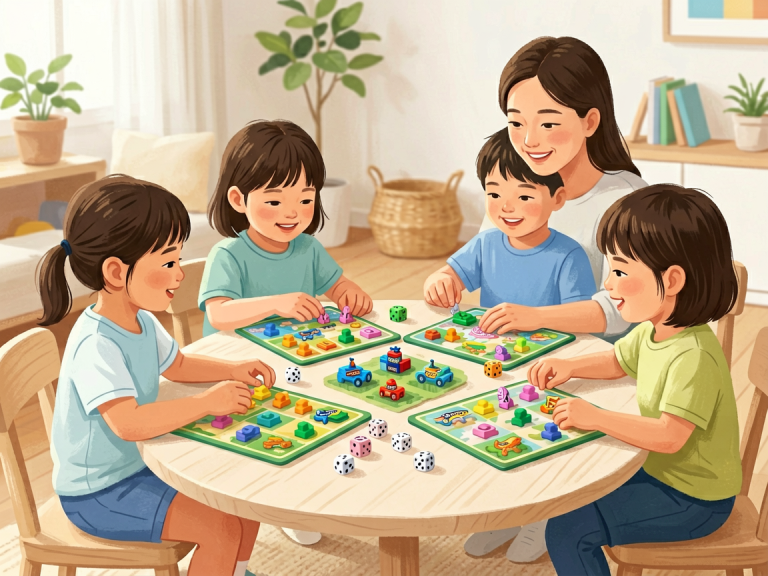
By age two, many children can count aloud to three or even five, though they may not yet understand one-to-one correspondence. Math toys for this age group should encourage counting in context. A set of 10 plastic dinosaurs and a counting mat, a simple board game with a spinner (no reading required), or a set of pattern blocks with picture cards all work well. Pretend play sets like a play grocery store with price tags also sneak in number recognition.
Special Considerations
Always prioritize safety and durability. Toddlers put objects in their mouths, so toys should be free of toxic paints, sharp edges, and detachable small parts. Also, consider the child’s interests: a toddler who loves cars will engage more with a counting activity that uses toy cars than with generic counting bears. Finally, remember that open-ended toys—those that can be used in multiple ways—offer better long-term value than rigid, single-purpose gadgets.
—
4. Integrating Math Toys into Daily Routines and Play
Having a collection of math toys is only half the battle. To maximize their benefit, parents should weave mathematical language and activities into everyday moments. This doesn’t mean scheduling “math time” for a toddler—it means using math toys as a natural part of interaction.
Create a Math-Rich Environment
Place a basket of shape sorters, counting blocks, and pattern cards where your toddler can reach them independently. Rotate toys every few weeks to maintain novelty. When your child picks up a toy, join in. Use descriptive language: “You have three red blocks. Can you find one more? Now you have four!” Even if your toddler doesn’t yet respond, hearing the numbers in context builds neural pathways.
Use Math Talk During Play
When playing with a nesting cup set, say, “This cup is big. This one is smaller. Let’s put the smallest inside the biggest.” With a balance scale, comment on “heavy” and “light.” Over time, these words become part of the child’s vocabulary, helping them categorize the world mathematically.
Turn Cleanup Into a Math Activity
After a play session, ask your toddler to sort toys back into bins: “All the red blocks go in this box, all the blue ones in that box.” Or, “Let’s count how many puzzle pieces we have. One, two, three…” Toddlers love helping, and this transforms a chore into a learning opportunity.
Combine Math Toys With Storybooks
Many picture books naturally incorporate math concepts—think *Goodnight Moon* (counting objects in the room) or *Brown Bear, Brown Bear* (patterns). After reading, bring out a related math toy. For example, after *Ten Little Ladybugs*, you might count toy ladybugs together. This cross-modal learning strengthens comprehension.
Avoid Pressure and Embrace Mistakes
The most important rule is to keep it joyful. If a toddler insists on stacking blocks in a way that doesn’t match the pattern card, let them. The process of experimentation is more valuable than getting the “right” answer. If you notice frustration, step back and simplify the activity. Math anxiety can begin surprisingly early, so protecting a child’s positive association with numbers is crucial.
—
5. The Long-Term Benefits of Early Mathematical Play
Critics sometimes ask, “Why push math on toddlers? They have their whole lives to learn numbers.” This perspective misunderstands the nature of high-quality math play. When a toddler fits a triangle into a triangle-shaped hole, she is not “learning math” in the way an adult might—she is building cognitive architecture. These early experiences pay dividends for years to come.
Stronger Number Sense
Number sense—the ability to understand quantity, magnitude, and the relationships between numbers—is a cornerstone of later math success. Studies show that children who engage in spontaneous counting and number comparison activities in preschool tend to perform better in elementary school math. Math toys provide the repetition and hands-on practice that builds this sense intuitively.
Enhanced Problem-Solving Skills
Many math toys require trial and error. A toddler trying to fit a star-shaped block into a square hole learns that if something doesn’t work, you try a different strategy. This resilience and flexible thinking transfer to all areas of learning, from reading to science.
Early Exposure to Mathematical Language
Vocabulary like “more,” “less,” “same,” “different,” “around,” “through,” “first,” and “last” are all embedded in math play. Children who acquire this vocabulary early are better able to follow instructions in a classroom setting and to articulate their own thinking.
A Foundation for STEM Learning
Science, technology, engineering, and math all rely on spatial reasoning and logical thinking. A toddler who plays with pattern blocks and balance scales is already practicing the kind of spatial visualization that later helps with geometry, coding, and even physics. In a world increasingly driven by technology, giving children an early comfort with these concepts is a gift.
Social and Emotional Benefits
Math toys often invite cooperative play. When two toddlers share a set of counting animals, they learn turn-taking, negotiation, and communication. Moreover, the sense of accomplishment after successfully completing a puzzle or stacking five blocks builds confidence and a growth mindset.
In conclusion, math toys for toddlers are far more than mere entertainment. They are carefully designed tools that harness the natural power of play to build essential cognitive foundations. By choosing age-appropriate toys, integrating math talk into daily life, and following the child’s lead, parents can give their little ones a strong start—not just in mathematics, but in lifelong learning. The blocks, shapes, and counters scattered across the living room floor are not a mess; they are the building blocks of a numerical mind.
Start with the complete guide: Beyond Counting: The Best Early Math Toys That Build a Foundation for Lifelong Numeracy.