The Playful Pathway: How to Build Language Development Through Play
Introduction: The Invisible Curriculum of Play
Language is not merely a tool for communication; it is the foundation of human cognition, social interaction, and emotional expression. For children, the journey from babbling to constructing complex sentences is both remarkable and delicate. While formal instruction and structured lessons have their place, research in developmental psychology and linguistics consistently points to one powerful, organic, and joyful catalyst: play. Play is not a break from learning; it is learning in its most natural form. When children play, they are not just having fun—they are actively building neural pathways, experimenting with syntax, expanding vocabulary, and practicing the pragmatic rules of conversation. This article explores the multifaceted relationship between play and language development, offering practical strategies for parents, educators, and caregivers to harness the power of play in nurturing linguistic growth.
Understanding the Connection: Why Play Works
The Neuroscience of Play and Language
Neuroimaging studies reveal that play activates multiple regions of the brain simultaneously, including those responsible for language processing, social cognition, and executive function. When a child engages in pretend play, for example, the prefrontal cortex—the seat of planning and self-regulation—works in tandem with Broca’s area, which governs speech production. This cross-activation strengthens the neural networks that underpin language. Moreover, play releases dopamine, a neurotransmitter associated with pleasure and motivation. A child who associates language with joy is far more likely to seek out verbal interaction and persist in challenging linguistic tasks.
The Role of Social Interaction
Language is inherently social. Lev Vygotsky, the pioneering Russian psychologist, argued that all higher cognitive functions, including language, first appear on the social plane before being internalized. Play provides a low-stakes, high-engagement social context where children can practice turn-taking, question-asking, and narrative construction. Unlike a classroom drill, play offers immediate, meaningful feedback: a playmate who misunderstands a request forces the child to rephrase; a story that falls flat encourages elaboration. This dynamic, responsive environment is precisely what language acquisition requires.
Strategies for Building Language Through Play by Age Group
For Infants and Toddlers (0–2 Years): Sensory and Interactive Play
At this stage, language development is rooted in sensory exploration and caregiver interaction. The primary goal is to build phonological awareness, establish joint attention, and introduce basic vocabulary.
Use repetitive, rhythmic play. Songs like “Itsy Bitsy Spider” or “Pat-a-Cake” combine melody with gesture, helping infants associate sounds with actions. The repetition of words such as “spider,” “water,” and “sun” allows the child to hear phonemes in context, while the hand movements create a multisensory link that cements meaning.
Narrate the child’s play. When a toddler stacks blocks, describe what is happening: “You are putting the red block on top of the blue block. Up! Up! Now it’s tall.” This technique, often called “self-talk” or “parallel talk,” models sentence structure and introduces prepositions (on, under, beside) and action verbs (put, stack, fall). Importantly, it does not pressure the child to respond; it simply floods the environment with rich language.
Introduce cause-and-effect toys. Toys that make sounds when pressed, like a pop-up piano or a squeaky rubber duck, encourage the child to vocalize in response. A caregiver can say, “You pressed the button, and it played a song! Can you say ‘again’?” Even if the child only makes a sound, the reciprocal interaction builds the foundation of conversational turn-taking.
For Preschoolers (3–5 Years): Pretend Play and Storytelling
This is the golden age of language explosion. Children begin to understand that words can represent absent objects, imagine alternative realities, and construct narratives. Guided pretend play is exceptionally powerful.
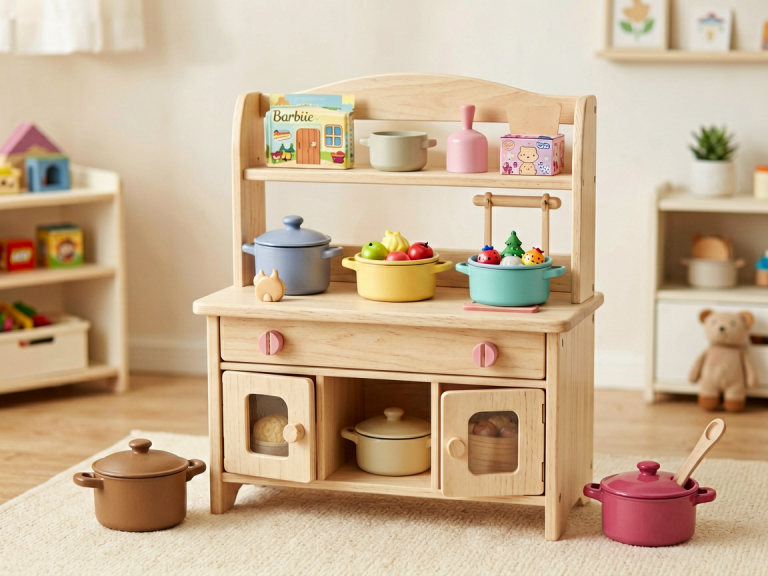
Create a play-based “Story Corner.” Set up a small area with costumes, puppets, and props (e.g., a toy kitchen, a doctor’s kit, a cardboard spaceship). Encourage the child to take on a role—chef, patient, astronaut—and then engage in dialogue. For instance, if the child is a chef, ask, “What are you cooking today? Can I have a menu?” The adult should model complex sentences: “I would like a bowl of soup, please, but I don’t like carrots. Could you make it with only potatoes?” This forces the child to process negation, conditionals, and polite forms.
Use open-ended questions. Instead of “Is that a cat?” ask “What is your cat doing? Why is it hiding under the table?” Open-ended questions demand more than a one-word answer; they require the child to formulate a mini-narrative. Over time, these narratives grow in complexity, incorporating cause and effect, character motivation, and temporal sequencing (“First… then… finally”).
Incorporate puppet play. Puppets allow children to experiment with different voices, registers, and emotions. A shy child might feel safer speaking through a lion puppet, and in doing so, practice louder articulation or more assertive language. Puppets also facilitate the practice of dialogue, as the child can make two puppets talk to each other, thereby internalizing the structure of conversation.
For Early School-Age Children (6–8 Years): Rule-Based and Cooperative Play
As children enter formal schooling, play becomes more structured and rule-governed. This is an ideal time to focus on pragmatic language skills—the “how” of communication—such as taking turns, staying on topic, negotiating, and repairing misunderstandings.
Board games with language components. Games like “Scrabble Junior,” “Bananagrams,” or “Story Cubes” directly target literacy. But even classic games like “Candy Land” can be adapted: instead of simply moving a piece, require the child to describe their move in a full sentence: “I drew a red square, so I am moving my gingerbread man to the next red space.” For cooperative games like “The Game of Life: Junior Edition,” children must negotiate with each other, vote on decisions, and explain their reasoning.
Create a “Question Jar” for imaginative play. Write down intriguing prompts on slips of paper: “What would happen if animals could talk?” “How would you build a house from candy?” “What is the bravest thing you ever did?” Children take turns drawing a question and then must answer in a short story. This not only boosts vocabulary and sentence complexity but also cultivates creative thinking and narrative coherence.
Role-play social scenarios. Set up a “restaurant,” “post office,” or “school” at home. Assign roles (customer, waiter, mail carrier, teacher) and provide script-like scaffolds. For example, the waiter can say, “Welcome to our restaurant. What would you like to order?” The child must respond with a complete order, including modifiers (“I would like a large pizza with extra cheese, please”). If the child forgets to say “please,” the adult can gently model the correction without criticism. Over time, the child internalizes social scripts and the subtle nuances of politeness and register.
The Adult’s Role: Facilitator, Not Director
The Art of Scaffolding
A crucial concept in language development through play is Vygotsky’s “zone of proximal development” (ZPD). The adult should observe the child’s current language abilities and then offer support that is just beyond that level. If a child uses only two-word utterances (“dog run”), the adult might expand: “Yes, the dog is running fast. Where is the dog running?” This expansion adds grammatical complexity (the auxiliary verb “is,” the adjective “fast,” the question) without overwhelming the child. Over time, the child internalizes these structures and begins to use them independently.
Avoiding Over-Correction
Nothing kills the joy of play faster than constant correction. If a child says, “I eated my lunch,” it is far better to respond with a natural recast: “Oh, you ate your lunch? That’s great! What did you eat?” The correct form is modeled in a positive, non-judgmental context. Research shows that children acquire grammatical rules more effectively through repeated exposure to correct forms in meaningful situations than through explicit error correction.
Modeling Rich Language
Adults should deliberately use varied vocabulary, complex sentence structures, and descriptive language during play. Instead of saying, “That’s a big truck,” say, “That enormous dump truck is transporting thousands of pounds of sand to the construction site.” The child may not understand every word, but they will absorb the rhythm, the morphology (transport-ing, pound-s), and the academic register. Over many interactions, these words will become part of their active lexicon.
Play Across Cultures and Contexts
The Universality of Play-Based Language Learning
While specific types of play vary across cultures, the underlying mechanisms are universal. In many Indigenous communities, children learn language through “learning by observing and pitching in” (LOPI), where play is embedded in everyday work and community activities. For example, a child might pretend to cook while an adult narrates the steps in the local language. In urban settings, digital play—such as interactive storytelling apps or voice-activated assistants—can also support language development, provided the child still engages in human-to-human interaction. The key is that play must be interactive, responsive, and meaningful.
Adapting for Children with Language Delays
For children with speech or language disorders, play-based interventions are especially effective. Speech-language pathologists often use “play therapy” techniques where the adult follows the child’s lead, imitates their actions, and adds language at the child’s level. For instance, if a child pushes a car, the adult pushes another car and says, “Vroom vroom! My car is fast. Your car is slow.” This parallel play builds joint attention and provides language models without demanding a response. Over time, the child begins to imitate the sounds and words. The play environment is tailored to the child’s interests, which increases motivation and reduces anxiety.
Practical Tips for Daily Implementation
Integrate play into routines. Mealtime can become a “restaurant” where the child takes orders. Bath time can involve rubber animals that “talk” to each other. Even teeth-brushing can be a game: “Can you say ‘ah’ like a giant? Now ‘ee’ like a monkey?” These small moments accumulate into significant language practice.
Limit passive screen time. While some educational apps can be beneficial, passive video watching does not provide the interactive, responsive feedback that play offers. If screens are used, choose apps that require the child to speak, sing, or make choices, and always co-view with an adult who extends the conversation.
Join in wholeheartedly. A child who sees an adult enthusiastically participating in play feels validated and safe to take risks. Put down your phone, get on the floor, and build that block tower. Your presence is the most powerful language-learning tool in the room.
Conclusion: The Lifelong Gift of Playful Language
Language development through play is not a technique to be applied in isolated sessions; it is a philosophy that recognizes the child as an active, curious, and capable learner. When we play with children, we are not merely entertaining them—we are co-constructing the very fabric of their linguistic world. Every game of peek-a-boo, every make-believe tea party, every silly rhyme whispered into a giggling ear, lays a brick in the edifice of communication. The child who learns language through play does not simply learn words; they learn that language is a source of connection, creativity, and joy. And that is a lesson that will serve them for a lifetime. So, put away the flashcards, set aside the workbooks, and pick up a puppet. The greatest classroom in the world is the one built with laughter, imagination, and love.