The Sound of Learning: How Toys Shape Language Development in Babies
Introduction: The Hidden Curriculum of Play
Every coo, babble, and giggle marks a milestone in a baby’s journey toward spoken language. Long before a child utters their first word, their brain is busy absorbing sounds, patterns, and meanings from the world around them. Among the most powerful tools in this process are toys. Not just any toys, but those designed—or chosen intentionally—to stimulate auditory, visual, and tactile experiences that build the neural pathways for language. While parents often focus on feeding schedules and sleep routines, the humble toy chest holds a secret curriculum: a carefully orchestrated sequence of interactions that can accelerate vocabulary, comprehension, and social communication. This article explores the science and practice of using toys to nurture language development in babies, from birth through toddlerhood, and offers actionable insights for caregivers.
The Critical Windows of Early Language Acquisition
Language development does not begin when a child speaks. It begins at birth, or even earlier, as the fetus responds to the rhythm and melody of its mother’s voice. In the first three years of life, the brain undergoes explosive growth, forming synapses at a rate of more than one million per second. During this period, exposure to rich, varied, and responsive linguistic input is crucial. Babies need not only to hear words but to connect them with objects, actions, and emotions. This is where toys become indispensable.
Research shows that the quality of parent-child interaction—particularly the amount of back-and-forth conversation—predicts later language skills. Toys act as catalysts for this interaction. A simple rattle, when shaken by a parent who then says “Shake! Shake! Shake!” in a sing-song voice, creates a loop of sound, gesture, and language that the baby begins to anticipate. Over time, the baby learns that the rattle’s sound corresponds to a word and an action. Such repeated, context-rich experiences are the building blocks of lexical acquisition.
How Specific Toy Features Support Language Learning
Not all toys are created equal when it comes to language development. The most effective ones share several characteristics: they invite interaction, encourage repetition, provide clear cause-and-effect feedback, and offer opportunities for naming and describing. Here are the key features that make a toy a language-building tool.
1. Sound and Music: The Foundation of Phonological Awareness
Toys that produce varied sounds—rattles, musical instruments, cause-and-effect toys that play words or melodies—introduce babies to the phonemes and prosody of their native language. For example, a soft plush bear that plays a simple nursery rhyme when squeezed helps a baby associate a tune with a toy. More importantly, the rhythm and rhyming patterns in songs and chants promote phonological awareness, which is a strong predictor of later reading success. Parents can amplify this effect by singing along or pausing to let the baby “fill in” a familiar sound.
2. Visual Contrast and Labeling: Building the Vocabulary-Object Link
High-contrast black-and-white cards for newborns, and later colorful picture books with simple, clear images, help babies focus on objects and people. The key is the adult’s role: pointing to a picture of a ball and saying “ball” while the baby looks, then handing the baby a real ball. This multisensory pairing—visual image, spoken word, tactile sensation—creates a durable memory trace. Similarly, toys with distinct parts (e.g., a wooden shape sorter with a circle, square, and triangle) allow for repeated naming: “Circle goes in the circle hole. You did it! Circle!” Each repetition reinforces the word’s meaning.
3. Manipulable Parts: Encouraging Cause-and-Effect Language
Toys that require the baby to press a button, pull a lever, or open a door invite not only motor skills but also linguistic narration. For instance, a pop-up toy that surprises the baby with a hidden animal can prompt exclamations like “Pop! Where did the bunny go? There it is!” Such moments are rich opportunities for the parent to model language, ask questions (“Do you want to push it again?”), and pause for the baby’s response—even if that response is just a coo or a look. Over time, the baby learns that their actions (pushing) cause a reaction (the toy pops) and that adults use words to describe that whole sequence.
4. Social and Imitative Play: The Roots of Conversation
Toys that mimic real-life objects—toy phones, plastic cups, baby dolls, miniature tools—invite symbolic play and dialogue. A 12-month-old holding a toy phone to her ear is not just mimicking; she is experimenting with the turn-taking structure of conversation. When a parent picks up another toy phone and says, “Hello? Is that you? Yes, I hear you!” the baby begins to understand that sounds can be exchanged in a communication loop. This is the earliest form of dialogue, and it lays the groundwork for later verbal exchanges. Similarly, feeding a doll or putting a teddy to sleep prompts language about routines: “Time for bed, teddy. Night-night.” Repetitive scripted language helps babies grasp the social functions of words.
Recommended Toys for Each Stage of Language Development
Choosing age-appropriate toys maximizes their language-building potential. Below is a stage-by-stage guide that aligns with typical developmental milestones.
0–6 Months: Sensory Input and Bonding
At this age, babies are absorbing the melody and rhythm of language. Ideal toys include:
- Soft rattles and crinkle books
- Unbreakable mirrors for facial expressions
- Musical mobiles with gentle lullabies
- High-contrast pattern cards
Parents should hold toys close to their face while talking, so the baby sees both the object and the mouth movements. Narrating actions (“Mommy is shaking the rattle. Listen! Shake-shake-shake!”) provides a direct linguistic context.
6–12 Months: Babbling and First Words
Babies begin to produce consonant-vowel combinations like “ba-ba” and “da-da.” Toys that reward babbling or imitate sounds are powerful:
- Cause-and-effect toys: pop-up animals, busy boards with buttons
- Simple board books with one object per page (e.g., “Baby’s First Words”)
- Stacking cups and rings for naming colors and sizes
- Soft blocks with pictures or letters
Encourage the baby to vocalize by pausing during play. For example, when playing with a stacking ring, hold the ring and say “Your turn… put it on!” Then wait expectantly. Even if the baby just grunts, respond as if it was a word: “Yes, you want to do it! Go ahead!”
12–24 Months: Vocabulary Explosion and Simple Phrases
This is the period of rapid vocabulary growth, from about 50 words to over 200 by age two. Toys that support two-word combinations are ideal:
- Toy animals and a barn for “cow go” or “pig eat”
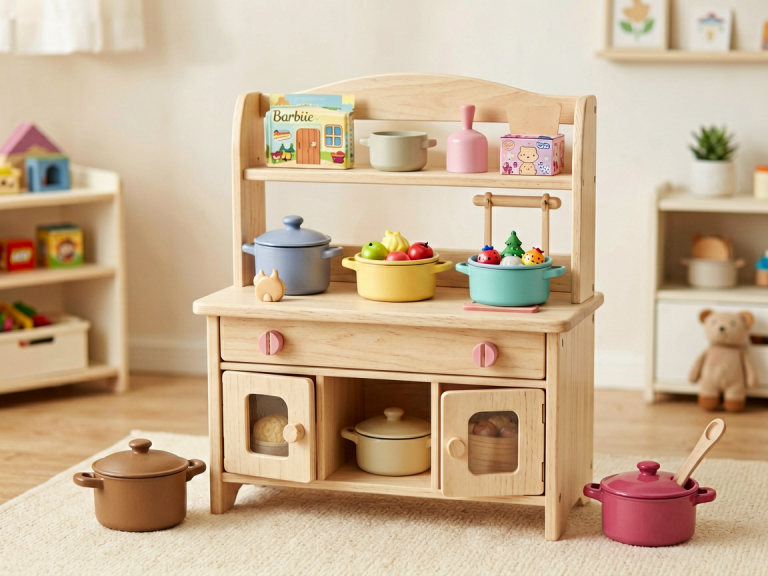
- Play food and dishes for “more apple” or “baby eat”
- Simple puzzles with large knobs for “dog up” or “ball in”
- Interactive electronic toys that say words when buttons are pressed (use sparingly—overreliance on electronics can reduce parent-child interaction)
The adult’s role is to expand the baby’s utterances. If the baby says “ball,” the parent can say “Yes, the red ball. You want to throw the ball?” This expansion models grammar without correction.
24–36 Months: Sentences and Storytelling
Toddlers begin stringing three- to four-word sentences and can follow simple narratives. Toys that encourage storytelling and pretend play are invaluable:
- Puppets and felt boards for creating scenes
- Construction sets (e.g., Duplo) for building and then describing the creation
- Dress-up clothes and props for role-playing
- Simple story sequencing cards
Ask open-ended questions: “What is the doll doing now?” “Where is the bear going?” Such questions push the child to formulate longer responses and practice narrative structure.
The Parent as the Most Important “Toy”
No matter how sophisticated the toy, its language-building power depends on the human interaction surrounding it. A screen-based toy that repeats words without a conversational partner does not foster language in the same way that a parent does. The key is contingent responsiveness—the adult’s ability to notice the baby’s focus of attention and respond with words that match that focus. For instance, if a baby is staring at a toy car, the parent can say “Car. The car goes vroom-vroom. Look, it’s rolling!” This is vastly more effective than trying to redirect the baby’s attention to something else.
Additionally, parents can use toys to create communicative temptations. Place a favorite toy just out of reach, or give the baby a toy that requires help to activate (e.g., a toy that needs a button pushed but is too stiff for tiny fingers). Wait for the baby to initiate—by looking, pointing, or vocalizing—before providing the help or the word. This strategy encourages intentional communication.
Research Insights: What Studies Tell Us
A landmark study by Hart and Risley (1995) demonstrated that the number of words a child hears in early childhood correlates strongly with later vocabulary and IQ. However, more recent research emphasizes the importance of conversational turns (back-and-forth interactions) rather than sheer word count. Toys that facilitate turn-taking—like a ball that can be rolled back and forth while saying “Ready, set, go!”—are more beneficial than toys that produce one-way speech.
Another study published in *Child Development* found that babies who played with traditional wooden blocks (requiring stacking and naming) showed better language growth than those who played with electronic toys that made sounds automatically. The reason? Electronic toys often distract from the adult-child interaction, while simple blocks demand the adult’s involvement to create meaning.
Furthermore, bilingual parents can use toys to introduce color-coded objects for each language (e.g., Spanish labels on one set of blocks, English on another) to support dual-language development without confusion.
Conclusion: Play with Purpose, but Play for Joy
Building language through toys is not about drilling flashcards or enforcing vocabulary quotas. It is about embedding rich, meaningful language into moments of shared joy. A baby learns “ball” not because they memorized it from a list, but because they watched their parent’s delighted face as the ball bounced, heard the exclamation “Bounce! Bounce!”, and felt the texture of the rubber against their palm. The toy is the medium; the relationship is the message.
As you select toys for your baby, resist the urge to buy the loudest, most electronic options. Instead, choose simple, open-ended toys that invite you to sit down and play together. Talk, sing, ask questions, and—most importantly—listen to your baby’s responses, even when they are just a smile or a squeal. In those moments, language is not being taught; it is being built, brick by brick, coo by coo, word by word, inside the most powerful learning machine ever created: the human brain, held safe in loving hands.