The Power of Play: A Comprehensive Guide to Meaningful Learning Activities for Babies
Introduction
The first years of a baby’s life are a period of extraordinary growth. During this time, neural connections are formed at a staggering rate, laying the foundation for all future learning, emotional regulation, and social development. While it is true that babies are born with an innate drive to explore and understand their world, the quality of their early experiences profoundly influences how their brains develop. This is where intentional, age-appropriate learning activities come into play. Far from being structured “lessons” in the traditional sense, the most effective learning activities for babies are those that emerge naturally from play, interaction, and sensory exploration. They transform everyday moments—a diaper change, a bath, a walk in the park—into rich opportunities for discovery. This guide explores a wide array of learning activities designed to support a baby’s cognitive, motor, language, and social-emotional development, all while strengthening the bond between caregiver and child. By understanding the “why” behind each activity, parents and educators can move beyond simple entertainment and create an environment where learning is joyful, organic, and deeply connected to the baby’s own curiosity.
Understanding the Developmental Landscape: Why Learning Activities Matter
Before diving into specific activities, it is essential to appreciate the developmental milestones that shape a baby’s first two years. Newborns are primarily focused on sensory input: the sound of a familiar voice, the contrast of light and shadow, the feel of a soft blanket. As they grow, their ability to interact with the world expands dramatically. By three months, they begin to reach for objects; by six months, they sit and grasp; by twelve months, they may take their first steps; and by eighteen months, they are experimenting with language and simple problem-solving. Learning activities should align with these natural windows of opportunity. For example, offering a high-contrast black-and-white card to a two-week-old stimulates developing vision, while giving a shape sorter to a nine-month-old supports hand-eye coordination and spatial reasoning. The goal is never to “teach” a baby to walk or talk sooner, but to provide the rich, responsive environment that allows them to practice emerging skills at their own pace. Activities that are too advanced can lead to frustration; those that are too simple may fail to engage. The art lies in observing the baby’s cues—their gaze, their coos, their reaching hands—and responding with just the right level of challenge.
Sensory Play: The Foundation of All Learning
Sensory activities are perhaps the most fundamental category of learning for babies, and they can begin from day one. The brain learns through the senses: sight, sound, touch, taste, and smell. By engaging multiple senses simultaneously, we strengthen the neural pathways that underpin later skills like categorization, memory, and language.
- Tummy Time with a Sensory Twist: Tummy time is crucial for strengthening neck, shoulder, and arm muscles, but it can also be a sensory treasure hunt. Place a small mirror in front of the baby so they can discover their own reflection. Lay out different textured mats or swatches of fabric—velvet, corduroy, silk, burlap—for them to touch as they raise their head. Hang a low-hanging mobile with contrasting colors and gentle rattles just out of reach. This combination of motor challenge and sensory reward keeps the baby engaged longer and builds perseverance.
- High-Contrast Visual Cards: From birth to about three months, babies see best in black, white, and other high-contrast patterns. Simple geometric shapes, bold stripes, and checkerboard patterns capture their attention and help develop the connections between the eyes and the brain. Hold the card about 8–12 inches from the baby’s face, slowly moving it from side to side. This also encourages visual tracking, a precursor to reading skills.
- Sound Exploration: Fill small, sealed containers with different materials—rice, dried beans, bells, or sand—to create soft shakers. Let the baby shake them, mouth them, and listen to the variations in sound. Alternatively, play simple games like “where is the rattle?” by shaking it to one side and then the other, encouraging the baby to turn their head toward the source. This develops auditory localization, an important safety skill as well as a cognitive one.
- Sensory Bags and Bottles: For babies who are sitting but not yet ready for loose parts (which can be a choking hazard), sealed sensory bags offer mess-free exploration. Fill a zip-top bag with clear hair gel and a few drops of food coloring, then add small toys like plastic fish or letters. Tape the bag to the tray of the high chair or the floor. The baby can press, squish, and swipe, watching the objects move in the gel. Likewise, a sensory bottle filled with water, glitter, and a drop of oil creates a mesmerizing lava-lamp effect that supports calm, focused attention.
Motor Development Activities: From Grasping to Galloping
Fine and gross motor skills are the physical tools through which babies interact with their environment. Activities that promote motor development not only build strength and coordination but also lay the groundwork for writing, drawing, and self-care later on.
- Grasping and Reaching Games: In the first few months, babies have an involuntary grasp reflex. To encourage voluntary reaching, offer toys that are easy to hold—soft blocks, rings, or fabric balls with a handle. Place them slightly to one side or above the baby’s chest so they must make a conscious effort to grab. As they succeed, slowly increase the difficulty by moving the toy a bit farther away. This builds spatial awareness and the understanding of cause and effect (“I reach, I get the toy”).
- The Treasure Basket: This is a classic Montessori-inspired activity suitable from around six months (when babies can sit independently). Gather a basket filled with natural, everyday objects that are safe to mouth but not choking hazards: a wooden spoon, a soft wool ball, a metal whisk, a large pinecone, a fabric pouch filled with lavender. The baby explores each object using all their senses—feeling the texture, mouthing the shape, hearing the sound when it is dropped. This open-ended activity promotes concentration, decision-making (which object to choose), and fine motor manipulation.
- Rolling and Crawling Circuits: Once a baby begins to move, create a simple obstacle course using pillows, cushions, and soft tunnels. Place interesting toys at the end of a short “tunnel” made from a cardboard box or under a draped blanket. The act of maneuvering around obstacles builds gross motor planning and spatial problem-solving. For babies who are crawling, scatter a few toys a short distance away so they must shift their weight and reach, strengthening core muscles and balance.
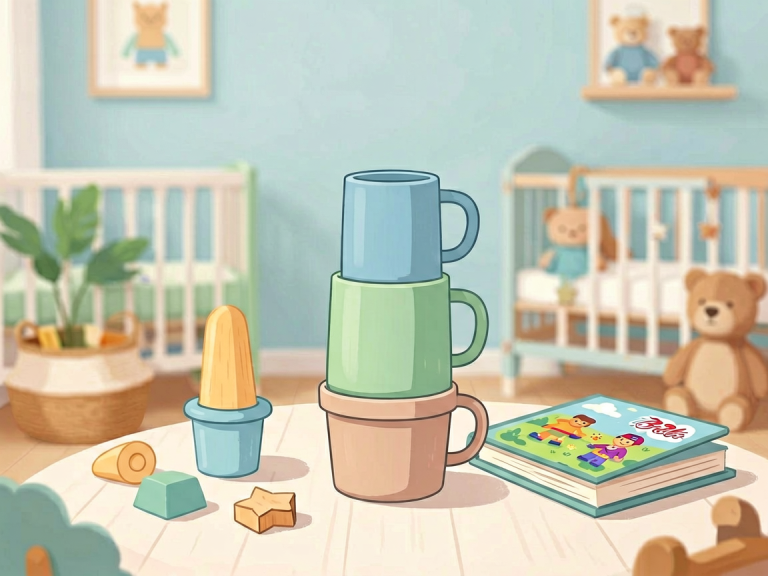
- Stacking and Knocking Down: Around eight to twelve months, babies become fascinated with stacking rings, blocks, or cups. However, they often enjoy the process of knocking them down even more than building them up. That is perfectly fine—the act of swatting a tower and watching it topple teaches cause and effect, gravity, and hand-eye coordination. Provide lightweight blocks that are easy to grip. Celebrate both the construction and the destruction, as both are part of the learning cycle.
Language and Communication Activities: The Gift of Conversation
Language development is not merely about vocabulary—it is about connection. Babies learn language through the back-and-forth rhythm of interaction, long before they utter their first word.
- Narrate the Day: Talk to your baby constantly, describing what you are doing as you do it. “Now I am putting on your red sock. First the toes, then the heel, then up over your ankle. Good! Now the other foot.” This exposes the baby to the natural cadence of language, vocabulary in context, and the idea that words have meaning. Even if they cannot respond, their brain is mapping the sounds onto actions and objects.
- Serve-and-Return Conversations: When your baby coos, babbles, or makes a sound, pause, look them in the eye, and respond as if they have said something important. Imitate their sound back, then add a variation. For example, if they say “ba,” you might say “ba ba ba” and then “bottle? Do you want the bottle?” This simple exchange teaches turn-taking—the foundation of conversation—and validates the baby’s attempt to communicate.
- Picture Books and Texture Books: From the earliest months, introduce board books with high-contrast images or simple faces. As the baby grows, choose books with one clear object per page and name it clearly. Touch-and-feel books add a sensory dimension; let the baby pat the fuzzy bunny or scratch the shiny foil while you say the corresponding word. Repetition is key—don’t worry if you read the same book twenty times in a row. That repetition is how the brain solidifies new vocabulary.
- Songs and Finger Plays: Singing is a powerful language-learning tool. The melody, rhythm, and repetitive lyrics help babies segment speech sounds. Classic finger plays like “Itsy Bitsy Spider” or “Pat-a-Cake” combine words with actions, engaging multiple areas of the brain. The motor movement reinforces the language, and the predictable pattern builds memory. Even a simple lullaby sung softly before sleep creates a linguistic and emotional anchor.
Cognitive and Problem-Solving Activities: Thinking Begins with Doing
Cognitive development is all about making sense of the world—understanding object permanence, cause and effect, and simple patterns.
- Peek-a-Boo Variations: The classic game of peek-a-boo teaches object permanence, the understanding that things continue to exist even when they are out of sight. Vary the game by hiding your face behind a scarf, then a toy, then the baby’s own hands. For older babies (around nine months), hide a toy under a cup while they are watching and encourage them to lift the cup and find it. This simple experiment is a profound cognitive milestone.
- Causes and Effect Toys: Provide toys that have a clear action-reaction relationship—a ball that lights up when pushed, a piano that plays notes when keys are pressed, a jack-in-the-box that pops up when the crank is turned. As the baby experiments, they are building neural pathways about agency and prediction. Resist the urge to show them “how it works” immediately; allow them the joy of discovery.
- Sorting and Matching (Simple): Around twelve to eighteen months, babies begin to notice similarities and differences. Offer two containers—one for red blocks, one for blue blocks—and model how to sort them. At first, they may just dump all the blocks together; that’s fine. Gradually, they will begin to mimic the sorting behavior. Color sorting, shape sorting (using large, easy-to-grip shapes), and later, matching identical objects (two identical cups) all support logical thinking and categorization.
- Open-Ended Loose Parts Play: Once a baby is past the mouthing stage (usually after 18 months), introduce safe loose parts like large wooden beads, fabric scraps, cardboard tubes, and pebbles. Without a predetermined outcome, the baby decides how to use these items—stacking them, filling a container, lining them up, or pretending they are food for a doll. This type of play fosters divergent thinking, creativity, and executive function skills.
Social-Emotional Activities: Building Trust and Empathy
Learning is not just about the mind and body; it is also about the heart. The earliest relationships shape a baby’s sense of security and their ability to form connections with others.
- Mirror Play: Babies are fascinated by faces, especially their own. Sit with your baby in front of a child-safe mirror. Make exaggerated expressions—happy, sad, surprised—and name them: “Look, Mama is happy! See the smile?” Then encourage the baby to make faces. This is the beginning of emotional literacy and self-awareness.
- Turn-Taking Games: Beyond conversation, turn-taking can be practiced with physical games. Roll a soft ball back and forth. Push a toy car toward the baby and wait for them to push it back. Even if the baby does not return the item, the act of waiting and anticipating models the rhythm of social interaction.
- Cozy Reading Nook: Create a small, comfortable space with cushions and a basket of books. Spend time there together every day, without any agenda. Let the baby choose a book, turn the pages, or just snuggle while you read. This consistent, calm, one-on-one attention builds a secure attachment, which is the foundation for all future social and emotional learning.
- Naming Emotions: When the baby cries or laughs or shows frustration, label the emotion in a calm, accepting tone. “You are feeling frustrated because the block fell down. That’s okay. Let’s try again.” By acknowledging their feelings, you teach them that emotions are valid and manageable. Over time, this language gives them the tools to regulate their own emotions.
Outdoor and Nature-Based Learning: The World as a Classroom
Fresh air and natural environments offer a sensory richness that no indoor space can replicate. Outdoor activities for babies can be subtle but powerful.
- Sensory Walks: Put the baby in a carrier or stroller and walk slowly through a park or garden. Pause to let them feel a leaf, listen to a bird, or watch the movement of clouds. Describe what you see: “The tree is very tall. Its leaves are green and they are rustling in the wind.” This passive exposure builds observational skills and a connection to the natural world.
- Water Play: In a shallow basin on a warm day, let the baby splash, pour, and scoop with cups and spoons. Water play is deeply calming and teaches basic physics (sinking, floating, pouring). For non-mobile babies, simply letting them sit in a shallow bath with a few floating toys provides similar benefits in a safe environment.
- Sand or Soil Play: Once the baby is sitting, fill a tray with clean sand or soil (outdoors or on a drop cloth). Provide spoons, scoops, and small containers. The tactile experience of scooping and sifting is not only calming but also supports fine motor coordination. Be sure to supervise closely to prevent ingestion.
Adapting Activities for Individual Needs
Every baby develops at their own pace, and what works for one may not work for another. The most important principle in selecting learning activities is to follow the baby’s lead. If an activity causes distress or disinterest, set it aside and try something else. Premature pressure to achieve milestones can backfire, creating anxiety instead of curiosity. Likewise, babies with special needs or developmental delays may benefit from modified activities—for example, using weighted toys for a baby with low muscle tone, or providing auditory toys for a baby with visual impairments. Always consult with a pediatrician or early intervention specialist if you have concerns. The goal is not to produce a “super baby,” but to nurture a child who feels safe, loved, and eager to explore.
The Role of the Caregiver: Being Present, Not Perfect
Finally, it is essential to remember that the most valuable learning resource a baby can have is a responsive, attentive caregiver. You do not need expensive toys, a perfectly decorated nursery, or a curriculum. You need your voice, your touch, your attention, and your willingness to be silly, patient, and observant. When you engage in these learning activities, your focus should be on the process, not the outcome. It does not matter if the baby “learns” to stack blocks by twelve months or not. What matters is that they feel the joy of your shared presence, the encouragement of your smile, and the safety of your arms. That emotional foundation is the soil in which all other learning will grow.
Conclusion
Learning activities for babies are not about rushed achievement or academic pressure; they are about honoring the innate curiosity of the human mind. From sensory bags that spark wonder to mirror games that build self-awareness, from tummy time that strengthens muscles to lullabies that weave language into the heart, each activity is a small, loving invitation to discover the world. By integrating these playful, developmentally appropriate activities into your daily routine, you are building a rich tapestry of experiences that will support your baby’s growth across all domains—cognitive, motor, language, social, and emotional. And in the process, you will deepen the most important relationship of all: the one between you and your child. So put away the flashcards, trust the process, and let play be the guide.