Building Bonds: The Best Toys for Social Skills for 2-Year-Olds
Introduction
The second year of life is a magical window of social awakening. At age two, children begin to move from playing alone or simply alongside others (parallel play) toward more interactive, cooperative experiences. They start to notice that the peer next to them has a red truck, that a friend is crying, or that sharing a toy can lead to a laugh. Nurturing these emerging social abilities is crucial—not only for making friends but for developing empathy, communication, and conflict-resolution skills that last a lifetime.
Toys are powerful tools in this developmental journey. The right playthings can create natural opportunities for turn-taking, sharing, imitation, and emotional expression. But not every toy marketed for toddlers supports social growth. This article explores the best toys for social skills for 2-year-olds, focusing on those that encourage interaction, cooperation, and emotional understanding. Each recommendation is backed by developmental research and practical parent experience, helping you choose playthings that turn solo fun into shared joy.
—
Why Social Skills Matter at Age Two
Before diving into specific toys, it helps to understand what social skills look like in a two-year-old. At this age, a child typically:
- Engages in parallel play (playing near, but not with, another child)
- Begins to imitate peers and adults
- Shows emerging empathy (e.g., patting a crying friend)
- May struggle with sharing and turn-taking (possessiveness is normal)
- Uses simple words and gestures to communicate wants and feelings
- Enjoys simple pretend play, often alone or with a supportive adult
The goal of social-skill toys is to gently scaffold these abilities—moving from solitary to interactive play, from “mine!” to “your turn,” from observing to joining in. Toys that are open-ended, require collaboration, or invite role-playing are especially effective.
—
What to Look for in Social-Development Toys for Toddlers
When selecting toys, keep these criteria in mind:
- Duplication: Two-year-olds love having the same item as a peer (two identical trucks, two shovels). This reduces conflict and encourages parallel play that can lead to sharing.
- Simplicity: Complex rules are frustrating. Toys with one or two simple actions (stacking, rolling, pushing) work best.
- Safety: No small parts, sharp edges, or long cords. Age-appropriate sizing for little hands.
- Interactivity: Toys that require two people to fully enjoy—like a seesaw, a two-person cart, or a play phone.
- Emotional resonance: Dolls, puppets, and stuffed animals help children process feelings and practice nurturing.
With these guidelines in mind, let’s explore the top categories of social-skills toys for two-year-olds.
—
1. Pretend Play Sets: Fostering Imagination and Cooperation
Pretend play is the foundation of social development. When a two-year-old puts on a chef’s hat or picks up a toy stethoscope, they step into another role. This “as-if” thinking allows them to practice adult behaviors, negotiate roles, and understand others’ perspectives.
Best options:
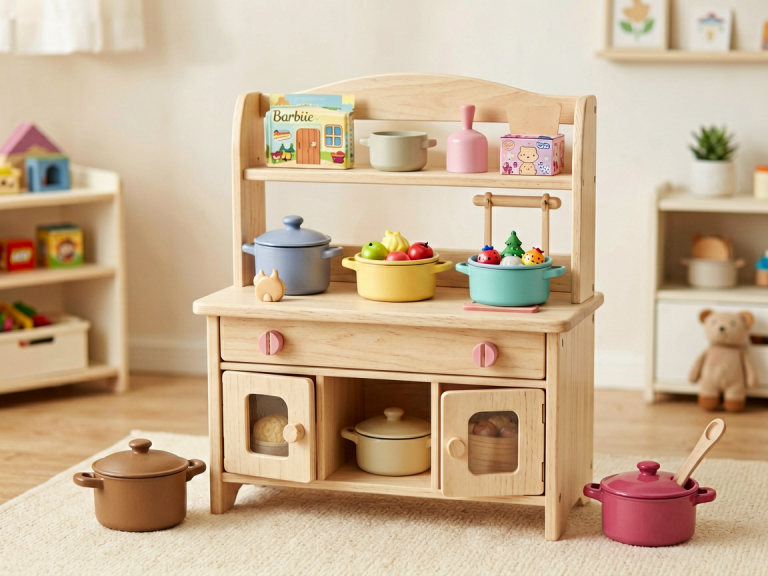
- Play kitchens and food sets: A simple wooden kitchen with pots, pans, and plastic vegetables invites two children to cook together. One stirs the soup while the other sets the plates. They naturally learn to coordinate actions and share tools.
- Doctor’s kits: A stethoscope, syringe (without needle), and bandages let children take turns being the patient and the doctor. This builds empathy as they pretend to comfort a sick friend.
- Tool benches: A plastic hammer, screwdriver, and wooden bolts encourage cooperative “fixing.” One child holds the nail while the other hammers—a perfect lesson in teamwork.
Why they work: Pretend sets have no right or wrong way to play. Children must communicate: “You be the mommy, I be the baby,” or “I need the spoon.” Adult modeling (e.g., “Let’s share the frying pan”) accelerates learning. Over time, toddlers internalize turn-taking and cooperative language.
—
2. Building Blocks and Construction Toys: Learning to Share and Collaborate
Blocks are arguably the most versatile social toy. A pile of wooden cubes or large plastic bricks can be used alone or together. The key is that blocks are open-ended—children must decide what to build, who uses which piece, and how to avoid knocking down the tower.
Best options:
- Large wooden unit blocks: Classic sets with rectangles, triangles, and arches. Two toddlers can build a “castle” together, learning to negotiate space.
- Magnetic tiles (e.g., Magna-Tiles): These colorful, see-through squares click together easily. Two-year-olds love making flat “houses” and then crashing them down—a moment of shared glee.
- Duplo-style bricks: Larger than standard LEGOs, these are safe for little fingers. Collaboratively building a simple car or house requires constant communication.
Why they work: Construction play naturally creates problems that require social solutions. “Where should we put this block?” “Don’t knock my tower!” An adult can help children use words like “can I have that?” and “wait for your turn.” Because blocks are non-representational (a block can be a cake, a bridge, or a phone), they spark joint imagination.
—
3. Simple Board Games and Matching Games: Teaching Turn-Taking
Most two-year-olds can’t follow multi-step rules, but they love simple “first you, then me” games. The right game makes turn-taking concrete and fun.
Best options:
- First games like “My First Orchard” (HABA): A cooperative game where children pick fruit from a tree before the raven reaches the garden. Because there is no loser, the focus is on working together.
- Matching/Memory cards with large pieces: Simple picture matching (animals, shapes) can be played with two children. Place cards face-up and take turns finding pairs—or just naming the images together.
- Color or shape bingo: Using a simple board where each child fills in matching tokens. This encourages verbal interaction (“I have a blue one!”) and patience.
Why they work: Structured games give a clear “turn” signal. When a child has to wait for the dice to be rolled or a card flipped, they practice impulse control. The adult can model phrases like “Now it’s Emily’s turn. Watch her spin.” Cooperative games (vs. competitive ones) reduce frustration and emphasize joint success.
—
4. Dolls and Stuffed Animals: Encouraging Empathy and Nurturing
At age two, children begin to project emotions onto toys. A doll that cries or a teddy that needs a bandage becomes a canvas for social-emotional learning.
Best options:
- Simple baby dolls with basic accessories: A soft doll with a bottle, a blanket, and a small crib. Two children can play “mommy and daddy,” feeding and putting the baby to sleep together. This fosters caring language (“Shh, baby sleeping”) and shared attention.
- Plush animal families (e.g., a parent and baby bunny): Puppets or figures that allow children to act out comforting scenarios.
- Dollhouses with simple furniture: A basic wooden house with a few figures. Two-year-olds may not create elaborate stories, but they will place figures in beds or at the table, often imitating each other’s actions.
Why they work: Dolls invite emotional talk. A child who hits a friend can be guided to “give the teddy a hug” to understand kindness. Playing with another child around a doll encourages reciprocal gestures—handing the bottle, putting a blanket on the baby together—building cooperation through empathy.
—
5. Musical Instruments: Creating Joyful Group Experiences
Music is a universal social glue. For two-year-olds, banging a drum or shaking a maraca alongside a peer creates immediate shared rhythm and eye contact.
Best options:
- Simple percussion set: A small drum, two shaker eggs, a xylophone (with mallets). Two children can play each instrument, then swap.
- Jingle bells on a strap: Easy to hold and shake. Perfect for marching and dancing together.
- Rain sticks or ocean drums: Visual and auditory toys that invite a child to watch the other tilt the rain stick, then try it themselves.
Why they work: Music-making is inherently social. Children intuitively mirror each other’s tempo. An adult can start a “call and response” game: one child taps the drum twice, the other copies. This builds listening skills and joint attention. Because there are no winners or losers, musical play is purely joyful and collaborative.
—
6. Large Motor Play Equipment: Promoting Physical Interaction and Teamwork
Physical play is often overlooked as a social skill builder, but climbing, sliding, and pushing require cooperation—especially when there’s only one slide or one wagon.
Best options:
- Small balance beams or stepping stones: Placed on the ground, two toddlers can hold hands and walk along them, practicing turn-taking and physical coordination.
- Plastic wagons or ride-on cars that accommodate two: A wagon with a handle and room for one passenger and one “driver” encourages role assignment.
- Tunnel and tent sets: A pop-up tunnel that one child crawls through while the other waits at the end encourages turn-taking and anticipation.
- Push-and-pull toys like a two-person “whale” cart: Some toys have two handles so children can push together.
Why they work: Gross-motor toys create natural constraints. “You go down the slide, then I go.” “Can you help me pull the wagon?” They demand physical coordination and verbal negotiation. Furthermore, moving together in rhythm (e.g., rocking on a seesaw) builds social synchrony—the feeling of being “with” someone.
—
Conclusion: Choosing the Right Toy for Your Two-Year-Old’s Social Journey
The best toys for social skills for two-year-olds are those that invite connection rather than isolation. Pretend kitchens, building blocks, first board games, dolls, musical instruments, and active play equipment all create miniature social laboratories where children practice taking turns, sharing, and caring.
Remember that the toy itself is only half the equation. Adult guidance is essential: model polite language, narrate emotions (“She looks sad when you take her block”), and celebrate cooperation with warm praise. Over time, these play experiences build a foundation of empathy and collaboration that will serve your child in preschool and beyond.
Invest in toys that are simple, safe, and open-ended. Watch as your toddler discovers that playing with a friend is far more fun than playing alone—and that a shared block tower, a passed maraca, or a doll’s gentle hug are the first steps toward a lifetime of meaningful relationships.
*(Word count: approximately 1,150)*
Start with the complete guide: The Best Toys for Social Play: Building Connection, Cooperation, and Communication Through Play.