Building Early Literacy Through Play: The Best Toys for 6-Month-Olds
Introduction
The journey of reading begins long before a child learns to recognize letters or sound out words. For infants as young as six months old, every sensory experience, every coo, and every exploration of texture and sound lays the foundation for future literacy. At this age, babies are not capable of decoding text, but their brains are rapidly forming neural connections that will eventually support language comprehension, vocabulary, and a love for stories. This is where carefully chosen toys come into play. The right toys for six-month-olds can spark curiosity, encourage vocalization, and introduce the rhythm and pattern of language. In this article, we will explore how specific toys—ranging from soft cloth books to interactive rattles—can nurture early reading skills. We will discuss the developmental milestones of a six-month-old, the principles of early literacy, and concrete toy recommendations that parents and caregivers can use to turn playtime into a powerful pre-reading experience.
—
Understanding the Six-Month-Old: Key Developmental Milestones
To choose effective toys for building early reading, we must first understand what a typical six-month-old can do. At this age, babies are usually sitting with support, reaching for objects, and bringing everything to their mouths. Their vision has improved significantly; they can track moving objects and recognize familiar faces. Most importantly, they are beginning to understand cause and effect, and they are highly responsive to sounds, especially the human voice.
Cognitive and Language Development
- Babbling: Six-month-olds often produce consonant-vowel combinations like “ba-ba” or “da-da.” This babbling is the precursor to spoken language.
- Object Permanence: They start to realize that objects exist even when out of sight, a concept that later helps with understanding that printed words represent real things.
- Joint Attention: Babies begin to follow an adult’s gaze or pointing gesture. This skill is critical for shared reading experiences.
Sensory and Motor Skills
- Hand-Eye Coordination: They can grasp and transfer objects from one hand to another.
- Oral Exploration: Mouthing is a primary way of learning about textures and shapes.
- Auditory Discrimination: They can distinguish between different tones, rhythms, and speech sounds.
These milestones tell us that the ideal toys for building early reading should engage multiple senses, encourage vocalization, and support social interaction with a caregiver.
—
How Toys Contribute to Early Literacy
Early literacy is not about flashcards or alphabet drills. It is about exposure to language in a meaningful, joyful context. Toys serve as tools that create opportunities for conversation, storytelling, and repetition. For a six-month-old, a toy can be the catalyst for a back-and-forth “dialogue” with a parent, even if that dialogue consists only of sounds and smiles.
Language Exposure Through Sounds and Rhymes
Toys that produce melodies, animal sounds, or simple words help infants associate sound patterns with meaning. When a parent presses a button on a musical toy and says, “That’s a cow! Moo!”, the baby begins to connect the auditory cue to a real-world concept. This is the first step toward comprehension.
Print Awareness and Book Handling
Even at six months, babies can be introduced to the physical form of a book. Soft cloth books with crinkly pages, flaps, and mirrors teach them that books are objects to hold, turn, and explore. They learn that pages move from left to right, and that pictures represent things. This “print awareness” is a foundational pre-reading skill.
Vocabulary Building Through Interaction
Toys that feature images of familiar objects—such as a ball, a dog, or a bottle—allow parents to label items repeatedly. Repetition is key. Every time a baby hears the word “ball” while touching a toy ball, neural pathways for that word strengthen.
—
Top Toy Categories for Early Reading Development
Below are specific types of toys that align with the abilities of a six-month-old and actively support early literacy. Each category is explained with examples and recommended usage.
1. Soft Cloth Books and Sensory Books
Cloth books are perhaps the most direct link between toys and reading. They are safe for mouthing, easy to grasp, and often incorporate different textures, crinkles, and squeakers.
- Why they work: They mimic the experience of turning pages, introduce basic vocabulary (e.g., “bear,” “star,” “red”), and encourage parent-baby interaction.
- Best features: Look for high-contrast patterns (black, white, and red) to stimulate developing vision. Books with attached teething rings or mirrors also hold a baby’s attention.
- Suggested play: Sit the baby on your lap, open the book, and point to each picture. Say the name clearly, then make a sound associated with it (e.g., “The cow says moo!”). Let the baby grab and chew the pages.
2. Musical and Sound-Making Toys
Rattles, shakers, and simple musical instruments (like soft drums or bells) expose babies to rhythm and tonal variation.
- Why they work: Rhythm is a precursor to phonemic awareness—the ability to hear and manipulate sounds in words. Singing along with a toy helps the baby tune in to syllables and stress patterns.
- Best features: Choose toys that produce a variety of sounds, not just one. A set of rattles with different pitches can be used to “talk” back and forth.
- Suggested play: Shake a rattle while saying a rhythmic phrase like “shake, shake, shake” or “up and down.” Pause, and see if the baby tries to imitate the sound.
3. High-Contrast Pattern Cards and Mobiles
While not traditional “toys,” black-and-white pattern cards and contrasting mobiles are excellent for visual stimulation.
- Why they work: At six months, babies are drawn to strong contrasts. These patterns help develop visual tracking and focus, which are necessary for scanning lines of text later.
- Best features: Cards with simple shapes (circles, stripes, faces) that can be propped up during tummy time or hung on a mobile.
- Suggested play: Lay the baby on their back and slowly move a card from side to side. Describe what you see: “Look at the black circle! It goes round and round.” This combines visual tracking with spoken language.
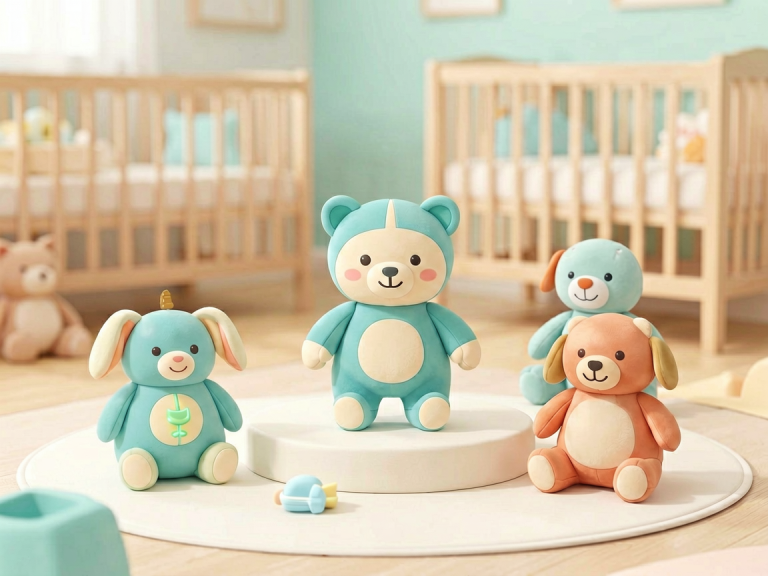
4. Interactive Plush Toys with Labels
Stuffed animals that have attached tags, labels, or different fabric textures encourage tactile exploration. Some plush toys also include a small book or a pocket for a photo.
- Why they work: Touching different fabrics and labels builds fine motor skills and allows the baby to associate words like “soft,” “rough,” or “fuzzy” with physical sensations.
- Best features: Choose plush toys that are machine-washable and free of small parts. Ones that make a gentle sound when squeezed are extra engaging.
- Suggested play: Let the baby hold the plush toy while you describe its features. “This is Bunny. Bunny has long ears. Can you feel the soft ears?” This builds vocabulary and narrative context.
5. Stacking Rings and Simple Shape Sorters
Although these are often categorized as motor skill toys, they also support early reading indirectly.
- Why they work: Stacking and sorting require concentration and problem-solving. As the baby places a ring on a peg, you can narrate the action: “The blue ring goes on top. One, two, three rings!” This introduces number words, color words, and action verbs.
- Best features: Rings with different textures (smooth, bumpy, ridged) add sensory variety. Oversized blocks with pictures on them are also great.
- Suggested play: Sit face-to-face with the baby and slowly demonstrate stacking while speaking in a sing-song voice. Let the baby knock the tower down—then laugh and say, “Boom! All fall down!” This repetition of sound and movement strengthens language memory.
—
The Role of the Caregiver: Interaction Is Key
No toy, no matter how sophisticated, can replace the human element. A six-month-old learns best through responsive, warm interactions with a caregiver. When a parent uses a toy to engage in “serve and return” conversations—where the baby makes a sound or gesture and the adult responds—the baby’s brain builds crucial language networks.
Tips for Maximizing Literacy Opportunities
- Narrate everything: Even while playing with a simple rattle, describe what’s happening. “You are shaking the rattle! It makes a loud sound. Shake it again!”
- Use exaggerated facial expressions: Babies are drawn to animated faces. Pair your words with smiles, raised eyebrows, and wide eyes.
- Repeat, repeat, repeat: Six-month-olds thrive on repetition. Saying the same words or reading the same cloth book multiple times helps solidify neural connections.
- Follow the baby’s lead: If your baby is fixated on the crinkly corner of a book, let them explore it. Use that moment to say, “Crinkle, crinkle, you like that sound!”
—
Avoiding Common Pitfalls
While the market is flooded with toys claiming to boost intelligence, not all are suitable for early literacy. Avoid toys that are overly electronic or that replace human interaction. A toy that flashes lights and speaks in a robotic voice may overstimulate a six-month-old and reduce opportunities for back-and-forth conversation. Also, be wary of small parts that pose choking hazards. Always check age recommendations and supervise play.
—
Conclusion
Building early reading skills in a six-month-old does not mean teaching the alphabet or drilling phonics. It means surrounding the baby with a rich sensory environment where language is woven into every playful moment. The best toys for this age are those that encourage touch, sound, movement, and—above all—human connection. A soft cloth book, a musical rattle, or a simple high-contrast card can transform into a gateway to literacy when paired with a loving voice and a patient smile. By choosing toys thoughtfully and using them interactively, parents lay the groundwork for a lifetime of reading enjoyment. Remember: every crinkle, every babble, every shared laugh is a step toward becoming a reader. So pick up that cloth book, shake that rattle, and start the story today.