Building a Foundation for Counting: Play Activities for 6-Month-Olds
From the moment a baby enters the world, their brain is hard at work, absorbing patterns, rhythms, and sequences that will later form the bedrock of mathematical thinking. While a six-month-old cannot yet recite numbers or point to "three" objects, this is precisely the age when the earliest concepts of quantity, order, and repetition begin to take root. Far from being too young for counting activities, six-month-olds are primed for playful interactions that build the neural pathways for numeracy. The key is to focus not on formal counting drills but on sensory-rich, repetitive, and joyful experiences that introduce the language of numbers, the idea of one-to-one correspondence, and the rhythm of sequences. This article explores a range of play activities specifically designed for six-month-old babies, framed within their developmental abilities—grasping, mouthing, tracking objects, responding to sounds, and engaging in back-and-forth social games. Each activity is backed by early childhood developmental research and is intended to be simple, safe, and fun for both baby and caregiver.
The Importance of Early Numeracy Play
Before diving into specific games, it is essential to understand why counting-oriented play matters at six months. Research in developmental psychology shows that even infants as young as a few months can distinguish between small quantities—for example, they notice when one toy is replaced by two (Starkey & Cooper, 1980). This innate "number sense" is an evolutionary gift, but it requires nurturing through environmental stimulation. When a caregiver counts aloud while stacking blocks, or when a baby hears a rhythmic chant like "one, two, three—go!" during a game of peek-a-boo, the baby's brain begins to associate specific sound patterns with changes in the world. These early connections form the scaffolding for later understanding of cardinality (knowing that "three" means three things) and ordinality (first, second, third). Moreover, counting activities at six months are never about rote memorization; they are about embedding mathematical language into daily routines. The more a baby hears the words "one more," "two toys," or "here comes number three," the more familiar these auditory patterns become. Over time, the baby starts to anticipate and even participate in these patterns, babbling or moving in rhythm. Thus, the goal of these play activities is to make counting a natural, pleasurable part of the baby's world.
Sensory Play with Repetition: The Magic of "One More"
At six months, babies are primarily sensory explorers. They learn by touching, mouthing, shaking, and watching objects move. One of the simplest yet most effective counting activities leverages this sensory curiosity: the "one more" game. Begin with a single soft block or a clean teething ring. Place it in front of the baby and say clearly, "Look, _one_ block." Let the baby hold it, mouth it, or bat at it. After a moment, add another block, saying, "Now we have _one more_ block! That makes _two_ blocks." Repeat this process up to three objects (babies this age rarely need more than three for meaningful engagement). The key is to emphasize the number words and to pause between additions so the baby can visually process the change. You might notice that after a few repetitions, the baby looks toward the spot where the new object will appear, showing anticipation of the sequence.
To extend this activity, use objects of different textures or sounds—a crinkly fabric ball, a smooth wooden ring, a rattle. As you add each item, narrate: "First we have the crinkly ball. Second comes the rattle. Third is the soft toy." You are subtly introducing ordinal words. Do not worry if the baby loses interest after a minute; six-month-olds have short attention spans. The goal is consistency, not duration. Repeat the activity daily, perhaps after a diaper change or during tummy time. Over weeks, the baby may begin to reach for the "second" object when you say the word, or they might vocalize in response to "one more." These small reactions are the first signs of counting comprehension.
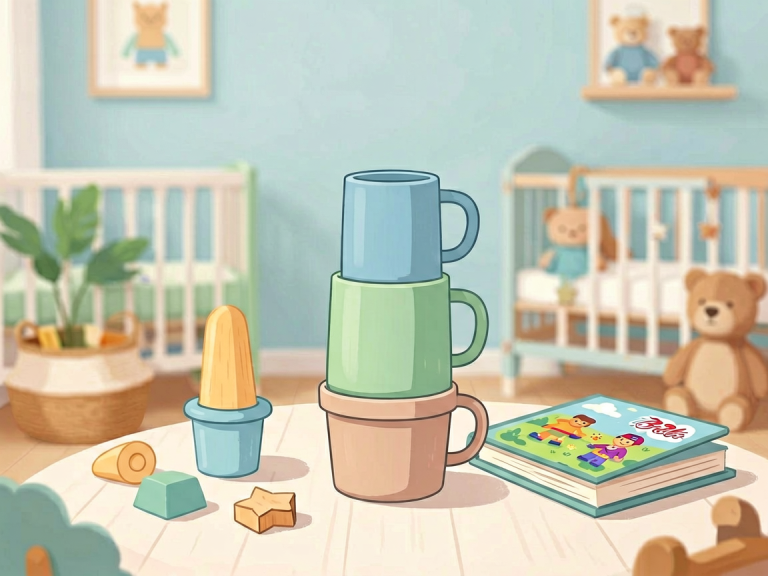
Another wonderful sensory activity involves stacking cups or rings—a classic toy for this age. Choose a set of three or four lightweight, brightly colored cups that nest inside one another. Sit facing your baby and slowly remove the cups one by one, counting each as you go: "One cup, two cups, three cups." Then, stack them back up, again counting "one, two, three." The visual and tactile repetition helps the baby grasp the concept of increasing and decreasing quantity. Don't expect the baby to stack themselves; instead, let them watch and maybe try to grasp a cup. If they succeed in holding one, say, "You have one cup! Let's see if we can add another." This builds not only counting awareness but also fine motor skills and hand-eye coordination.
Object Permanence and One-to-One Correspondence
One of the major cognitive milestones for a six-month-old is the beginning of object permanence—the understanding that objects continue to exist even when hidden. This concept is closely linked to counting, because counting requires tracking discrete items across space and time. A simple game of "hide and find" can serve as a counting activity. Take three small toys (e.g., three identical soft animals or three large plastic rings) and place them under three separate cups or cloths. Lift the first cloth, exclaiming, "Look! _One_ toy!" Let the baby grab it. Then lift the second cloth: "Here's the _second_ toy! That's _two_ toys." Finally, the third: "And here is the _third_ toy! We have _all three_!" The dramatic pause and excitement in your voice signal that each toy is a distinct entity, and that there is a predictable sequence.
You can also play this game with your own hands. Hide a small toy in one hand and show the baby your empty hand, then open the other hand and say "One!" Then hide the toy in the other hand, or use both hands to hide two toys. The baby will track where the toys go, and the counting words give them a language label for what they see. This activity also strengthens the idea of one-to-one correspondence—the foundational principle that each object gets one count. At six months, babies are not yet capable of pointing to each object and saying a number, but they can perceive the one-to-one relationship when you, as an adult, model it with exaggerated gestures and vocal emphasis.
A variation involves dropping objects into a container. Use a clean, empty plastic bottle or a small basket. Show the baby a set of three large wooden beads (too large to swallow) and drop them one by one into the bottle, saying "One bead in, two beads in, three beads in!" Each time you drop, shake the bottle so it makes a sound, delighting the baby. Then tip the beads out and do it again. This not only reinforces counting but also introduces the concept of "inside" and "outside," which is a spatial math skill. Over many repetitions, the baby may start to look at the bottle as you say "one," anticipating the drop. Some babies even try to mimic the action, though they lack the manual dexterity to drop objects accurately. The joy lies in the shared experience and the rhythmic repetition of numbers.
Rhythmic Games and Songs: Counting with the Whole Body
Music and rhythm are powerful tools for early numeracy because they naturally involve patterns, sequences, and repetition. Six-month-olds respond strongly to rhythm, often bouncing or swaying when they hear a beat. Incorporating counting into songs and body movements makes the numbers tangible and memorable. Start with a simple folk song like "This Old Man" or "One, Two, Buckle My Shoe." Sing it slowly, using finger play or gentle movements. For example, when you sing "One, two, buckle my shoe," touch one of the baby's feet, then the other. When you sing "Three, four, knock at the door," gently tap the baby's chest or a nearby surface. The physical sensation paired with the number words creates a multisensory learning experience.
Another classic is "Five Little Ducks" (adapted to three little ducks for this age). Hold up three fingers or use three toy ducks (bath toys). Sing: "Three little ducks went out to play, over the hills and far away. Mother duck said, 'Quack, quack, quack,' but only two little ducks came back." Then lower one finger or remove one duck. Repeat for two and then one. The baby may not understand the subtraction conceptually, but they will notice that the number of ducks changes. The rhythmic melody and your animated facial expressions keep them engaged. Over time, they may even turn their head toward the "missing" duck, a sign that they are tracking quantity.
You can also create your own counting rhymes. While giving the baby a gentle massage or during diaper changes, rhythmically tap their tummy while counting: "One little tap, two little taps, three little taps!" Or while moving their legs in a bicycle motion: "One pedal, two pedals, three pedals!" The key is consistency—use the same words and rhythms each time so the baby begins to predict them. Some caregivers find that babies start to kick or coo in anticipation when they hear the count beginning. This is the earliest form of counting "participation."
Clapping games are another excellent choice. Sit facing your baby and clap your hands together slowly, saying "One, two, three—clap!" Then take the baby's hands and help them clap while you count. At six months, they may not clap independently, but they enjoy the physical sensation and the sound. You can also pat a surface (like a highchair tray) in a steady beat: "One pat, two pats, three pats—pat pat pat!" Vary the tempo—sometimes fast, sometimes slow—so the baby experiences the concept of pacing, which is related to counting order.
Practical Tips for Parents and Caregivers
To make counting play effective and enjoyable for a six-month-old, keep these practical guidelines in mind. First, follow the baby's lead. If your baby turns away, yawns, or becomes fussy, stop the activity. Forced engagement can create negative associations with math. Aim for short, joyful sessions of two to five minutes throughout the day, rather than a long "lesson." Second, repeat, repeat, repeat. Six-month-olds thrive on repetition because it builds neural connections. The same counting song or game done thirty times over several weeks is far more valuable than thirty different activities done once. Third, use exaggerated vocal and facial expressions. Babies are drawn to high-pitched, animated voices. When you say "one" with a big smile and pause, your baby's attention locks on. Exaggerate the number words—stretch them out: "Oooone… twooooo… threeeee!" This auditory highlighting helps the baby distinguish number words from other language.
Fourth, incorporate counting into everyday routines, not just dedicated playtime. Count the baby's fingers while dressing: "One thumb, two thumbs." Count spoonfuls of puree during meals: "One bite, two bites, three bites." Count steps while walking to the car: "One step, two steps." This natural integration makes numbers part of the baby's world, not a separate subject. Fifth, use props that are safe and age-appropriate. Avoid small objects that could be a choking hazard. For six-month-olds, items larger than 1.6 inches in diameter are generally safe, but always supervise. Soft blocks, teething rings, large rattles, fabric toys, and board books with bright pictures are excellent choices.
Finally, be patient and celebrate small victories. Your baby may not "count" for another year or two, but the groundwork you lay now is invaluable. Notice when your baby looks toward the second toy as you say "two," or when they become excited by the repeated pattern of "one more." These subtle responses are your baby's way of saying they are building a counting brain. Praise them warmly: "You saw the second toy! Wonderful!" Positive reinforcement strengthens their curiosity and confidence.
Conclusion
Counting is not a skill that suddenly appears at age two or three; it emerges from thousands of small, playful interactions in infancy. For a six-month-old, the most powerful counting activities are those that engage their senses, their love of repetition, and their growing ability to track objects and patterns. Through simple games like adding "one more" block, hiding toys under cups, singing rhythmic counting songs, and clapping to a beat, caregivers can gently cultivate the neural architecture of numeracy. These activities require no expensive materials—only your voice, your hands, and your attention. As you play, you are not teaching your baby to recite numbers; you are teaching them that numbers have meaning, that quantity changes, and that the world is full of delightful patterns waiting to be discovered. So pick up a rattle, sing a silly song, and count your baby's toes for the hundredth time. Every repetition counts.