Building Minds: How Pretend Play Activities Ignite Engineering Thinking in Children
Introduction: The Hidden Curriculum of Play
In a quiet corner of a kindergarten classroom, a four-year-old child carefully balances a wooden block on top of two others, muttering, “This bridge needs to be stronger so the toy car can cross.” Meanwhile, in a backyard, a group of seven-year-olds are busy constructing a “spaceship” out of cardboard boxes, assigning roles such as “chief engineer” and “materials manager.” These scenes are not merely cute childhood moments; they are the very laboratories where engineering thinking begins to take shape. Pretend play—often dismissed as simple fun—is actually a powerful, natural vehicle for developing the cognitive skills that underlie engineering. Through imagination, trial and error, and social negotiation, children engage in the same fundamental processes that professional engineers use to design, test, and improve solutions. This article explores how specific pretend play activities nurture engineering thinking, breaking down the mechanisms by which a cardboard castle or a blanket fort becomes a training ground for tomorrow’s innovators.
What Is Engineering Thinking? A Framework for Young Minds
Before diving into play activities, it is essential to define what we mean by “engineering thinking.” At its core, engineering thinking involves a systematic approach to solving problems within constraints—whether those constraints are physical materials, time, or budget. Key components include:
- Problem identification and framing: Recognizing a need or a challenge and defining it clearly.
- Ideation and design: Generating multiple possible solutions and planning a structure or system.
- Spatial reasoning and visualization: Understanding how parts fit together in three dimensions.
- Iteration and optimization: Testing, failing, learning, and improving the design.
- Systems thinking: Seeing how individual components interact to create a whole.
- Persistence and grit: Accepting failure as a step toward success.
For young children, these concepts are not abstract. They emerge naturally when a child tries to build a tower that won’t fall, or when a group decides that their “castle” needs a drawbridge that actually works. Pretend play provides a low-stakes, high-engagement context where engineering thinking can flourish without formal instruction.
Pretend Play Activities That Cultivate Engineering Thinking
1. Block Construction and Architectural Design
The classic activity of building with blocks is perhaps the most direct precursor to engineering. When children stack, balance, and arrange blocks to create structures such as houses, skyscrapers, or bridges, they are engaging in structural engineering. They must consider stability—a tall tower requires a wider base—and load distribution. A child who builds a “garage for toy cars” quickly learns that a flat roof collapses under too many cars, prompting them to add supports or redistribute weight. This is the essence of iteration: a failed design leads to a refined one. Provide children with various block shapes (unit blocks, arches, cylinders) and encourage them to build specific structures—like a bridge that spans a “river” (a blue towel) or a castle with a working drawbridge. These challenges mimic real engineering briefs.
2. Role-Playing as Engineers and Builders
Dramatic play that involves assuming the identity of an engineer, architect, or construction worker is extremely rich in engineering thinking. Set up a “construction site” with hard hats, toy tools, measuring tapes, and clipboards. Children can be tasked with “building” a new playground or repairing a “broken” bridge using Legos or recycled materials. As they play, they naturally adopt engineering language: “We need stronger pillars,” “Let’s measure this beam,” “Hold it steady while I attach it.” They also learn teamwork—a critical engineering skill—as they delegate tasks and negotiate design decisions. For example, one child may argue that the “hospital” needs a helicopter pad, while another insists on a wider entrance for ambulances. This negotiation teaches trade-offs and constraint-based decision-making.
3. Creating Imaginative Machines and Vehicles
Children love to invent fantastical machines, from “time-travel cars” to “robot dogs that do chores.” Providing loose parts—cardboard tubes, bottle caps, string, tape, wheels from broken toys, plastic gears—allows them to build working models of imaginary inventions. The engineering thinking here lies in the need to make connections: How can a cardboard box become a car that actually rolls? Which attachment method (tape vs. glue) holds better under the weight of a toy passenger? Children learn about simple machines (levers, pulleys, wheels and axles) through trial and error. For instance, a child making a “crane” may discover that a spool used as a pulley reduces the effort needed to lift a small bucket. This tactile understanding of mechanical advantage is far more powerful than any textbook diagram.
4. Designing Cities and Infrastructure
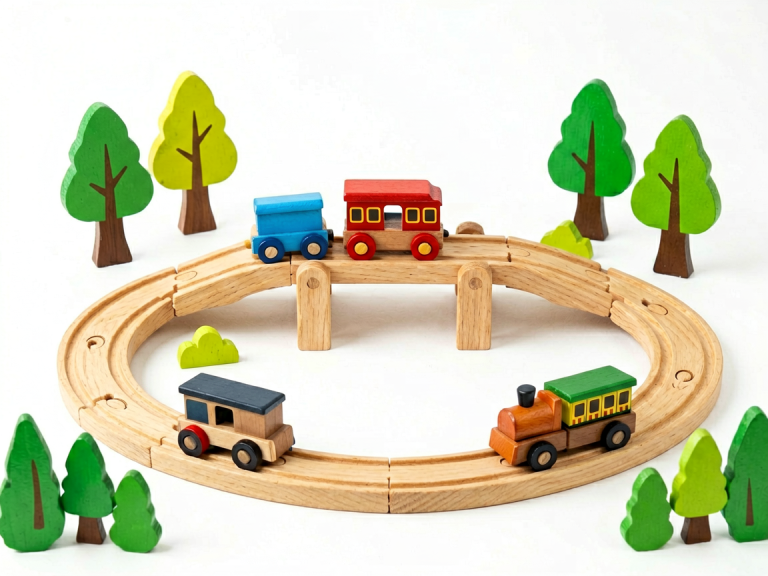
Larger-scale pretend play, such as constructing an entire town out of blocks, paper, and everyday items, fosters systems thinking. Children must consider how roads connect to houses, where the “power plant” goes (away from the school?), and how a water system might work. This activity often emerges spontaneously when children gather materials and decide to “build a whole world.” As they plan, they encounter real-world engineering challenges: traffic flow (cars back up if the road is too narrow), structural support (a tall building falls over), and resource allocation (not enough blocks for everyone’s house). Guiding them with open-ended questions—“What happens to the houses near the ‘volcano’?”—helps them think about risk and resilience. Such play mirrors the work of urban planners and civil engineers.
How Pretend Play Develops Key Engineering Skills
1. Problem-Solving and Iteration Through Failure
One of the most valuable aspects of pretend play is that failure is not punished but rather becomes part of the narrative. When a block tower collapses, the child does not feel shame; instead, they rebuild with a different strategy. This low-risk environment encourages the kind of rapid prototyping that engineers rely on. In a study of children engaged in block play, researchers found that those who were allowed to freely experiment showed greater persistence and creativity in solving structural problems. They learned to ask, “Why did it fall? Maybe the base is too small,” and then test that hypothesis. This is the scientific method in action, wrapped in play.
2. Spatial Awareness and Geometry
Engineering thinking depends heavily on the ability to visualize objects in three dimensions and mentally rotate them. Pretend play with construction materials inherently develops this skill. When a child tries to fit a triangular block into a square hole, they learn about shape properties. When they build a ramp for cars, they explore slopes, angles, and momentum. Over time, these experiences build a mental library of geometric relationships. For example, a child who repeatedly builds archways begins to understand that a keystone is essential to hold an arch together—a concept that reappears in real-world architecture.
3. Cause and Effect Reasoning
Pretend play often involves cause-and-effect chains: “If I put this heavy stone on the roof, the walls will crush.” Or, “If I make the river too wide, the bridge won’t reach.” Children learn to anticipate consequences and adjust their designs accordingly. This kind of causal reasoning is central to engineering: a bridge designer must predict how wind, weight, and materials interact. In play, children experiment with variables such as material strength (paper vs. cardboard), height, and weight distribution, building intuitive understanding of forces.
4. Collaboration and Communication
Engineering is rarely a solo endeavor. Pretend play that involves multiple children forces them to communicate ideas, negotiate roles, and compromise. A child might say, “I think we should make the door bigger so the giant can come in,” while another responds, “But then the walls will be weaker. We need to add extra blocks on the sides.” This dialogue mirrors the interdisciplinary teamwork of real engineering projects. They learn to listen, to justify their reasoning, and to synthesize different perspectives—a skill that is as crucial as technical knowledge.
Encouraging Engineering Play at Home and in the Classroom
To maximize the engineering thinking benefits of pretend play, adults can take a few simple steps. First, provide open-ended materials: blocks, loose parts, recycled containers, fabric, and tools like tape and string. Avoid kits that prescribe a single outcome; instead, stock a “maker space” that invites creativity. Second, ask thoughtful questions that prompt reflection: “What would happen if you made the base wider?” or “How could you make the bridge even longer?” These questions guide children to think like engineers without taking over their play. Third, allow ample uninterrupted time for play. Engineering thinking requires deep focus to test, fail, and iterate. Finally, celebrate failure as learning. When a structure falls, instead of saying “Oh no, it broke,” say “That’s interesting! Let’s figure out why it fell and how you can make it stronger next time.”
Conclusion: From Fortresses to Formulas
The bridge between a cardboard box fort and a suspension bridge is not as wide as it seems. In both cases, the builder must understand balance, materials, and the relationship between form and function. Pretend play is the soil in which the seeds of engineering thinking are planted. It provides children with the freedom to explore, experiment, and create without the fear of getting an answer “wrong.” As they hoist a “crane” made from a coat hanger or negotiate the best way to build a castle with a working elevator, they are not just playing—they are learning to think like engineers. By recognizing and nurturing this connection, parents and educators can turn every playroom into a workshop, every backyard into a laboratory, and every imaginative moment into a stepping stone toward a future of innovation. The engineers of tomorrow are not born in lecture halls; they are built, one block and one pretend scenario at a time.