How to Choose Language Toys: A Comprehensive Guide for Parents and Educators
Introduction
In an age of digital saturation and screen-based learning, the humble toy remains one of the most powerful tools for fostering a child’s linguistic development. Language toys—those specifically designed or naturally suited to stimulate vocabulary, grammar, listening, and communication skills—are not merely entertainment; they are the building blocks of cognitive and social growth. Yet with countless options flooding the market, from flashy electronic gadgets to classic wooden puzzles, choosing the right language toy can feel overwhelming. How do you separate genuine learning aids from marketing gimmicks? How do you match a toy to your child’s developmental stage, interests, and learning style? This article provides a structured, research-informed approach to selecting language toys that truly nurture a child’s ability to understand, produce, and enjoy language. By the end, you will have a practical framework to make informed decisions—whether you are a parent looking for the perfect birthday gift or an educator curating a classroom resource center.
Why Language Toys Matter
Before diving into selection criteria, it is essential to understand why language toys deserve special attention. Language acquisition in early childhood is not a passive process; it thrives on active, meaningful interaction. Toys act as catalysts for this interaction in several ways:
- Stimulate verbal exchange: Unlike passive media consumption, well-designed toys invite conversation. A set of animal figurines, for example, naturally prompts questions like “What does the cow say?” or “Where is the elephant going?”
- Provide contextual learning: Children learn words best when they connect them to concrete objects, actions, or emotions. A toy kitchen set lets a child experience the words “stir,” “pour,” and “hot” in a tangible, memorable context.
- Encourage repetition and practice: Language mastery requires repetition. Toys that children love to revisit—such as a puzzle with letters or a storytelling puppet—offer countless opportunities to rehearse sounds, words, and sentence structures.
- Support diverse learning styles: Some children learn best through listening, others through touching or moving. Language toys can cater to auditory, visual, kinesthetic, or multimodal learners, ensuring no child is left behind.
Understanding these benefits helps you shift your perspective from “What toy is popular?” to “What interaction does this toy invite?” This shift is the first step in making a wise choice.
Age-Appropriate Selection: Matching Toys to Developmental Milestones
One of the most common mistakes is choosing a toy that is too advanced or too simple for a child’s current language stage. Language development follows a predictable, though individual, trajectory. Here is a breakdown of how to align toy choices with key milestones.
Infants (0–12 months): Sensory and Sound Exploration
Babies in their first year are attuned to the rhythm and melody of speech, even before they understand words. Their language toys should focus on auditory stimulation, cause-and-effect, and social bonding. Look for soft rattles, fabric books with crinkle pages, and simple musical toys that produce varied sounds. Toys that encourage eye contact and turn-taking—like a soft mirror or a puppet that “peeks” at the baby—lay the groundwork for conversational reciprocity. Avoid toys with loud, jarring noises, which can overwhelm a developing auditory system. Instead, choose those with gentle chimes or soft melodies that you can sing along with.
Toddlers (12–24 months): First Words and Simple Actions
As toddlers begin to utter their first words, toys should reinforce labeling, imitation, and daily routines. Picture books with clear, realistic images of common objects (ball, cup, dog) are invaluable. Simple shape sorters, stacking rings, and toys that have corresponding animal or vehicle sounds encourage the connection between object, name, and function. At this stage, take care to select toys that are safe and durable—no small parts that could be swallowed, and no sharp edges. The best language toys for toddlers are those that you can use together: sit on the floor, point to the “red ball,” and wait for your child to attempt the word.
Preschoolers (2–4 years): Sentences and Storytelling
Between ages two and four, children experience an explosion of vocabulary and begin combining words into sentences. Now is the time for toys that promote narrative thinking and question-asking. Puppets, dollhouses, play food sets, and dress-up costumes all support role-playing, which requires children to use language to assign roles, describe actions, and negotiate storylines. Alphabet puzzles, magnetic letters, and simple word-matching games can introduce letter sounds and print awareness, but only if the child shows interest. Resist pushing formal literacy too early; instead, prioritize toys that allow the child to tell their own stories. For example, a set of story cards with pictures (a cat, a tree, a rain cloud) invites the child to arrange them and say what happens next.
Older Preschoolers and Early School Age (4–6 years): Phonemic Awareness and Complex Language
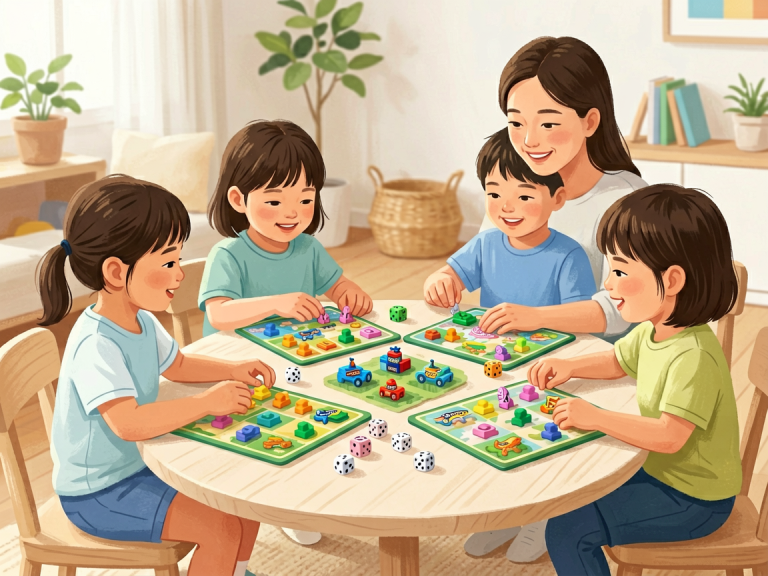
As children approach kindergarten, they benefit from toys that sharpen phonemic awareness, expand vocabulary, and develop conversation skills. Board games with simple rules (e.g., matching games, memory games, “I Spy” cards) encourage listening, turn-taking, and using descriptive language. Letter tiles, magnetic boards, and beginning reading games can be introduced playfully—never as drills. Toys that require following multi-step instructions, such as simple building kits or cooking toys with recipe cards, help children process and produce longer sentences. Interactive electronic toys can also play a role, but use them sparingly and always as a supplement to human interaction, not a replacement.
Types of Language Toys: A Categorical Overview
Not all language toys are created equal. They fall into distinct categories, each with unique strengths and potential pitfalls. Understanding these categories will help you curate a balanced toy collection.
Interactive Digital Toys
Tablets designed for children, talking dictionaries, and electronic reading pens are increasingly popular. Their advantage lies in immediate feedback—a tap on a picture produces a spoken word, which can aid vocabulary building. However, they have significant downsides: they can reduce face-to-face interaction, encourage passive consumption, and expose children to screen time that may hinder social development. If you choose digital language toys, set strict limits (e.g., 10–15 minutes per session) and always use them together with your child, asking questions like “What did the bear say?” to keep the experience interactive.
Traditional Manipulatives
Blocks, puzzles, threading beads, and sorting toys belong here. Their power comes from hands-on, multi-sensory engagement. When a child picks up a wooden letter “A” and feels its shape while you say “A is for apple,” they connect touch, sight, and sound. These toys also promote fine motor skills and spatial reasoning—bonus benefits. They are generally safer, more durable, and foster open-ended play. For language development, look for manipulatives that include letters, numbers, or pictures, but remember that the language happens in the conversation around the activity, not in the object itself.
Role-Playing and Pretend Play Sets
Kitchen playsets, doctor kits, tool benches, and puppet theaters are gold mines for language learning. They create natural contexts for dialogue. A child playing “restaurant” must take orders, describe dishes, and negotiate payments—all rich language experiences. These toys are especially effective for developing pragmatics (the social use of language), turn-taking, and narrative skills. When choosing pretend play toys, opt for open-ended collections (e.g., a set of simple skirts, hats, and scarves rather than a specific costume) that allow the child to invent scenarios rather than follow a script.
Books and Storytelling Materials
Books are the quintessential language toy, but not all books are equal. Lift-the-flap books, texture books, and books with repetitive phrases (like *Brown Bear, Brown Bear, What Do You See?*) actively engage a child’s participation. Felt boards, story dice, and sequencing cards are non-book alternatives that promote oral storytelling. The key is to choose materials that invite the child to speak, not just listen. When reading, pause to ask questions or let the child “read” the pictures. This turns a passive activity into an active language lesson.
Sound and Music Toys
Musical instruments (simple drums, shakers, xylophones) and toys that produce different animal or vehicle sounds help children discriminate between sounds, a foundational skill for phonemic awareness. Singing songs together with a toy microphone or following a music-and-movement video can enhance rhythm and vocabulary. However, be wary of toys that constantly make noise without the child’s active input—these can become background noise rather than learning tools. The best sound toys require the child to perform an action (press, shake, sing) to produce the sound.
Key Factors to Consider When Choosing
Beyond age and type, several overarching factors will determine whether a language toy serves its purpose.
Educational Value vs. Entertainment Value
A toy that merely keeps a child busy is not necessarily a learning tool. Evaluate the ratio of active to passive time the toy encourages. A toy that flashes lights and repeats a phrase every few seconds teaches little, because the child is not required to respond. In contrast, a set of picture cards that requires the child to name the object, match it to the letter, or invent a sentence demands active cognition. Always ask: “Will this toy make my child speak, listen, or think, or just watch and press?”
Open-Endedness
Open-ended toys—those that can be used in multiple ways—generally outperform single-purpose toys for language development. A pile of colorful scarves can become a cape, a river, a book cover, or a curtain for a puppet show, each scenario generating new vocabulary and conversation. A specific puzzle with only one correct solution, on the other hand, offers limited linguistic opportunities once the child masters it. When possible, prioritize toys that allow the child to create, invent, and repurpose.
Safety and Accessibility
Language toys are used by young children who explore with their mouths and hands. Ensure that materials are non-toxic, free from sharp edges, and do not contain small parts that pose choking hazards (use a toilet paper roll test: any part that fits through is too small for children under three). Additionally, consider the child’s physical abilities: a toy that is too hard to grasp or manipulate will frustrate and discourage engagement, undercutting language learning. Look for toys with large, easy-to-hold pieces and clear, high-contrast visuals.
Cultural Relevance and Inclusivity
Language is deeply tied to identity and experience. Toys that reflect the child’s own culture, family structure, and daily life make language learning more meaningful. A set of play food that includes foods from different cuisines (dumplings, tortillas, sushi) expands vocabulary and fosters respect. Similarly, dolls and puppets that represent diverse ethnicities, abilities, and family configurations allow children to practice inclusive language and see themselves as language users. Avoid toys that rely on stereotypes or narrow representations.
Durability and Longevity
Language development is a long journey, and a toy that falls apart after a week offers little value. Invest in well-made toys that can withstand repeated use, washing, and even sibling sharing. Solid wood, thick cardboard, and soft, machine-washable fabrics are good choices. A durable toy can serve multiple children over several years, often becoming a cherished “language companion” that evolves with the child’s skills.
Practical Tips for Parents and Educators
Theory is important, but practical action closes the gap. Here are concrete steps you can take next time you are choosing a language toy.
- Watch how your child plays. Before buying, observe what your child currently enjoys: building, pretending, sorting, or singing? A toy that aligns with their natural interests will naturally spark more language. A child obsessed with trains will learn more from a toy train set with station signs and passenger tickets than from a generic alphabet puzzle.
- Test it yourself. If possible, play with the toy before purchasing. Does it invite you to speak? Can you imagine a conversation unfolding around it? If the toy makes you feel silent, it will likely do the same for your child.
- Prioritize “co-play” potential. The single best predictor of a toy’s language benefit is whether an adult or peer can use it together with the child. A toy that requires two people (like a ball that you roll back and forth while saying “my turn, your turn”) is inherently more language-rich than a solo device.
- Rotate, don’t overwhelm. Too many toys can overwhelm a child and discourage deep engagement. Keep a small, curated selection of language toys available, and rotate them every few weeks. This maintains novelty and focus.
- Beware of “educational” packaging. Marketing labels like “teaches 100 words” are often deceptive. The words are only learned if the child uses them repeatedly in context. Trust your own observation over flashy claims.
- Embrace imperfection. The best language toy is often the one your child uses imperfectly—mismatching shapes, babbling at a puppet, or “reading” a book upside down. Those “mistakes” are language experiments. Choose toys that allow for error and exploration, not those that punish failure.
Conclusion
Choosing language toys is not about finding the perfect product; it is about selecting tools that invite, extend, and celebrate a child’s natural drive to communicate. From the soft rattle that first catches an infant’s ear to the complex board game that challenges a kindergartner’s narrative reasoning, each toy can be a doorway to words, sentences, and stories. The overarching principle is simple: the best language toy is the one that sparks a conversation. It is the toy that makes a child look up, point, ask “What’s that?” or exclaim “Look what I did!” It is the toy that brings an adult down to the floor, eye to eye, ready to talk.
As you navigate the crowded shelves of toy stores and online marketplaces, remember that you are not just buying an object—you are buying an opportunity. An opportunity to slow down, to listen, to laugh, and to build the most critical skill a child will ever possess: the power of language. Choose wisely, but also choose joyfully. For in the end, the toys that children love are the toys that teach them best. And those are the toys that, decades later, they will still remember—not for their batteries or their colors, but for the words they shared.