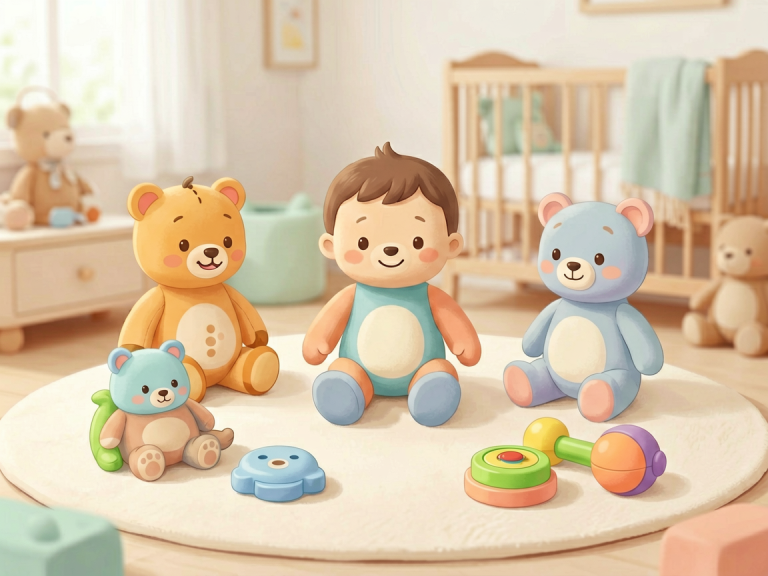
Engineering Toys for Babies: Building the Foundations of Future Innovators
Introduction: Why Engineering Begins in the Cradle
When we hear the phrase “engineering toys,” our minds often jump to complex robotics kits or intricate construction sets designed for school-aged children. Yet the most profound period for developing engineering thinking occurs far earlier—during infancy. Engineering toys for babies are not merely colorful distractions; they are carefully designed tools that tap into the infant brain’s extraordinary plasticity, laying the groundwork for spatial reasoning, causal understanding, problem-solving, and even early mathematical intuition. In an era that demands creative and analytical thinkers, introducing engineering principles through play during the first year of life is not just beneficial—it is essential.
The concept of “engineering” in this context does not mean teaching a six-month-old about load-bearing beams or torque. Instead, it refers to the fundamental cognitive processes that underpin engineering: observation, prediction, trial and error, pattern recognition, and cause-effect relationships. An infant who repeatedly drops a wooden block from a high chair is, in essence, conducting a rudimentary physics experiment about gravity and impact. An infant who struggles to fit a triangular peg into a round hole is engaging in geometric problem-solving. Engineering toys for babies are designed to amplify and channel these natural explorations, providing structured opportunities for cognitive growth.
The Neuroscience Behind Early Engineering Play
Critical Windows for Spatial and Causal Learning
Between birth and 18 months, the human brain forms synapses at an astonishing rate—approximately one million new neural connections per second. This period, known as the critical window of neuroplasticity, is when foundational cognitive architectures are established. Research in developmental psychology and neuroscience has consistently shown that spatial reasoning skills, which are directly linked to later success in STEM fields, can be significantly enhanced through targeted play during infancy.
Engineering toys that involve stacking, nesting, and interlocking parts stimulate the parietal lobe—the region of the brain responsible for spatial awareness and mental rotation. When a baby attempts to place a ring onto a stacking peg, they are not merely practicing fine motor skills; they are encoding spatial relationships, learning about size hierarchies, and developing the ability to mentally manipulate objects. These neural pathways, once solidified, become the scaffolding for more complex engineering thinking later in life.
Moreover, causal learning—understanding that one event leads to another—is a cornerstone of engineering reasoning. Toys that produce a sound when a button is pressed, or that roll away when pushed, teach infants about agency and consequence. This is the same cognitive mechanism that allows older children to understand the relationship between a lever and a lifted weight, or between an electrical circuit and a light bulb. By providing clear, immediate feedback, engineering toys for babies embed this causal logic into the developing brain.
Key Categories of Engineering Toys for Babies
Stacking and Nesting Toys: The First Lessons in Structures
Perhaps the most classic engineering toy for babies is the humble stacking ring or nesting cup set. Despite their simplicity, these toys introduce a range of engineering principles. A baby must understand that rings come in different sizes and that only one specific order will allow them to be stacked without toppling. This is a primitive lesson in structural stability, weight distribution, and sequence.
Nesting cups, where smaller cups fit inside larger ones, teach volume relationships and the concept of containment. When a baby tries to force a large cup into a smaller one and fails, they are experiencing the physical reality of size constraints—a fundamental concept in engineering design. Modern nesting toys often include graduated colors or textures, adding an element of visual and tactile feedback that reinforces the learning.
These toys also promote what developmental psychologists call “means-end analysis”—the ability to identify a goal (building a tall tower) and then plan the steps necessary to achieve it. Even though a baby cannot verbalize this process, their repeated attempts and adjustments demonstrate that they are engaging in active problem-solving. Studies have shown that infants who engage frequently with stacking toys show advanced object permanence and early numeracy skills by the age of two.
Shape Sorters: Geometry in Action
The shape sorter is another cornerstone engineering toy for babies. At first glance, it appears to be a simple puzzle: match the shape to the corresponding hole. But the cognitive demands are surprisingly complex. The baby must recognize the shape’s attributes (number of sides, angles, symmetry), mentally rotate the object to align it with the hole, and then adjust the orientation through trial and error.
This process directly mirrors the engineering skill of fitting components together—an essential task in everything from assembling furniture to designing circuit boards. Shape sorters also introduce the concept of tolerances: the square peg will only fit into the square hole if it is aligned correctly; a slight rotation causes it to jam. Infants learn that precision matters, and that even small deviations can lead to failure—a lesson that lies at the heart of engineering quality control.
Modern shape sorters have evolved to include unconventional shapes like stars, hexagons, and asymmetrical forms, as well as color-coded systems that add an extra layer of classification. Some even integrate sound or lights when the correct shape is inserted, providing positive reinforcement that strengthens the neurological reward pathways associated with successful problem-solving.
Cause-and-Effect Toys: The Physics of Interaction
Engineering is fundamentally about designing systems that produce predictable outcomes. Cause-and-effect toys are the infant’s first exposure to this principle. A classic example is the “pop-up” toy—a box with buttons that, when pressed, make a character spring up. The baby learns that a specific action (pressing the button) leads to a specific reaction (the pop-up). This is the same logical chain that underpins mechanical engineering, from a simple gear train to a complex automated assembly line.
Other cause-and-effect engineering toys include ramps and balls: when a ball is placed at the top of a ramp, it rolls down. Infants as young as six months can begin to understand this relationship, and by 12 months they will actively experiment by changing the angle of the ramp or the weight of the ball. These experiments are informal but powerful—they are the precursors to formal physics education.
More sophisticated cause-and-effect toys for older babies (12–18 months) may include simple gears that can be turned by hand, or levers that lift objects. These toys explicitly introduce the concepts of mechanical advantage and rotational motion. When a baby turns a large gear and sees a smaller gear spin faster, they are absorbing the basic principle of gear ratios—even if they cannot articulate it.
Designing Engineering Toys for Safety and Development
Material Selection and Safety Standards
The engineering of toys for babies must prioritize safety above all else. Since infants explore the world through mouthing, all components must be nontoxic, free from small parts that could pose choking hazards, and resistant to breaking into sharp edges. High-quality engineering toys are typically made from solid wood (such as beech or maple) with water-based, lead-free paints, or from medical-grade silicone and BPA-free plastics.
Designers also consider the size and weight of components. Stacking rings should be large enough that they cannot be swallowed but light enough that a baby can lift them without difficulty. Edges should be rounded, and surfaces should be smooth to prevent splinters or abrasions. These design constraints actually mirror real-world engineering challenges: creating a product that is functional, safe, and user-friendly.
Age-Appropriate Complexity
Effective engineering toys for babies follow a scaffolded design—they offer multiple levels of challenge that grow with the child. A simple stacking toy for a six-month-old might consist of just three oversized rings that are easy to grasp and difficult to misalign. By 12 months, a similar toy might have five rings of decreasing size, requiring more precision. By 18 months, the same child might be ready for a toy that requires stacking rings in a specific color pattern or sequence.
This progressive complexity is critical for maintaining engagement and avoiding frustration. If a toy is too easy, the baby loses interest; if it is too hard, they become discouraged. Engineering toy designers often use detailed observational studies of infant behavior to determine the optimal difficulty curve. The best toys are those that offer a “just right” challenge—what developmental psychologist Lev Vygotsky called the zone of proximal development.
The Long-Term Impact of Early Engineering Exposure
Building a STEM Mindset
There is growing evidence that early exposure to engineering toys has lasting effects on a child’s academic trajectory. A longitudinal study published in *Child Development* found that children who engaged in frequent construction play (including stacking, sorting, and interlocking toys) during infancy scored significantly higher on spatial reasoning tests at age five. Spatial reasoning, in turn, has been identified as one of the strongest predictors of later achievement in STEM fields—even stronger than early verbal ability.
Moreover, engineering toys foster a “growth mindset” by teaching babies that failure is a natural part of the learning process. A baby who tries repeatedly to fit a shape into the correct hole experiences setbacks but eventually succeeds. This builds resilience and the understanding that effort leads to improvement—a mindset that is invaluable for any future engineer or scientist.
Gender-Neutral Play and Breaking Stereotypes
Historically, engineering and construction toys have been marketed primarily to boys, while infants’ toys for girls have emphasized soft dolls and domestic play. However, research indicates that gender differences in spatial ability are largely a product of differential exposure, not innate biology. Engineering toys for babies, when offered without gender bias, can help close the gender gap in STEM fields from the very beginning.
Parents and caregivers play a crucial role here. By actively encouraging both male and female infants to play with stacking toys, shape sorters, and cause-and-effect mechanisms, they send a powerful message: engineering thinking is for everyone. Many modern toy manufacturers are now producing gender-neutral engineering toys with natural wood finishes, muted colors, and inclusive imagery that appeal to all children.
Practical Tips for Parents and Caregivers
Choosing the Right Engineering Toys
When selecting engineering toys for a baby, look for products that are open-ended—those that allow for multiple uses and creative exploration. A simple set of wooden blocks, for example, can be stacked, knocked down, sorted by color, or used as pretend “bricks” for building imaginary structures. Avoid toys that do all the work for the baby (e.g., a pop-up toy that activates with a single push and offers no variation). The best toys are passive tools that require the infant to actively engage.
Also consider the sensory qualities: different textures (smooth wood, bumpy silicone, soft fabric) provide tactile feedback that enriches the learning experience. Toys that make gentle sounds (rattles, clicks, chimes) when manipulated add an auditory dimension to cause-and-effect learning.
How to Play Together
Parental involvement magnifies the benefits of engineering toys. While self-directed play is valuable, guided interaction can extend the learning. For example, when a baby struggles to stack rings, a caregiver can verbally narrate the process: “I see you’re trying to put the big ring on first. What happens if we try a smaller one? Let’s see.” This teaches vocabulary and conceptual framing. Caregivers can also model problem-solving by deliberately making mistakes and then correcting them, showing the baby that trial and error is a normal and productive approach.
It is important, however, to let the baby lead. Over-directing can diminish the child’s sense of agency and discovery. The goal is to provide a supportive environment where the baby feels safe to experiment, fail, and try again.
Conclusion: Toying with the Future
Engineering toys for babies are far more than commercial products; they are instruments of cognitive architecture. Through stacking, sorting, fitting, and activating, infants build the neural circuits that will later allow them to design bridges, write code, or invent new technologies. The simplicity of these toys belies their profound complexity—each ring placed on a peg, each shape dropped into its slot, is a tiny act of engineering genius.
As we look toward a future that demands innovative thinkers and problem-solvers, we must recognize that the journey begins not in a classroom, but on a nursery floor. By investing in thoughtful, well-designed engineering toys for our youngest children, we are not just entertaining them; we are building the foundational skills that will shape the engineers, architects, and inventors of tomorrow. And that is the most important construction project of all.