Learning Through Play: A Definitive Guide to Choosing Age-Appropriate Toys That Nurture Growth
Introduction
Play is often described as the “work of childhood,” and for good reason. Through play, children explore the world, experiment with social roles, develop motor skills, and lay the foundation for cognitive abilities such as problem-solving, creativity, and language. Yet not all toys are created equal. The most effective play experiences arise when the toy aligns with a child’s developmental stage, interests, and innate curiosity. Choosing age-appropriate toys is not merely about safety — it is about maximizing the learning potential embedded in every giggle, every stack of blocks, and every pretend tea party.
This guide is designed to help parents, caregivers, and educators navigate the vast landscape of children’s toys with a clear, research-backed framework. We will explore how play evolves from infancy through the early school years, what developmental milestones matter at each stage, and which types of toys best support learning through play. By the end, you will feel empowered to make thoughtful choices that turn simple objects into powerful tools for growth.
—
The Philosophy of Learning Through Play
Before diving into specific age categories, it is essential to understand what “learning through play” really means. This concept, championed by developmental psychologists such as Jean Piaget and Lev Vygotsky, holds that children actively construct knowledge by interacting with their environment. Play is not a break from learning; it *is* learning. When a toddler repeatedly drops a spoon from the high chair, she is investigating gravity, cause and effect, and the social response she receives. When a preschooler builds a castle with blocks, he is practicing spatial reasoning, balance, and perseverance.
The role of an age-appropriate toy is to provide the right level of challenge — what Vygotsky called the “zone of proximal development.” A toy that is too simple leads to boredom; one that is too complex leads to frustration. The sweet spot is a toy that invites exploration, allows for open-ended use, and grows with the child. The best toys are often the simplest: wooden blocks, play dough, art supplies, and pretend-play props. But even electronic or structured toys can be beneficial if they are designed with developmental principles in mind.
—
Infants (0–12 Months): Sensory Exploration and Attachment
The first year of life is a period of rapid sensory and motor development. Newborns see the world in high contrast and are drawn to faces and sounds. By three to six months, they begin reaching, grasping, and mouthing objects — their primary way of understanding texture, weight, and shape. By nine to twelve months, they start to understand object permanence and may engage in simple cause-and-effect play.
Key developmental goals:
- Visual tracking and focus
- Hand-eye coordination
- Sensory integration (touch, sound, sight)
- Social bonding through interaction
Recommended toy types:
- High-contrast black-and-white cards or mobiles for visual stimulation in the first two months.
- Soft rattles and teethers with varied textures (wood, silicone, fabric) to encourage grasping and mouthing.
- Activity gyms or play mats with hanging toys that babies can bat at, promoting reaching and kicking.
- Simple mirrors — babies love looking at faces, and unbreakable mirrors support self-awareness.
- Cause-and-effect toys like a ball that lights up when rolled, or a simple pop-up toy, suitable from about six months.
What to avoid:
- Toys with small parts that could be choking hazards.
- Overly bright, loud electronic toys that can overstimulate a developing nervous system.
- Toys that do most of the “work” for the baby (e.g., a phone that plays songs when touched) — these limit active exploration.
Learning through play example:
When a five-month-old shakes a rattle, she learns that her action produces a sound. She will shake it again, harder or softer, testing variations. This is early scientific thinking. A caregiver can enhance the experience by making eye contact, mimicking the sound, or gently shaking a second rattle to introduce turn-taking.
—
Toddlers (1–3 Years): Movement, Language, and Pretend Play
Toddlers are on the move. They are learning to walk, run, climb, and manipulate objects with increasing precision. Language explodes during this period — from single words at 12 months to short sentences by age 2½. Symbolic thinking emerges, allowing a block to become a phone or a banana to become a phone. Parallel play (playing alongside other children) gives way to early cooperative play.
Key developmental goals:
- Gross motor skills (balance, coordination, climbing)
- Fine motor skills (pincer grasp, stacking, scribbling)
- Vocabulary expansion and early conversation
- Pretend play and imitation of adult roles
- Basic problem-solving (how to fit a shape into a hole)
Recommended toy types:
- Push-and-pull toys (e.g., a wooden cart, a toy lawnmower) for balance and walking practice.
- Simple puzzles with large knobs and 2–4 pieces, introducing shape recognition.
- Stacking cups, nesting blocks, and large beads for threading — these build fine motor control and spatial awareness.
- Play kitchens, tool sets, and dolls — pretend play allows toddlers to act out everyday scenes, developing language and social understanding.
- Ride-on toys (low, foot-powered scooters or bikes) for gross motor development and coordination.
- Art supplies: chunky crayons, washable markers, finger paints — focus on process, not product.
- Musical instruments like shakers, drums, and xylophones for rhythm and cause-and-effect.
What to avoid:
- Toys that require reading or complex rules (frustrating for a toddler).
- Electronic toys that limit imagination — a toy phone that only says pre-recorded phrases is less valuable than a plastic phone that becomes anything.
- Toys with long strings or cords that pose strangulation risks.
Learning through play example:
A 22-month-old pushing a wooden shopping cart is not just walking; she is planning, navigating obstacles, and engaging in a narrative (“I go to store, get apples”). An adult can join by saying, “What else do we need? Bread?” This extends her vocabulary and conversational skills.
—
Preschoolers (3–5 Years): Imagination, Logic, and Social Skills
Preschoolers are bursting with questions. Their pretend play becomes elaborate and rule-based. They begin to understand sequences, counting, letters, and the concept of “more” and “less.” Socially, they are learning to share, negotiate, and take turns. Their fine motor skills are refined enough for cutting with scissors, drawing simple shapes, and building more complex structures.
Key developmental goals:
- Executive function (self-regulation, working memory, cognitive flexibility)
- Early math and literacy concepts (counting, letter recognition, patterns)
- Collaboration and conflict resolution
- Increased creativity and narrative ability
- Physical skills: hopping, skipping, throwing, catching
Recommended toy types:
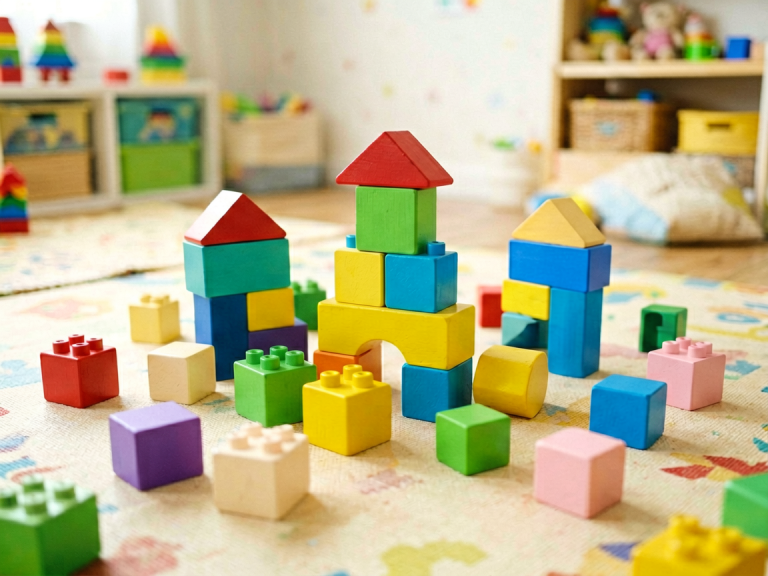
- Building sets with more variety (LEGO Duplo, wooden unit blocks, magnetic tiles) — these encourage engineering, symmetry, and storytelling.
- Board games with simple rules (Candy Land, Hi Ho! Cherry-O, or matching games) — they teach turn-taking, following directions, and handling winning/losing.
- Art and craft kits including safety scissors, glue sticks, colored paper, clay — open-ended creation supports problem-solving and fine motor control.
- Dress-up clothes and costumes — essential for elaborate role-play that develops empathy and narrative thinking.
- Simple science tools (magnifying glass, bug catcher, magnetic wand) — these feed natural curiosity about the world.
- Puzzles with 12–48 pieces — increasingly complex puzzles enhance concentration and visual-spatial skills.
- Balance bikes or tricycles — advanced gross motor work and confidence building.
What to avoid:
- Toys that are overly prescriptive (e.g., a craft kit that must be assembled exactly as shown with no room for variation).
- Screens and passive entertainment: tablets with educational apps have a time and place, but they should never replace physical, social, and imaginative play.
- Toys that promote stereotypical gender roles too rigidly — a child should be free to play with a kitchen set or a tool set regardless of gender.
Learning through play example:
A group of four-year-olds building a castle with magnetic tiles must negotiate who places which tile, discuss whether the castle needs a tower, and count how many tiles they have. This activity simultaneously develops math skills (counting, geometry), social skills (negotiation, compromise), and creativity (design, narrative).
—
School-Age Children (6–12 Years): Rules, Strategy, and Complex Systems
As children enter formal schooling, their play becomes more structured and rule-bound. They enjoy games with complex rules, strategy, and competition. They develop logical thinking and can understand abstract concepts. Fine motor skills are now sophisticated enough for intricate building, writing, and crafting. Social hierarchies and friendships become more important, and cooperative play often involves negotiating fairness.
Key developmental goals:
- Critical thinking and strategic planning
- Reading, writing, and mathematical reasoning
- Sportsmanship and teamwork
- Understanding cause and effect in complex systems
- Persistence and goal-setting
Recommended toy types:
- Construction sets with small pieces (LEGO classic, K’Nex, Meccano) — these challenge patience and engineering skills.
- Strategy board games (Settlers of Catan Jr., Ticket to Ride, chess, checkers) — they develop planning, logic, and flexibility.
- Science kits (crystal growing, simple circuits, chemistry sets) — support the scientific method and hands-on learning.
- Art and craft supplies on a larger scale (looms, sewing kits, model painting) — improve fine motor control and creative expression.
- Sports equipment (balls, jump ropes, goal nets, bicycles) — promote physical health, coordination, and social skills.
- Coding toys and kits (Sphero, LEGO Boost, simple robotics) — introduce computational thinking and problem-solving.
- Collectible card games or trading card games (Pokémon, Magic: The Gathering) — can enhance reading, arithmetic, and social interaction when played in moderation.
What to avoid:
- Toys with overly rigid scripts (e.g., a playset that dictates a single story).
- Highly branded toys that limit imagination to existing narratives (though some licensed toys can be enjoyable, balance is key).
- Toys that encourage passive consumption — a toy that “plays itself” (such as an electronic pet that requires minimal interaction) offers little developmental value.
Learning through play example:
Two seven-year-olds playing a game of Chess Jr. must think several moves ahead, anticipate their opponent’s actions, and cope with losing. They learn that effort and strategy matter more than luck. A parent can debrief after the game by asking, “What was your best move? What would you do differently next time?” — turning the game into a lesson in metacognition.
—
Practical Tips for Choosing Age-Appropriate Toys
Beyond developmental milestones, keep these universal principles in mind when selecting any toy:
1. Observe Your Child’s Current Interests
A toy that aligns with a child’s natural curiosity will be used more often. If your toddler is obsessed with doors, a toy with hinges, latches, and flaps might be perfect. If your preschooler loves animals, choose animal figurines and animal-themed puzzles.
2. Prioritize Open-Ended Play
Toys that can be used in multiple ways (blocks, clay, fabric scraps, water, sand) provide far more learning opportunities than single-purpose toys. An open-ended toy never becomes “outgrown” because it can be reimagined at every developmental stage.
3. Consider the “100 Toys” Principle
Children do not need a vast quantity of toys. In fact, too many choices can overwhelm and reduce the depth of play. Rotate toys every few weeks to keep them fresh, and observe which ones engage your child most deeply.
4. Look for Durability and Safety
Check for sharp edges, small parts (for children under 3), non-toxic materials, and robust construction. Well-made toys can last through multiple children and even become family heirlooms, fostering sustainable consumption.
5. Resist the Urge to Over-Entertain
The best learning often happens when a child is slightly bored and must invent their own fun. Avoid buying toys that do everything for the child; instead, provide raw materials for the child’s imagination to act upon.
6. Join the Play
A toy’s learning value multiplies when an engaged adult participates. Ask open-ended questions (“What happens if we put the block here?”), model curiosity, and allow the child to lead. Your presence is the most powerful “toy” in the room.
—
Conclusion
Choosing age-appropriate toys is not about following a rigid checklist but about understanding the beautiful, messy, and wondrous process of childhood development. Each stage brings unique abilities and challenges, and the right toy can act as a bridge — connecting a child’s innate drive to play with the skills they need to thrive.
Remember that learning through play is not an occasional activity; it is the very fabric of childhood. A toy does not need to be expensive, flashy, or “educational” in a traditional sense. A cardboard box can be a spaceship, a castle, or a car. A collection of stones can be a counting game, a treasure hunt, or a sensory experience. What matters is that the child is actively engaged, making decisions, and finding joy in the process.
By using the guidance in this article — observing developmental milestones, prioritizing open-ended materials, and joining your child in play — you will become a confident curator of your child’s play environment. And in doing so, you will give them the greatest gift: a childhood rich with discovery, creativity, and the deep, lasting learning that only authentic play can provide.