The Power of Play: How Learning Toys Shape Infant Development and Early Cognition
Introduction
The first year of a baby’s life is a period of astonishing growth. In just twelve months, a newborn who can barely focus their eyes transforms into a curious, crawling, babbling explorer who reaches for objects, recognizes faces, and begins to understand cause and effect. This rapid development does not happen in a vacuum; it is driven by a combination of genetic programming and environmental stimulation. Among the most powerful tools for providing that stimulation are learning toys for babies. These are not mere distractions or entertainment; they are carefully designed instruments that engage a baby’s senses, challenge their motor skills, and lay the foundation for cognitive, emotional, and social development. Understanding the role of learning toys is essential for parents, caregivers, and educators who wish to support a child’s natural curiosity and developmental milestones. This article explores the science behind early learning, the various categories of learning toys, their specific benefits, and practical guidance for selecting and using them effectively.
The Science Behind Early Learning: Why Play Matters
Neuroscience has confirmed what parents have long observed: a baby’s brain is exceptionally plastic during the first three years. Synapses form at a rate of more than one million per second, and every interaction—every sight, sound, touch, and movement—helps to wire the neural circuits that will support lifelong learning. Play is the primary vehicle for this wiring. When a baby shakes a rattle, they are not just making noise; they are learning that their action produces a predictable effect, strengthening the neural pathways associated with motor control and auditory processing. When they reach for a dangling toy, they are practicing hand-eye coordination and depth perception. Learning toys are purpose-built to maximize these opportunities. They provide just the right level of challenge—neither too easy nor too difficult—to keep a baby engaged in what developmental psychologists call “optimal challenge” or “scaffolding.” This concept, rooted in the work of Lev Vygotsky, suggests that children learn best when they are guided just beyond their current ability level. Learning toys are the tools that provide this gentle push.
Moreover, the sensory richness of learning toys is critical. Babies are born with an innate drive to explore, and their primary tool is their senses. Toys that incorporate bright colors, varied textures, contrasting patterns, and different sounds stimulate the visual, tactile, and auditory systems. For example, a soft fabric book with crinkly pages and a mirror not only entertains but also encourages visual tracking, tactile discrimination, and self-recognition—a milestone in social-emotional development. The multisensory nature of these toys helps integrate information across different brain regions, a process known as sensory integration, which is crucial for later skills such as reading, writing, and complex problem-solving.
Types of Learning Toys and Their Specific Benefits
Learning toys for babies can be broadly categorized by the developmental domain they target: sensory and motor, cognitive and problem-solving, language and communication, and social-emotional.
Sensory and Motor Development Toys
These are often the first toys a baby encounters. Rattles, teethers, soft blocks, and activity gyms fall into this category. Their primary purpose is to refine gross and fine motor skills while engaging the senses. For instance, a baby grasping a rattle learns to coordinate the muscles of the hand and fingers—a precursor to holding a spoon or a pencil. As they bat at a dangling toy above an activity gym, they strengthen their shoulder and arm muscles and learn to control the trajectory of their movements. Toys with different textures (smooth, bumpy, furry, silky) provide tactile stimulation that helps the brain map the sense of touch. Activity centers with lights and sounds also encourage reaching, grasping, and eventually sitting and standing. These toys are especially important in the first six months, when motor control is rapidly evolving.
Cognitive and Problem-Solving Toys
As babies grow past six months, they begin to understand object permanence—the idea that objects continue to exist even when out of sight. This is a landmark cognitive achievement. Toys like shape sorters, stacking rings, nesting cups, and simple puzzles directly support this understanding. A shape sorter, for example, requires the baby to recognize that a square block will not fit into a round hole, forcing them to problem-solve, rotate the block, and try again. This trial-and-error process builds persistence, spatial reasoning, and logical thinking. Stacking rings teach concepts of size and order. Cause-and-effect toys—such as a pop-up toy that reveals a character when a button is pressed—introduce the baby to the idea that their actions have predictable outcomes, a foundation for scientific thinking. These toys also encourage focused attention, which is a precursor to executive function skills like self-regulation and planning.
Language and Communication Toys
Language development begins long before a baby speaks their first word. Listening, babbling, and understanding are all part of this journey. Learning toys that incorporate sounds, words, and songs are powerful aids. Musical toys, such as xylophones or drums, encourage auditory discrimination and rhythm. Books—especially those with flaps, textures, and bright pictures—are arguably the most important language toys of all. Reading to a baby exposes them to vocabulary, sentence structure, and the rhythm of language. Interactive toys that say words or phrases when a button is pressed can reinforce vocabulary, though they should be used sparingly and always in conjunction with human interaction. Mirrors are also language-promoting: when a baby sees their own reflection and hears you say “baby” or their name, they begin to associate the sound with the image. Soft dolls or stuffed animals can prompt simple conversations (“Where is teddy’s nose?”) that build early comprehension.
Social-Emotional Toys
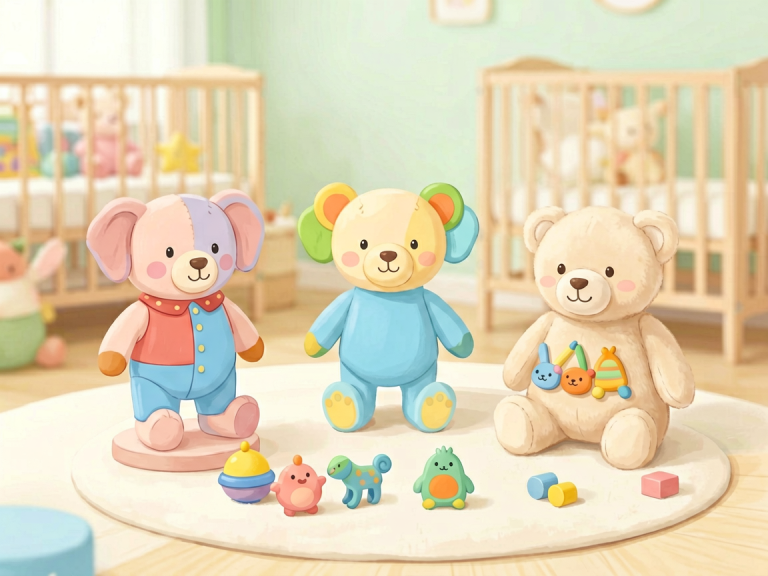
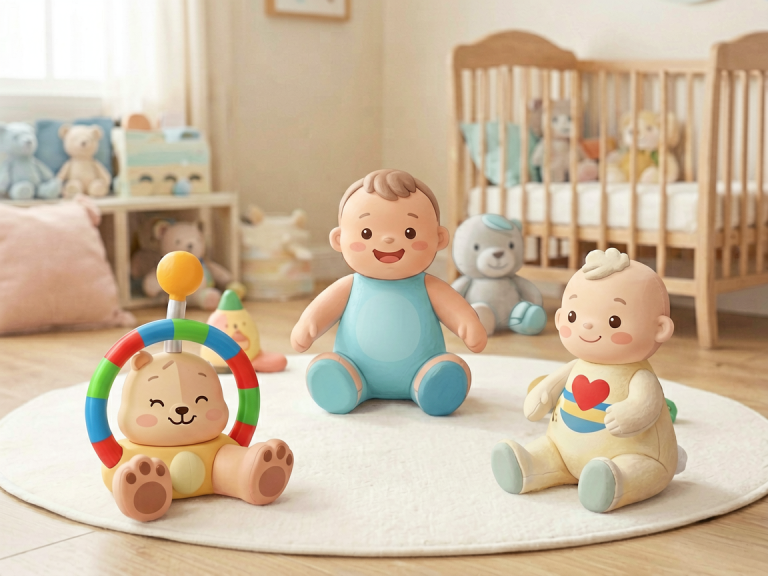
Babies are social beings from birth, and learning toys that encourage interaction with caregivers help build emotional bonds and self-awareness. Simple toys like puppets, peek-a-boo scarves, or soft dolls with expressive faces allow a baby to practice turn-taking, imitation, and empathy. For instance, when you make a puppet “talk” to your baby, they learn that communication is a two-way street. When they hug a stuffed animal, they are practicing comfort and affection. These toys also provide a safe way for babies to explore emotions. A toy that “cries” or “laughs” can help a baby start to recognize and label feelings. Building emotional intelligence in infancy sets the stage for healthy relationships later in life.
How to Choose Safe and Effective Learning Toys
While the benefits of learning toys are clear, not all toys marketed as “educational” are created equal. Safety is the top priority. Always check for age recommendations and avoid toys with small parts that could pose a choking hazard. Ensure that materials are non-toxic, especially for teething toys that will end up in a baby’s mouth. Look for toys that are durable and easy to clean, as babies love to explore with their mouths. Beyond safety, the best learning toys are open-ended, meaning they can be used in multiple ways. A simple set of wooden blocks, for example, can be stacked, knocked down, sorted, lined up, and eventually used in imaginative play. Open-ended toys encourage creativity and adaptability, whereas toys that do only one thing (like a battery-operated singing robot with a single button) can quickly lose their novelty.
Another important criterion is the toy’s ability to engage the baby without overwhelming them. Too many flashing lights and loud noises can overstimulate a young nervous system, leading to fussiness or withdrawal. The best learning toys often have a calm, simple design that invites the baby to explore at their own pace. Also, consider the toy’s potential for parent-child interaction. A toy that prompts a caregiver to talk, sing, or play alongside the baby is far more valuable than one that keeps the baby passively entertained. Finally, it’s wise to rotate toys periodically. Babies get bored with the same toys, but a slight rotation every week or two can rekindle curiosity and deepen learning.
The Role of Parents and Caregivers in Guided Play
No learning toy, no matter how well designed, can replace the warmth and responsiveness of a loving adult. The “serve and return” interaction—when a baby coos and a parent responds with a smile and a word—is the most powerful learning tool of all. Learning toys are most effective when they are used as part of this dynamic. For example, instead of handing a baby a shape sorter and walking away, a parent can sit with them, name the shapes (“That’s a blue triangle!”), demonstrate how to fit it in, and celebrate when the baby succeeds. This guidance not only teaches the skill but also reinforces the emotional bond that makes learning feel safe and rewarding.
Parents should also follow the baby’s lead. If a baby is more interested in mouthing a stacking ring than in stacking it, that’s fine—oral exploration is a valid form of learning. The adult’s role is to be present, observant, and responsive. They can introduce new ways to play with a toy without forcing it. For instance, if a baby is banging two blocks together, the parent can join in and create a simple rhythm, turning it into an early music lesson. This kind of respectful, attuned interaction is the essence of high-quality play.
It is also important to remember that babies learn through repetition. They will put the same toy into their mouth, shake it, drop it, and retrieve it countless times. Each repetition reinforces neural connections. Patience is key. A learning toy is not a tool to accelerate development in a linear way; it is a catalyst for rich, varied experiences that unfold at the baby’s own pace.
Conclusion
Learning toys for babies are far more than colorful amusements. They are precisely crafted instruments that support the extraordinary work of early brain development. From the simplest rattle to the most sophisticated shape sorter, each toy offers a unique opportunity for a baby to practice motor skills, solve problems, build language, and explore social connections. The science is clear: purposeful play during infancy lays the foundation for lifelong curiosity, creativity, and cognitive flexibility. However, the true magic of these toys emerges only when they are paired with the loving attention of a caregiver who talks, plays, and learns alongside the baby. Choosing high-quality, safe, and open-ended toys, and using them with intention and warmth, is one of the most valuable investments a parent can make in their child’s future. As the old saying goes, “Play is the work of childhood.” For babies, learning toys are the tools of that work—and the results are nothing short of miraculous.