The Power of Play: How Toys Foster Language Development in Children
Introduction
Language is the cornerstone of human connection, and its development begins long before a child speaks their first word. From babbling to constructing complex sentences, the journey of language acquisition is a remarkable process that thrives on interaction, repetition, and meaningful context. Among the most powerful yet often underestimated tools in this journey are toys. Far from being mere sources of entertainment, carefully selected toys can serve as catalysts for vocabulary expansion, grammatical understanding, conversational skills, and even emotional expression. In an age dominated by screens and passive media, understanding how physical, interactive toys contribute to language development is more critical than ever. This article explores the multifaceted relationship between toys and language growth, offering insights into the types of toys that work best, the mechanisms behind their effectiveness, and practical advice for parents and educators seeking to nurture linguistic potential through play.
The Role of Toys in Early Language Acquisition
Language development is not an isolated cognitive process; it is deeply embedded in social and sensory experiences. Toys provide a tangible bridge between a child’s internal world and the external environment. When a child plays with a toy, they are not just manipulating an object—they are constructing narratives, testing sounds, and engaging in the kind of repetitive practice that solidifies neural connections. For instance, a simple set of animal figurines can prompt a toddler to imitate the sounds of a cow or a dog (“moo” and “woof”), which are early forms of onomatopoeic language. This type of play encourages phonological awareness, the ability to recognize and manipulate sounds, which is a foundational skill for reading and speaking.
Moreover, toys facilitate what linguists call “joint attention”—the shared focus between a child and a caregiver on an object or activity. When an adult holds up a toy car and says “vroom vroom,” the child learns that sounds have meaning and that specific words correspond to specific actions or objects. This back-and-forth interaction, often called “serve and return,” is the bedrock of language acquisition. Toys are the perfect medium for this exchange because they are inherently engaging and can be used repeatedly in different contexts. Whether it’s a stack of blocks, a puppet, or a set of play food, each toy offers endless opportunities for labeling, describing, and storytelling.
Types of Toys That Promote Language Skills
Not all toys are created equal when it comes to language development. While any toy can spark conversation, certain categories are particularly effective at targeting specific linguistic domains.
*Role-Playing and Pretend Play Toys*
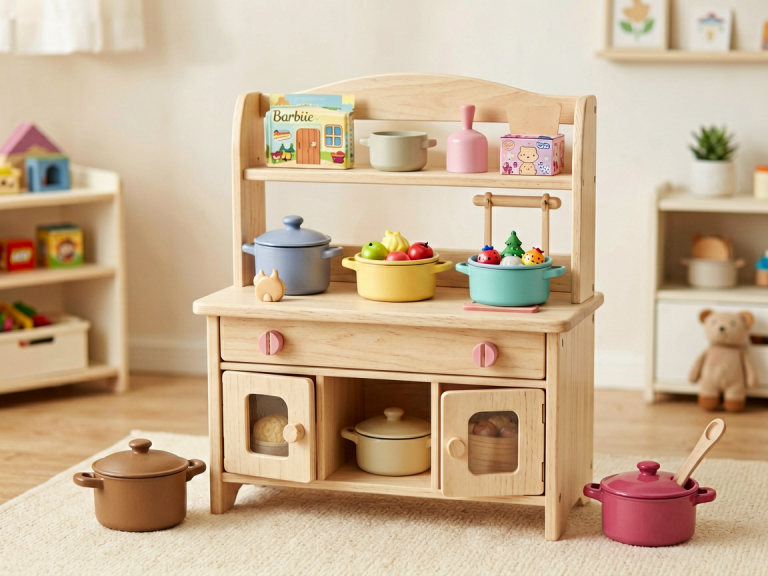
Dollhouses, kitchen sets, doctor kits, and dress-up costumes encourage children to create their own scenarios and dialogues. Pretend play is a natural laboratory for language because it requires children to take on different roles, negotiate with peers, and narrate actions. For example, a child pretending to be a shopkeeper might say, “Welcome to my store! Would you like some apples?” This type of play builds vocabulary related to social roles, objects, and actions, while also practicing turn-taking and question formation. Studies have shown that children who engage in more sophisticated pretend play demonstrate advanced language skills, including the use of complex sentences and narrative structure.
*Musical and Sound-Making Toys*
Rattles, drums, xylophones, and toy microphones help children explore the rhythm and tone of language. Musical toys encourage vocalization—children often hum, sing, or chant along with the sounds. This is particularly beneficial for phonemic awareness and the ability to hear differences between similar sounds (like “bat” and “pat”). Songs and rhymes embedded in musical toys also teach rhyming patterns and repetition, both of which are crucial for learning grammatical structures.
*Puzzles and Matching Games*
While puzzles are often thought of as cognitive or motor skill tools, they are powerful for vocabulary building. A picture puzzle with animals, vehicles, or everyday objects prompts caregivers to name each piece: “This is a giraffe. Where does the giraffe go?” The child learns to associate the spoken word with the image. Matching games (like lotto or memory cards) further reinforce this by requiring children to say the names aloud when they turn over a card. These activities also introduce categorization (e.g., “all animals” or “all fruits”), which expands semantic networks in the brain.
*Construction and Building Toys*
Blocks, LEGOs, and magnetic tiles might seem purely spatial, but they generate rich language. As children build, they describe their creations: “I’m making a tall tower,” or “This blue block goes on top of the red one.” They also use language to plan, problem-solve, and explain—key components of expository language. When playing with others, they must articulate their ideas and negotiate: “Can you hand me the long piece?” This kind of spontaneous talk is more beneficial than drilling vocabulary because it is contextual and meaningful.
How to Choose the Right Toys for Language Development
The best toys for language development are not necessarily the most expensive or the most technologically advanced. Instead, they share three key characteristics: interactivity, open-endedness, and age-appropriateness.
An interactive toy invites conversation. A simple pull-string toy that says a phrase can be used as a prompt for the child to repeat the phrase. However, purely passive toys—such as those that only play pre-recorded sounds without requiring a response—are less effective. Ideally, the toy should act as a partner in dialogue, not a one-way transmitter. For example, a puppet that “talks back” when the child speaks encourages back-and-forth exchange. Similarly, toys that require the child to press buttons, move parts, or combine pieces naturally elicit verbal commentary.
Open-ended toys—those that can be used in multiple ways—are superior because they adapt to a child’s growing language abilities. A set of wooden blocks can be used to build a castle (narrative), to stack and count (number words), or even to create a “family” of blocks (social roles). In contrast, a single-purpose toy like a battery-powered singing robot quickly loses its novelty and offers limited linguistic expansion. Open-ended toys encourage creativity and therefore a wider range of vocabulary and sentence structures.
Age-appropriateness is equally important. A toy that is too advanced may frustrate a child, while one that is too simple may fail to challenge them. For infants (0–12 months), high-contrast soft books, rattles, and crinkle toys that produce sounds help build auditory and visual attention. Toddlers (1–3 years) thrive with toys that promote naming and simple actions: animal figurines, shape sorters, and chunky puzzles. Preschoolers (3–5 years) benefit from more complex play sets, storytelling cards, and board games that require following instructions and taking turns. School-age children (5+) can enjoy strategy games, word-building games like Scrabble Junior, and sophisticated construction kits that involve written instructions.
Practical Tips for Parents and Educators
Having the right toys is only half the battle. To maximize language benefits, adults must actively engage with children during play. Here are concrete strategies:
*Narrate the Play*
Instead of simply observing, describe what the child is doing in real time. “You are putting the red car on the ramp. Now it’s going down! Whee!” This exposes the child to a rich variety of verbs, adjectives, and prepositions. Over time, the child will internalize these structures and begin to use them.
*Ask Open-Ended Questions*
Avoid questions that can be answered with a simple “yes” or “no.” Instead, ask “What happens next?” “How do you think the bear feels?” or “Why did the tower fall?” These prompts encourage children to form longer sentences and express reasoning. Even if the child cannot yet answer fully, the adult can model the answer: “The bear might feel sad because his house broke. Let’s fix it together.”
*Expand on the Child’s Utterances*
When a child says a single word, such as “dog,” the adult can expand it into a full sentence: “Yes, that’s a big brown dog. The dog is barking.” This technique, known as recasting, demonstrates how to combine words and introduces new vocabulary without direct correction. It is a gentle, natural way to scaffold language.
*Create a Language-Rich Environment*
Rotate toys regularly to maintain interest and introduce new themes. Label toy storage bins with pictures and words. Incorporate books that relate to the toys (e.g., a farm book alongside farm animal toys). Encourage pretend play with peers and siblings to practice conversational turn-taking. And remember: the most important “toy” is the attentive, responsive adult who talks, listens, and plays alongside the child.
Conclusion
Toys are far more than playthings; they are the instruments through which children compose their first linguistic symphonies. From the rattle that first draws a baby’s attention to sound, to the elaborate dollhouse that inspires a story, each toy holds potential for language growth. By choosing toys that invite interaction, encourage open-ended play, and align with developmental stages, and by engaging with children in meaningful conversation during play, parents and educators can transform ordinary objects into extraordinary tools for communication. In a world where language is the key to learning, connection, and self-expression, investing in the right toys—and in the quality of play—is one of the most impactful gifts we can give to the next generation. So the next time you reach for a toy, ask yourself: not just what it does, but what it might help a child say.