The Tablet-Free Toddler: Embracing Screen-Free Play for One-Year-Olds
—
Introduction: Why One-Year-Olds Don’t Need Tablets
In many modern households, a tablet or smartphone has become the default babysitter—a quick fix to calm a fussy toddler, entertain a restless baby during a diaper change, or buy a parent five minutes of silence. For a one-year-old, however, screen time is not only unnecessary but potentially harmful. The American Academy of Pediatrics recommends avoiding all digital media (except video chatting) for children under 18 months, and even for those between 18 and 24 months, high-quality programming with adult co-viewing is the only acceptable exception. Yet the reality is that many families rely on tablets to manage daily chaos.
This article explores a simple, powerful alternative: screen-free play specifically designed for one-year-olds. Replacing tablet time with intentional, hands-on, and developmentally appropriate activities does not require expensive gadgets or elaborate setups. Instead, it taps into the natural curiosity, sensory exploration, and motor development that define a child’s first year. By understanding why tablets are problematic and learning how to implement engaging, screen-free routines, parents can foster deeper bonding, stronger cognitive growth, and healthier habits from the very start.
—
The Hidden Costs of Tablet Time for One-Year-Olds
1. Disrupted Brain Development
At age one, a child’s brain is forming 700 to 1,000 new neural connections every second. These connections are built through real-world interactions: the feel of a squishy toy, the sound of a parent’s voice responding to a babbled sound, the sight of a ball rolling across the floor. Screens, however, provide a two-dimensional, fast-paced stream of images that overwhelm the developing visual system and reduce opportunities for cause-and-effect learning. Studies show that excessive screen exposure in infancy is linked to delays in language, attention, and executive function later in life.
2. Limited Social and Emotional Engagement
A one-year-old learns emotions by watching faces, hearing tone of voice, and feeling the warmth of a hug. Tablets cannot mirror a parent’s smile, react to a child’s gleeful shriek, or offer the gentle reassurance of a comforting embrace. When a toddler stares at a screen, they miss countless moments of back-and-forth interaction—the very foundation of secure attachment and emotional intelligence.
3. Reduced Physical Activity
One-year-olds are natural movers. They are pulling up, cruising along furniture, taking tentative steps, and exploring their environment with every muscle and sense. Tablet time typically requires sitting still, which directly contradicts their developmental drive. Sedentary behaviors at this age can lead to weaker core muscles, delayed gross motor milestones, and a long-term preference for passive entertainment over active play.
4. Sleep and Attention Disruptions
The bright, flickering blue light from screens suppresses melatonin production, making it harder for a one-year-old to fall asleep and stay asleep. Moreover, the rapid scene changes and high-contrast animations overstimulate an immature nervous system, leading to increased fussiness, shorter attention spans during low-tech activities, and difficulty with self-soothing.
—
The Core Principles of Screen-Free Play for One-Year-Olds
Before diving into specific activities, it is essential to understand what makes play truly meaningful for a one-year-old. These principles will guide every choice you make:
- Sensory Richness: Babies learn through all five senses. Offer textures, sounds, tastes (safe, of course), scents, and sights that vary naturally.
- Open-Ended Materials: Avoid toys that do only one thing (like a light-up button that plays a song). Instead, provide blocks, scarves, containers, and balls that can be stacked, thrown, rolled, hidden, and explored in countless ways.
- Adult Presence, Not Constant Interference: Your role is to be a secure base—nearby, responsive, and engaged—without directing every move. Let your child lead.
- Safe, Simple, and Accessible: All items should be free of small parts that could be choked on, and stored low so the toddler can choose their own exploration.
—
15 Screen-Free Play Ideas to Replace Tablet Time
Below are five categories of play, each with three concrete examples. These activities require minimal preparation, use common household objects, and support the major developmental domains of a one-year-old: fine motor, gross motor, language, cognitive, and social-emotional.
1. Sensory Exploration Stations
a. The “Treasure Basket”
Place 6–8 everyday, safe objects in a shallow, sturdy basket: a wooden spoon, a silicone whisk, a large pinecone, a clean sock, a metal measuring cup, a crinkly fabric handkerchief, and a smooth stone. Let your child sit and explore freely. They will mouth, shake, bang, and turn each item, discovering weight, texture, sound, and temperature differences. Rotate items weekly to maintain novelty.
b. Edible Finger Painting
Mix plain yogurt with a few drops of natural food coloring (or use mashed berries, pureed pumpkin, or beet juice). Spread a thin layer on a high-chair tray or a large sheet of parchment paper taped to the floor. Let your child squish, smear, and taste. This activity strengthens hand muscles and provides visual delight without toxic chemicals.
c. Water Play in a Low Tub
Fill a shallow plastic bin with just an inch of lukewarm water. Add a few floating toys (a plastic cup, a sponge, a rubber duck). Place the bin on a towel on the floor, and let your child sit beside it, splashing and pouring. Always supervise closely. Water play is calming and teaches early concepts of volume, cause, and effect.
2. Gross Motor Adventures
a. The “Pillow Obstacle Course”
Scatter a few couch cushions and firm pillows on a carpeted floor. Encourage your child to crawl over, climb onto, and slide off them. This builds balance, spatial awareness, and muscle strength. Join them by moving slowly alongside, narrating their actions: “Up you go over the big mountain… now down the other side!”
b. Push-and-Pull Toys
A simple cardboard box with a short string tied to it becomes a pull-along toy. Fill it with a few soft blocks or a stuffed animal. Watch your child stagger while pulling it behind them—a powerful practice for walking and weight shifting. A lightweight child-size shopping cart or a plastic lawn mower also works wonders.
c. Dancing with Scarves
Play a short, rhythmic song (e.g., a simple folk tune or a calm instrumental piece). Give your child a lightweight silk scarf or a piece of tulle. Model gentle swaying, waving, and tossing. Your toddler will copy your movements, developing body awareness and enjoying the shared emotional connection of moving together.
3. Fine Motor and Hand-Eye Coordination
a. Container Play (In-and-Out)
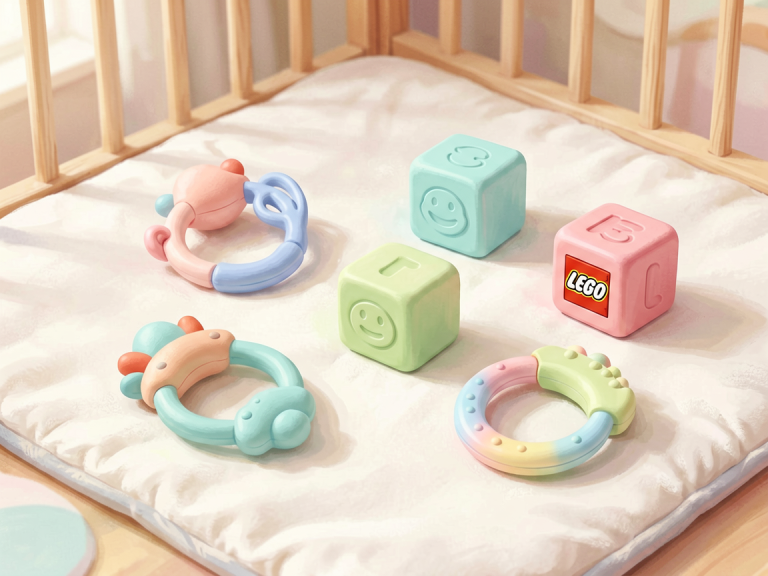
Provide a large plastic bowl or an empty wipes container, plus a handful of large wooden rings or blocks. Show how to drop the items inside, then dump them out. Your one-year-old will repeat this over and over, practicing the pincer grasp (thumb and forefinger) and understanding object permanence.
b. Stacking and Knocking Down
Use lightweight, soft blocks (foam or fabric). Build a small tower of three or four blocks while your child watches. Encourage them to knock it over. Then, let them try stacking two blocks themselves. The thrill of cause and effect is deeply satisfying at this age.
c. Basket of Balls
Fill a low basket with soft balls of various sizes (tennis ball, squishy ball, knitted ball, jingle bell ball). Let your child pick them up, roll them, chase them, and try to hold two at once. This activity strengthens grip and encourages bilateral coordination (using both hands together).
4. Language and Sound Play
a. “Look at That!” – Picture Walks
Instead of a tablet, hold a sturdy board book and turn the pages slowly. Point to a simple image (e.g., a cat, a ball, a baby) and say its name clearly. Then wait for your child to point, babble, or make eye contact. This back-and-forth “conversation” is far richer than a pre-recorded voice reading a story.
b. Homemade Shakers
Fill a sealed, unbreakable container (e.g., a small plastic water bottle with the label removed) with a few dried beans, rice, or pasta. Superglue the cap shut. Let your child shake it to different rhythms. You can shake along while chanting simple rhymes, like “Shake, shake, shake, shake the bottle now!”
c. Animal Sounds and Gestures
Sit face-to-face with your baby. Make exaggerated animal noises (“Moo,” “Baa,” “Quack-quack”) and pair each with a simple hand gesture (e.g., fingers to head for cow horns). Your child will attempt to imitate both the sound and the motion, building vocal imitation skills and early symbolic thinking.
5. Outdoor and Nature-Based Play
a. Barefoot Grass Time
Find a safe patch of clean grass. Place a blanket nearby, but let your toddler sit or crawl directly on the grass for a few minutes. The tickling sensation, the sight of blades moving in the wind, and the scent of earth are all rich sensory inputs. Never leave them unsupervised, and keep sessions short (5–10 minutes).
b. Leaf and Stick Collection
Go on a “walk” (which may be just a slow crawl across the yard). Collect a few large, smooth leaves and a short, thick stick. Back inside, let your child hold, crinkle, and wave these treasures. Natural objects are non-toxic, textured, and infinitely more interesting than plastic counterparts.
c. Bird or Cloud Watching (Lying Down)
On a nice day, lie on a blanket with your baby and look up. Point to a bird flying overhead or a cloud drifting by. Say simple descriptive words: “Look! Bird. Fly, fly, fly.” This quiet, shared activity cultivates attention span and visual tracking without any screen.
—
How to Transition from Tablet Time to Screen-Free Play
If your one-year-old is already accustomed to tablet time (even just 15 minutes a day), expect some resistance at first. Follow these steps for a smooth, loving transition:
- Cold Turkey vs. Gradual Weaning: For very young toddlers, cold turkey often works best—simply remove the device from reach and do not offer it. The meltdown typically lasts only a few minutes, and the child quickly redirects to a toy if a parent is present and engaged. For more determined toddlers, reduce tablet time by 2–3 minutes per day over a week.
- Replace, Don’t Remove: Whenever you would normally hand over the tablet, immediately offer one of the activities above. Have a “play menu” mentally prepared: “Let’s go shake our bottle!” or “Come see the treasure basket!”
- Get Down on the Floor: Your presence is the most powerful tool. If your child seems bored or fussy, sit beside them, pick up a block, and build a tower. Do not wait for them to become absorbed—enter their world first.
- Manage Your Own Screen Use: One-year-olds are master imitators. If they see you on your phone constantly, they will crave screens. Set aside your own devices during playtime. Designate certain hours (like during naptime) for your own digital work or relaxation.
- Celebrate Small Wins: Notice when your toddler plays independently for even 30 seconds without a screen. Smile, nod, and say, “You are having so much fun with the ball!” Your positive attention reinforces that real-world play is rewarding.
—
Conclusion: The Gift of Presence
Replacing a tablet with screen-free play for your one-year-old is not about perfection; it is about intention. Every time you choose a crumpled scarf over a glowing screen, you are building a tiny scaffolding: stronger neural pathways, deeper trust, and a lifelong love for hands-on exploration. The activities described above are simple, low-cost, and deeply rooted in what a baby truly needs—a responsive adult, a safe environment, and the freedom to move, touch, taste, and discover.
The first year of life passes in a blur. In the midst of sleep deprivation and endless laundry, it is tempting to hand over a tablet for a moment of quiet. But the quiet you gain through screen-free play is a different kind—one filled with the rustle of a shaking bottle, the giggle of a successful tower, and the warmth of a head resting against your shoulder. That is the play that shapes a child’s world. And it begins with a simple decision: put down the tablet, and pick up the treasure basket.