Top Toys for Boosting Language Development in 2-Year-Olds: A Parent’s Guide
The second year of life is a miraculous time for language. At 24 months, most toddlers are transitioning from single words to simple phrases, and their vocabulary is expanding at an astonishing rate—some studies suggest that a typical 2-year-old learns up to 10 new words per day. This sensitive period is the perfect window for parents to intentionally scaffold communication skills through play. However, not every toy on the shelf is created equal when it comes to language development. The best toys for a 2-year-old’s language growth are those that invite back-and-forth interaction, introduce new vocabulary in context, and encourage imitation, questioning, and storytelling. In this article, we’ll explore seven categories of toys that research and pediatric speech-language pathologists agree are most effective, along with specific play strategies to maximize their benefits.
Interactive Books with Lift-the-Flaps and Textures
Books remain the gold standard for language enrichment, but for a 2-year-old, passive reading isn’t enough. The most powerful books are those that require active participation. Lift-the-flap books (like *Where’s Spot?* by Eric Hill) create a “peek-a-boo” effect that naturally elicits anticipation, pointing, and vocalization. The child’s fine motor action of lifting the flap is paired with an exciting reveal, which prompts the parent to model language: “What’s under the flap? It’s a yellow duck! Quack, quack!” Similarly, books with textured pages (such as *Pat the Bunny*) invite the child to feel and describe: “Soft fur. Rough sandpaper. That’s bumpy.” These multisensory experiences strengthen the neural connections between words, objects, and sensations. For 2-year-olds, repetition is key—reading the same book multiple times allows them to anticipate the words and eventually “fill in the blanks” themselves. Studies show that dialogic reading, where the adult asks open-ended questions (“What do you think happens next?” “Where is the dog?”), can increase expressive vocabulary by up to 40% in toddlers. Therefore, a simple board book with flaps, mirrors, or tactile elements is a non-negotiable tool for language development.
Pretend Play Sets: Kitchens, Tool Benches, and Animal Farms
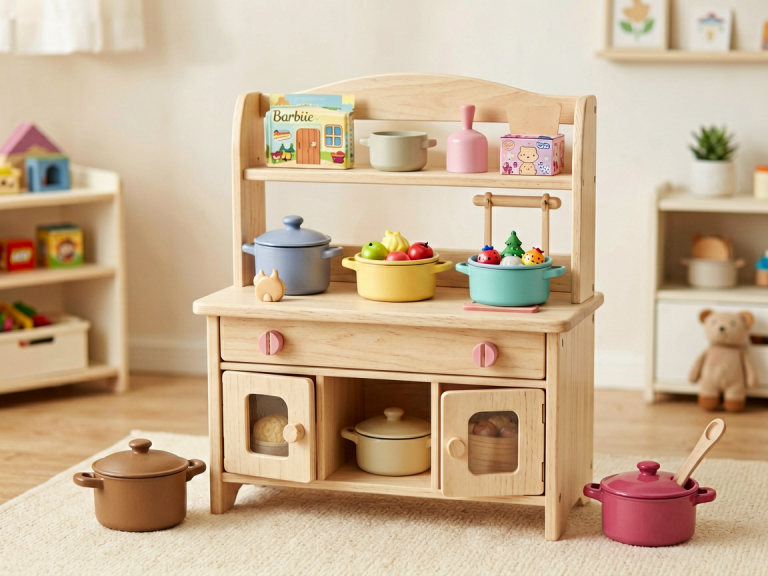
Symbolic play—the ability to use one object to represent another—explodes around age 2, and it directly fuels language. Pretend play sets like a toy kitchen, a doctor’s kit, or a farm animal collection provide rich contexts for vocabulary building and conversational turn-taking. Imagine a 2-year-old “cooking” a plastic egg in a toy skillet. An adult can join the play and narrate: “You’re frying an egg! I’m hungry. Can you give me a plate? Let’s say ‘thank you’.” This type of play naturally introduces action verbs (fry, pour, stir), nouns (plate, spoon, pan), and social phrases (please, thank you, more). The best sets are open-ended—a simple wooden kitchen with a few pots and felt food pieces encourages more language than a battery-powered set that sings songs alone. Animal farms, in particular, are fantastic for 2-year-olds because they combine imitation of animal sounds (“Moo! Baa! Neigh!”) with naming and categorization. When a child picks up a cow figure, the parent can model “cow” and then extend: “The cow says moo. Where does the cow live? On the farm.” This “serve and return” interaction—where the child’s action (serving) is met with a verbal response (returning)—is the biological foundation of language acquisition, according to Harvard’s Center on the Developing Child.
Musical Instruments and Singing Toys
Rhythm and melody are powerful vehicles for language. The left temporal lobe, which processes speech, overlaps with the auditory cortex that processes music. When a 2-year-old shakes a maraca, bangs a drum, or rings a bell, the parent can chant simple songs or nursery rhymes in time with the beat. Instruments like egg shakers, xylophones, and handbells encourage vocal imitation—children often try to match the pitch or rhythm with sounds like “ba-ba-ba” or “la-la-la.” Specifically, toys that play simple songs when a button is pressed (e.g., a “B-I-N-G-O” songbook) can teach syllables and word patterns. The key is to use the instrument as a prompt for verbal interaction. For example, while shaking a tambourine, say: “Shake it fast! Shake it slow! Now stop!” This introduces opposites (fast/slow) and commands, which help with receptive language. Moreover, singing nursery rhymes like “Old MacDonald” forces the child to fill in the animal sounds at the end of each verse, a classic technique for building expressive language. Rather than a complex electronic toy, a simple pair of wooden rhythm sticks or a hand-drum set that requires manual effort (not batteries) will engage the child’s motor planning and vocal production simultaneously.
Building Blocks and Shape Sorters with Verbal Labeling
Construction toys, such as large wooden blocks or foam shape sorters, are often underestimated for language. Yet they are perfect for teaching spatial vocabulary (up, down, on, under, behind), color names, and size comparisons (big, small, tall, short). When a child stacks two blocks, an adult can say: “You put the red block on top of the blue block. It’s a tower! One, two, three blocks.” This simple narration exposes the child to prepositions and number words. Shape sorters, especially those with different shapes and corresponding holes, offer another layer: the child must pick up a triangle, hear the word “triangle,” and then try to fit it. Even if the child cannot yet say “triangle,” the repeated auditory exposure builds receptive vocabulary. More advanced sets—like those that include animal-shaped blocks that fit into a base with animal sounds—also combine categorization. The crucial element is that the parent talks *during* the play, not just after. Research from the University of Chicago’s Language Development Lab shows that the number of words a toddler hears in a conversational context (as opposed to passive background noise) predicts later language outcomes. Therefore, a simple set of colorful blocks is a powerful language tool when paired with an engaged, talking adult.
Puzzles with Pictures and Simple Matching Games
Puzzles, particularly those with large, easy-to-grasp pieces featuring familiar objects (animals, vehicles, foods), are excellent for building vocabulary and problem-solving language. For a 2-year-old, a chunky wooden puzzle with only four to six pieces is ideal. As the child tries to place the dog piece into the puzzle board, the parent can model the word “dog” and add a description: “The dog says woof. You found the dog’s spot. Good job!” Over time, the child will begin to name the pieces as they pick them up. Matching games—for instance, a simple set of picture cards where the child finds two identical images—also promote labeling. The parent can hold up a card and say, “I have a cat. Can you find the other cat?” The child then searches, points, and eventually says “cat.” This “find the same” activity builds categorization skills and reinforces word-object associations. More advanced puzzle sets may include simple scenes (a farm, a bedroom) that allow the adult to ask questions: “Where is the cow? Is the cow sleeping?” This encourages the child to use location words and answer yes/no or “where” questions—all foundational for two-word phrases like “cow sleep.”
Simple Cause-and-Effect Toys with Verbal Play
Toys that create a clear outcome when the child interacts with them—such as a pop-up toy where the child presses a button and a character pops up, or a ball-drop tower where the ball rolls down and rings a bell—are highly motivating for 2-year-olds. These toys create natural opportunities for the adult to narrate the sequence: “Push the button… pop! The lion comes out. You pushed it, and the lion jumped!” This cause-effect language (if-then) introduces complex sentence structures. A ball-drop tower, for example, allows the parent to model “drop,” “roll,” “down,” and “go.” The child may then imitate the word “down” or “go” as they drop the ball. Similarly, a simple car track where the child places a car at the top and it races down elicits words like “ready, set, go!” The repetitive nature of cause-and-effect play also helps toddlers learn prediction and sequencing—both of which are precursors to storytelling. When selecting such toys, avoid those that are too automatic; ones that require the child’s physical action (pressing, pushing, dropping) are far better for language than toys that run on their own.
Mirror and Emotion-Cards Toys
A lesser-known but incredibly effective category for 2-year-old language development involves toys that focus on faces and emotions. At this age, toddlers are learning to identify and name feelings—happy, sad, angry, surprised. A toy mirror allows the child to see their own facial expressions while the parent says, “Look, you’re smiling! You are happy. Now show me a sad face.” Some toy sets include cards with different emotional expressions; the child can match their face to the card or point to “the baby who is crying.” These activities build emotional vocabulary and also prompt social referencing—the child looks to the parent for confirmation, which reinforces joint attention. Joint attention (the shared focus of two individuals on an object) is a critical precursor to language because it establishes the foundation of communication: “We are both looking at the same thing, and I will say its name.” Therefore, a simple unbreakable mirror (safety-tested for toddlers) combined with a set of emotion picture cards can be a surprising powerhouse for language and social-emotional growth.
Technology and Apps: A Cautionary Note
While there are many educational apps and electronic tablets marketed for language development, the American Academy of Pediatrics strongly recommends limiting screen time for 2-year-olds to no more than one hour per day of high-quality programming, with co-viewing by a parent. The problem with tablets is that they are often passive or encourage solo tapping, which reduces the back-and-forth conversation that is vital. Even the most advanced “talking” toy cannot replace a human’s responsive, contextual language. If you do choose a digital toy, opt for ones that require the child to respond verbally—such as a simple app that asks “What color is this?” and waits for the child to say the color (with parental prompting). However, traditional toys remain superior because they demand physical manipulation, face-to-face interaction, and open-ended creativity.
Conclusion
The best toys for language development in 2-year-olds are not necessarily the most expensive or the most technologically complex. Instead, they are the ones that create a bridge between the child’s action and the adult’s speech. Interactive books, pretend play sets, musical instruments, building blocks, puzzles, cause-and-effect toys, and mirror-based tools all invite the kind of responsive, joyful communication that wires a toddler’s brain for language. The common thread is joint engagement: a parent sitting on the floor, using a toy as a prop to talk, listen, wait, and respond. With these seven types of toys in your parenting toolkit, you can turn every play session into a rich language lesson—without a single flashcard in sight. Remember, the child is not just playing; they are learning the building blocks of human connection, one word at a time.