The Ultimate Toy Guide for Parents: How to Choose Age‑Appropriate Toys That Foster Growth and Joy
Introduction
Every parent has experienced that moment of indecision in a toy aisle: rows of colourful boxes, flashing lights, and promises of “educational fun” compete for attention. Yet the most important factor in choosing a toy is not its price tag or popularity—it is how well it matches a child’s developmental stage. Age‑appropriate toys do more than entertain; they build fine and gross motor skills, nurture creativity, develop problem‑solving abilities, and teach social‑emotional lessons. Without the right fit, a toy can quickly become frustrating (too advanced) or boring (too simple). This guide will walk you through the key considerations for each age group, from newborns to early adolescents, so you can make informed, confident choices that bring lasting value and delight.
Why Age Appropriateness Matters
Children’s brains undergo rapid, stage‑specific changes. A toy that engages a toddler’s budding sense of cause and effect will be lost on an infant, while a complex board game may overwhelm a preschooler. Choosing toys that align with a child’s current abilities and interests supports what child development experts call “scaffolding”—offering just enough challenge to encourage growth without causing frustration. Moreover, safety standards vary by age. Small parts, sharp edges, and materials that can be harmful if mouthed are regulated based on age labelling. By respecting these guidelines, you protect your child physically and nurture their cognitive and emotional development.
Newborns to 6 Months: Sensory Awakening
At this stage, babies are discovering the world through their senses. They cannot yet grasp objects deliberately, but they respond to sounds, sights, textures, and movement. The best toys for this period are simple, safe, and sensory‑rich.
*High‑contrast black‑and‑white picture cards* stimulate developing vision. Soft *rattles and crinkle toys* offer auditory and tactile feedback. *Unbreakable mirrors* encourage self‑awareness. *Play mats with dangling toys* promote reaching and kicking, building early gross motor coordination. Always ensure toys are free of small parts and made from non‑toxic materials, as babies will mouth everything. Avoid loud, jarring sounds that can overstimulate; gentle chimes or soft melodies are ideal.
6 to 12 Months: Exploration and Grasping
As babies learn to sit, crawl, and eventually stand, their curiosity explodes. They begin to understand object permanence—that things exist even when hidden. Toys that encourage grasping, shaking, and transferring from one hand to another are perfect.
*Stacking cups* teach size relationships and cause‑and‑effect when they topple. *Soft blocks* introduce early construction. *Activity centres* with buttons, levers, and sliding beads develop fine motor skills. *Teething toys* with different textures soothe sore gums and provide sensory variety. *Board books* with bright pictures and simple rhymes build language exposure. During this phase, avoid any toy with long strings (strangulation risk) and ensure all items are large enough not to be swallowed. The key is to offer toys that respond to the baby’s actions, reinforcing the connection between movement and outcome.
1 to 2 Years: Toddling Independence
Toddlers are on the move, and their play becomes more purposeful. They imitate adults, engage in simple pretend play, and love to push, pull, and dump objects. Fine motor skills advance rapidly, so toys that require precise hand‑eye coordination are beneficial.
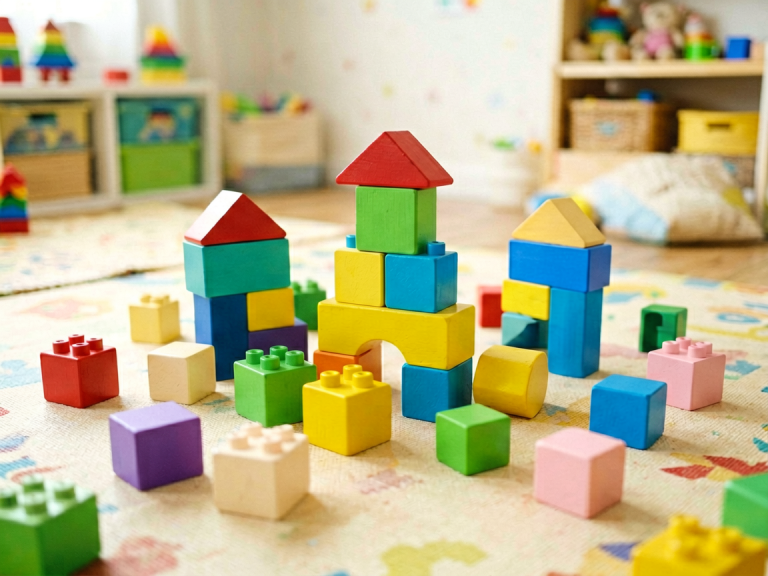
*Push‑and‑pull toys* (e.g., a wooden animal on wheels) support walking practice and coordination. *Shape sorters* and simple puzzles with large knobs teach problem‑solving and spatial reasoning. *Play kitchens, tool benches, and dollhouses* foster imitation and early storytelling. *Building blocks* encourage creativity and balance. *Chunky crayons and washable markers* let them scribble, strengthening grip for later writing. Safety remains paramount: avoid any toy with small magnets, batteries accessible without a screwdriver, or sharp edges. Also remember that toddlers have short attention spans—rotate toys to keep novelty alive.
3 to 5 Years: Imagination and Social Play
The preschool years are a golden age of make‑believe. Children start to play cooperatively, negotiate roles, and follow simple rules. Their language blossoms, and they ask endless “why” questions. Toys that spark narrative thinking and social interaction are ideal.
*Dress‑up costumes and props* (e.g., hats, capes, toy money) let children become firefighters, doctors, or astronauts. *Art supplies* like Play‑Doh, safety scissors, glue sticks, and watercolour sets encourage creativity and fine motor development. *Building sets* with interlocking pieces (e.g., Duplo or unit blocks) teach engineering concepts. *Simple board games* (e.g., Candy Land or matching games) introduce turn‑taking, following rules, and handling wins and losses. *Puzzles with up to 24 pieces* challenge problem‑solving. *Storytelling puppets or magnetic playsets* nurture verbal skills. At this age, children often have strong preferences, but it is wise to limit toys that promote passive screen time; active, open‑ended play yields the most growth.
6 to 8 Years: Rules, Logic, and Collaboration
Entering school age, children develop a fascination with rules, logic, and peer groups. They can concentrate longer, read simple instructions, and enjoy cooperative games. Fine motor skills are refined, allowing more complex manipulations.
*Construction kits* like LEGO Classic, K’Nex, or magnetic tiles encourage engineering thinking and patience. *Science kits* (e.g., growing crystals, simple circuits) satisfy their curiosity about how things work. *Strategy board games* (e.g., checkers, Connect Four, or cooperative games like Operation) teach planning and sportsmanship. *Jump ropes, balls, and flying discs* promote physical activity and coordination. *Beginning chapter books* paired with journaling or sticker‑boosting activities support literacy. *Craft kits* (friendship bracelet kits, bead looms) foster focus and creativity. Keep an eye on screen‑based toys; if electronic, ensure they require active participation rather than passive consumption.
9 to 12 Years: Specialization and Complexity
Tweens are developing strong personal interests and hobbies. They thrive on challenges that allow mastery and self‑expression. Social dynamics become more nuanced, and they often enjoy both solo projects and team‑based play. Toys should now foster advanced skills and peer interaction.
*Advanced building systems* (e.g., LEGO Technic, robotics kits) teach engineering, coding, and patience. *Model kits* (planes, cars, architectural replicas) require attention to detail. *Board games with deeper strategy* (e.g., Settlers of Catan, Risk, or Carcassonne) develop critical thinking, negotiation, and resilience. *Art sets* with quality materials (acrylic paints, drawing pencils, clay) allow them to refine their craft. *Sports equipment* tailored to a specific sport fosters discipline and teamwork. *Musical instruments* (keyboards, ukuleles) encourage creativity and practice habits. *Science and coding subscriptions* (e.g., electronics labs, programming games) prepare them for STEM learning. Digital toys like coding apps or video games should be limited in time and chosen for their creative or problem‑solving content rather than pure entertainment.
Additional Tips for Choosing Age‑Appropriate Toys
Beyond the age brackets, a few universal principles can guide your selection:
- Follow the child’s lead. Some children develop faster in certain areas. If a four‑year‑old shows intense interest in numbers, an early math game might work, even if it is labelled for ages 5+ (provided it is safe). Conversely, a child may need simpler toys for comfort. Observe their play style and adjust.
- Prioritise open‑ended toys. Items that can be used in multiple ways—blocks, play dough, balls, art supplies—grow with the child and encourage creativity. A specific cartoon‑themed toy often has limited replay value.
- Check for safety certifications. Look for EN71 (European) or ASTM (American) marks. Avoid toys with small magnets for children under 6, and ensure batteries are securely enclosed.
- Limit screen time. Many digital toys claim to be educational, but research shows that real‑world, hands‑on play is superior for building spatial skills, social competence, and physical health. If you do choose an electronic toy, pick one that requires active problem‑solving, not just tapping.
- Consider sustainability and longevity. Well‑made wooden toys, metal building sets, and quality art supplies often last for years and can be passed down. They also reduce clutter and environmental waste.
- Watch for choking hazards. The standard small‑parts tester (a tube with a diameter of 1.25 inches) is your friend. For any child under 3, avoid anything that can fit entirely in a child’s mouth.
- Remember that less is more. Too many toys can overwhelm a child and reduce the depth of play. Rotating a small selection of well‑chosen toys every few weeks keeps interest fresh without overstimulation.
Conclusion
Choosing age‑appropriate toys is not about finding the “perfect” item; it is about understanding where your child is developmentally and offering opportunities for discovery, challenge, and fun. From the sensory simplicity of a baby rattle to the strategic complexity of a tween’s board game, every stage brings unique joys and learning possibilities. By staying attuned to your child’s interests and developmental milestones, and by prioritising safety and open‑ended play, you become an active partner in their growth. The best toy is one that sparks joy, invites interaction, and lays a foundation for a lifetime of curiosity. So next time you walk down that aisle, take a deep breath—you now have the knowledge to choose wisely. Happy playing!