Unlocking Words: The Best Toys for Language Development in 3-Year-Olds
Introduction
The third year of life is a remarkable linguistic leap. Between ages two and four, a child’s vocabulary explodes from roughly 50 words to over 1,000, and simple two-word phrases evolve into complex sentences. This rapid development is not automatic—it thrives on rich, interactive experiences. While everyday conversations, reading, and songs are foundational, the right toys can transform playtime into a powerful language laboratory. Toys that encourage dialogue, storytelling, problem-solving, and imitation provide the context children need to practice sounds, learn new words, grasp grammar, and develop narrative skills. But not all toys are created equal. The best language-development toys for 3-year-olds are those that invite back-and-forth interaction, spark curiosity, and allow for repetition and creativity—all while feeling like pure fun. This article explores seven categories of toys that research and experience have shown to be most effective, explaining exactly how each supports a child’s growing communication abilities.
1. Interactive Storybooks and Audio Players: The Gateway to Narrative Thinking
At three, children are ready to move beyond simple picture books and engage with stories that have a beginning, middle, and end. Interactive storybooks—especially those with sound buttons, lift-the-flap features, or textured pages—turn reading into a multisensory experience. When a child presses a button to hear a character’s voice or a sound effect, they connect the printed word with auditory meaning. More importantly, these toys encourage dialogue: a parent can ask, “What do you think will happen next?” or “Why is the bunny sad?” Such questions promote prediction, inference, and emotional vocabulary.
Audio players designed for children, such as Tonieboxes or Yoto players, are also excellent. They allow the child to insert a character figurine or a card to play a story, song, or poem independently. While listening passively might not seem interactive, it actually builds listening comprehension—a prerequisite for speaking. Many children will repeat phrases they hear, imitate voices, or later use story language in their own pretend play. For example, a 3-year-old who listens to a story about a “brave little fox” might later say, “I’m brave like the fox!” when facing a small challenge. These toys also introduce rhythm, rhyme, and varied vocabulary that may not appear in everyday conversation.
2. Pretend Play Sets and Role-Playing Toys: The Natural Stage for Language
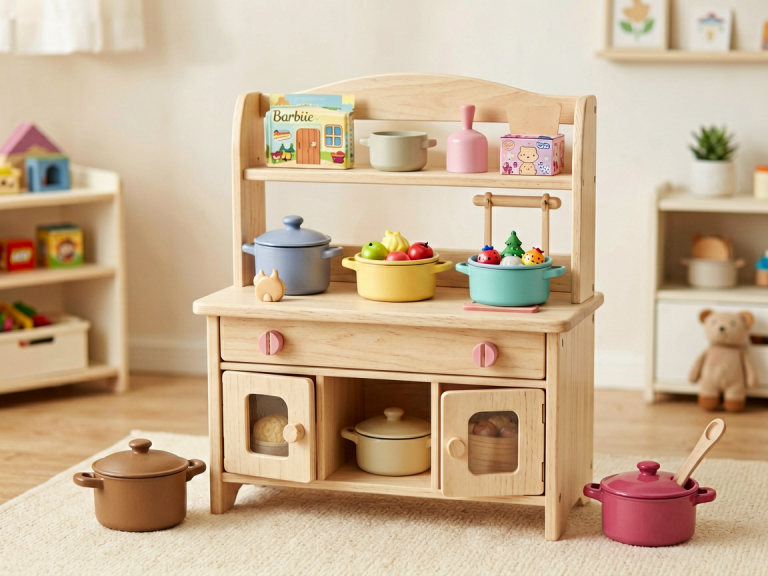
A toy kitchen, doctor’s kit, or tool bench is far more than an imitation of adult life—it is a stage for dialogue. When a 3-year-old puts on a chef’s hat and announces, “I’m making soup for you, Mommy,” they are not just pretending; they are constructing a scenario, assigning roles, and negotiating actions. This requires them to use language to plan, describe, and respond. High-quality pretend play sets include realistic accessories (plates, utensils, a stethoscope, a cash register) that prompt specific vocabulary: “stir,” “pour,” “patient,” “checkup,” “pay,” “receipt.” The richer the set, the more words the child can incorporate.
What makes these toys so effective is the social context. A parent or sibling can join in, asking open-ended questions like “What should I order?” or “Is my temperature normal?” This forces the child to formulate answers, ask their own questions, and maintain a conversation. Even solitary pretend play builds internal monologue, which is the foundation of self-regulation and later writing skills. Look for sets that have multiple pieces to encourage sorting and categorization (e.g., a fruit basket with different fruits), as naming and grouping objects also builds vocabulary.
3. Puzzles and Matching Games with Words: Building Phonological Awareness
Puzzles are often overlooked as language tools, but they are excellent for developing the cognitive skills underlying speech. For 3-year-olds, the best puzzles are those that pair images with corresponding words—for example, a puzzle where each piece has a picture of a cat and the word “cat” underneath. As the child places the piece, the adult can say the word slowly, emphasizing the initial sound (“c-c-cat”). This builds phonological awareness, the ability to hear and manipulate sounds, which is a strong predictor of later reading success.
Matching games (such as Memory) also work wonders. When a child turns over two cards and says, “I found a dog!” they are practicing labeling and using past tense (“found”). Games that require naming objects before matching them—like “Find the one that starts with ‘b’”—add a layer of challenge that stretches vocabulary and sound discrimination. Magnetic letters and foam bath letters are another variation: children can match a letter to a picture (e.g., put the “A” next to an apple picture). These activities are best done with an adult or older peer who can model correct pronunciation and expand the child’s utterances (“Yes, it’s a dog. A big brown dog. The dog is running.”)
4. Musical Instruments and Sing-Along Toys: Rhythm, Repetition, and Memory
Music and language share deep neurological connections. Rhythm, melody, and repetition help children memorize words and sentence patterns. Simple instruments like drums, tambourines, maracas, or xylophones allow a child to keep a beat while chanting or singing. Sing-along toys—microphones that amplify voice, karaoke machines, or plush animals that sing nursery rhymes—encourage vocalization. A 3-year-old who sings “Twinkle, Twinkle, Little Star” is practicing articulation, breath control, and sequential memory (remembering the order of lines).
More importantly, musical play often involves call-and-response: an adult sings a line, and the child repeats it. This mirrors the conversational turn-taking that is central to dialogue. Toys that allow the child to record and play back their own voice (like a simple voice recorder) are particularly powerful. Hearing themselves helps children self-correct pronunciation and builds confidence. Additionally, songs introduce vocabulary in a stress-free, playful context. A child who learns the words to “The Wheels on the Bus” gains prepositions (“round and round,” “up and down”), action verbs (“go,” “open,” “shut”), and social terms (“people,” “driver”). Look for instruments with bright colors and different sounds that invite exploration, and always pair them with songs or chants.
5. Building Blocks with Letters and Pictures: Constructing Words and Meaning
Classic wooden blocks are already excellent for spatial language (“on top,” “under,” “next to”), but blocks that feature letters, numbers, or pictures add a literacy dimension. Alphabet blocks (both wooden and foam) allow a child to spell simple words like “cat” or “dog” with adult guidance. As they stack the blocks, they are also building fine motor skills and hand-eye coordination. More advanced sets include puzzle-like blocks that form images when correctly arranged—for example, four blocks that show a truck when combined, with the word “truck” on the side.
The key to language development here is the adult’s role. While the child plays, the parent can describe actions: “You put the red block on top of the blue one. Now we have a tower!” Or ask questions: “Can you find the block with the letter ‘B’? What sound does ‘B’ make?” This turns construction play into a vocabulary-rich conversation. Some toy brands offer blocks with images of animals, fruits, or household items on one side and their names on the other. The child can sort them by category (animals vs. foods) while learning the words. This categorization builds semantic networks, helping children store and retrieve words more efficiently.
6. Simple Board Games for Turn-Taking and Vocabulary
Three-year-olds are developmentally ready for very simple board games—those with no reading required, only color matching, counting, or image recognition. Games like “Hi Ho! Cherry-O,” “Candy Land,” or “Zingo!” (a Bingo-style word game) are perfect. These games force children to wait for their turn, listen to instructions, and respond verbally. For example, in Zingo, a child must say the name of the picture (e.g., “sun”) before placing the tile on their board. This rapid naming practice improves word retrieval speed—an important skill for fluent conversation.
Other games involve following directions (“Move your piece to the red space”) which requires understanding spatial prepositions and colors. Even losing and winning prompts language: “Oh, you got a red card! That means you skip a turn. You will try again next time.” These interactions teach cause-and-effect language and emotional vocabulary (frustration, excitement). When playing with an adult, the adult can model language expansions. If the child says “my turn,” the adult can say, “Yes, it’s your turn now. You rolled a three. Count the spaces: one, two, three.” This combines numbers, sequence words, and social language.
7. Open-Ended Creative Toys: Play-Doh, Drawing Kits, and Sensory Bins
Finally, do not underestimate the power of open-ended toys like Play-Doh, finger paints, modeling clay, or sensory bins filled with rice, beans, or sand. While these are not obviously “language toys,” they naturally elicit descriptive language. A child poking a finger into Play-Doh might say, “It’s squishy! I made a snake!” The adult can then extend: “A long green snake. Is it slithering? Where is it going?” Sensory play also invites questions about texture, color, size, and action—all building vocabulary. Drawing kits with crayons, paper, and stickers encourage the child to tell a story about their picture; even a scribble can become “a rocket going to the moon.” The act of describing what they create builds narrative skills and cause-and-effect thinking.
For sensory bins, adding small figurines (animals, people, vehicles) turns them into miniature worlds. A child might scoop beans with a cup and say, “I’m making soup for the cow.” This pretend play, combined with sensory feedback, keeps children engaged for long periods, providing ample opportunities for language-rich interaction. The best part: these toys evolve with the child. A 3-year-old will use them differently than a 2-year-old, and they never become obsolete.
Conclusion
Language development at age three is not a passive process—it happens through doing, talking, listening, and playing. The toys that best support this growth are those that create contexts for meaningful communication: interactive books that spark questions, pretend sets that script dialogue, puzzles that build sound awareness, instruments that encourage vocalization, blocks that prompt labeling, board games that enforce turn-taking, and open-ended materials that invite description. None of these toys work magic on their own; they require an engaged adult who listens, responds, and expands on the child’s words. But with the right tools in the toy box, every play session becomes a lesson in language. And because children learn best when they are having fun, these toys do not feel like learning at all—which is exactly the point.