Unlocking Words Through Play: The Science and Art of Language Toys for Toddlers
Introduction: Why Language Toys Matter More Than You Think
In the first few years of life, a toddler’s brain is a sponge—absorbing sounds, rhythms, and meanings at an astonishing pace. By age three, most children have acquired a vocabulary of several hundred words, yet the pathway to that milestone is anything but automatic. It is paved with interactions, repetitions, and, crucially, play. Language toys for toddlers are not merely colorful distractions; they are carefully designed tools that scaffold the neural architecture of communication. Unlike passive screen-based media, physical toys such as talking books, alphabet blocks, and interactive puzzles invite hands-on exploration, social engagement, and multi-sensory learning. This article delves into the cognitive science behind these toys, examines the most effective categories, and offers practical guidance for parents and educators who want to turn playtime into a rich linguistic experience.
The Role of Play in Language Acquisition: A Neuroscientific Perspective
Language development in toddlers is deeply intertwined with sensorimotor experiences. According to developmental psychologist Lev Vygotsky, language emerges through social interaction within a “zone of proximal development”—the sweet spot where a child can achieve more with guidance than alone. Language toys act as mediators in this zone. For instance, when a toddler presses a button on a sound board and hears “cow says moo,” the toy provides immediate auditory feedback that reinforces the connection between the object (the picture of a cow), the sound, and the word. Neuroscientific research shows that such repeated pairings strengthen synaptic connections in the left hemisphere, particularly in Broca’s area (speech production) and Wernicke’s area (language comprehension).
Moreover, toys that encourage turn-taking—like a simple telephone with two handsets—teach the conversational rhythm of listening and responding. This back-and-forth mimics the natural “serve and return” interactions that pediatricians recommend for healthy brain development. A study published in the journal *Child Development* found that toddlers who engaged with responsive toys (toys that react to the child’s actions, such as a toy that says a word when a button is pushed) showed a 20% increase in spontaneous vocalizations compared to those using non-responsive toys. The key mechanism is contingency—the child learns that their action has a predictable linguistic consequence, which motivates them to experiment further.
Categories of Language Toys: From Simple to Sophisticated
Not all language toys are created equal. To maximize linguistic benefits, it helps to understand the distinct functions that different categories serve. Below are four major types, each targeting a specific aspect of language development.
1. Phonological Awareness Toys: Sound Puzzles and Musical Instruments
Phonological awareness—the ability to hear and manipulate the sounds in words—is a foundational skill for later reading. Toddlers can develop this through toys that isolate phonemes. For example, a set of animal sound blocks (e.g., a block that plays “buh” for bear, “duh” for duck) trains the ear to distinguish beginning sounds. Musical instruments like drums, shakers, and xylophones also contribute: when a toddler taps a drum while saying “boom,” they are linking rhythmic motor output to syllabic production. A simple toy like a “see-and-say” spinner, where the child points to an animal and pulls a string to hear its name, reinforces the segmentation of words into syllables.
2. Vocabulary and Concept Toys: Picture Books, Flashcards, and Interactive Posters
By age two, toddlers are rapidly learning nouns, verbs, and adjectives. Toys that present clear, labeled images help build a mental lexicon. High-quality board books with textures (e.g., “touch and feel” books) engage multiple senses, making the word “fur” memorable when the child can actually stroke a patch of synthetic fur. Electronic wall posters that say the name of a fruit when touched (e.g., “apple”) provide independent practice. The best vocabulary toys include real-world objects: a set of plastic fruits and vegetables, for instance, allows a parent to model phrases like “I have a red apple” while the child holds the item. This concrete link between word and object is far more effective than a two-dimensional image alone.
3. Narrative and Sequencing Toys: Story Cubes and Puppets
Around 30 months, toddlers begin to understand simple story structures—beginning, middle, and end. Toys that encourage narrative creation foster complex language use. Story cubes (dice with pictures on each face) invite children to roll and then string together a sentence like “The dog went to the park and found a ball.” Puppets are even more powerful: when a child speaks for a puppet, they practice dialogue, intonation, and perspective-taking. Research from the University of Cambridge indicates that puppet play increases the mean length of utterance (MLU) in toddlers by encouraging them to speak in complete sentences rather than single words. A simple hand puppet of a favorite animal can transform a quiet child into a chatty storyteller.
4. Social and Conversational Toys: Telephones, Walkie-Talkies, and Pretend Play Sets
Language is inherently social. Toys that mimic human communication—plastic telephones, toy walkie-talkies, and doctor kits with a stethoscope—promote reciprocal interactions. When a toddler picks up a toy phone and says “Hello? Who is it?” they are practicing the pragmatics of conversation: turn-taking, topic initiation, and greeting routines. Pretend play sets (e.g., a kitchen with a menu, a grocery store with a cash register) encourage the use of functional language (“I want a cookie,” “How much is this?”). These toys also provide opportunities for adults to model more complex language, such as asking open-ended questions (“What should we cook for dinner?”) rather than yes/no questions.
How to Choose the Right Language Toys: Evidence-Based Guidelines
With hundreds of products on the market, selecting the best language toy can be overwhelming. The following criteria, drawn from recommendations by the American Speech-Language-Hearing Association (ASHA) and early childhood experts, can guide your choice.
Prioritize Open-Ended and Interactive Features. Toys that have only one correct answer (e.g., a tablet app that requires tapping the right picture) limit creative language use. Instead, look for toys that allow multiple ways to play. A set of wooden blocks printed with letters and pictures, for example, can be used for stacking, naming, spelling alphabetically, or creating stories. The more flexible the toy, the richer the language opportunities.
Ensure Age-Appropriate Complexity. A toy that is too simple (e.g., a single button that plays one sound) will bore a three-year-old, while one that is too complex (e.g., a sentence-building game with 50 cards) will frustrate a 18-month-old. As a rule of thumb, the toy should require just enough cognitive effort to remain challenging but achievable. For toddlers under two, toys that produce a single sound or word per action are ideal. For older toddlers (2.5+), toys that combine sounds into phrases (e.g., “The cat is sleeping”) support syntactic development.
Favor Multi-Sensory Engagement. Language learning is not just auditory; it is visual, tactile, and even olfactory. Toys that combine textures, colors, sounds, and movements activate more neural pathways. A “smart” plush toy that responds to touch with different phrases—such as “Pat my tummy!” or “Give me a hug!”—integrates kinesthetic feedback with language. Conversely, screen-based toys that only require swiping are less effective because they reduce physical interaction with the world.
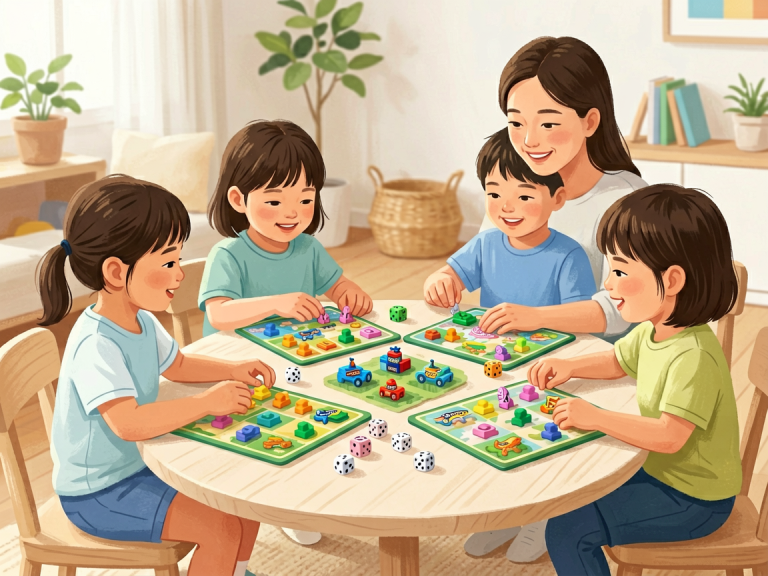
Look for Toys That Encourage Adult-Child Interaction. No toy can replace a human caregiver. The most impactful language toys are those that invite a parent or sibling to join in. For instance, a simple matching game (e.g., memory cards with pictures and words) becomes a conversational exercise when the adult says “You found the dog! Where is the bone?” The toy itself is a prop; the real learning happens in the dialogue around it. Avoid toys that are designed to replace adults (e.g., electronic devices that read stories aloud without pausing for interaction). Research consistently shows that live interaction, with its contingent responses, emotional warmth, and scaffolding, is far superior for language growth.
Practical Activities: Turning Any Toy into a Language Tool
Even without specialized toys, parents can enhance language learning through attentive play. For example, a simple set of stacking cups can be used to practice prepositions: “Put the blue cup *under* the red cup.” A ball can become a lesson in verbs: “I *throw* the ball. Now you *catch* it.” The key is to narrate the child’s actions in real time—a technique called “self-talk” and “parallel talk.” Self-talk means describing what you are doing (“I am building a tower”), while parallel talk describes what the child is doing (“You are putting the green block on top”). Studies show that this constant verbal commentary, even with ordinary toys, expands a toddler’s vocabulary by up to 30% over six months.
Another powerful activity is “dialogic reading,” where the adult asks open-ended questions while looking at a picture book. Instead of simply reading the words, the adult prompts: “What do you think the bunny will do next?” or “What color is the hat on that bear?” This turns a book into an interactive language toy. For toddlers who are pre-verbal, pointing and vocalizing (e.g., “Ba-ba?”) can be reinforced by the adult naming the object (“Ball! Yes, that’s a ball.”).
Conclusion: Toys as Catalysts, Not Teachers
Language development in toddlers is a marvel of nature and nurture, but toys can tilt the balance toward richer, faster growth. The best language toys are those that spark curiosity, invite conversation, and adapt to the child’s growing abilities. Yet they remain just one piece of the puzzle. A child surrounded by a thousand electronic gadgets but spoken to infrequently will lag behind a child who has only a few simple blocks but a parent who talks, sings, and listens. As we choose language toys for toddlers, let us remember that the ultimate “toy” is the human voice—warm, responsive, and full of meaning. The toys we buy are merely amplifiers for that voice, turning every giggle, grunt, and babble into the foundation of a lifelong love of language.