Building Language Through Play: Essential Toys for 5-Year-Olds
Introduction
At age five, children are in a critical window for language development. Their vocabulary is expanding rapidly—from roughly 2,000 words at age four to over 5,000 by age six—and they are beginning to master complex sentence structures, storytelling, and even early literacy skills. While formal education plays a role, the most natural and effective way for five-year-olds to build language is through play. The right toys can transform ordinary moments into rich opportunities for conversation, narration, and linguistic exploration. This article explores the best types of toys for supporting language development in five-year-olds, explaining how each category fosters specific skills such as vocabulary acquisition, phonemic awareness, narrative thinking, and social communication.
1. The Critical Age for Language Growth
Before diving into specific toys, it is important to understand why age five is so pivotal. At this stage, children are moving from simple “here-and-now” language to the ability to talk about past events, future plans, and imaginary scenarios. They begin to understand and use pronouns, prepositions, and verb tenses more accurately. Their sentences grow longer and more complex, and they start to recognize that words are made of sounds—a skill called phonological awareness that underpins reading readiness. Toys that engage their curiosity, encourage them to ask questions, and require them to describe, explain, or negotiate are invaluable. The goal is not just to add words to their repertoire, but to help them use language flexibly and confidently in different contexts.
2. Interactive Storytelling Toys: Igniting Imagination and Vocabulary
One of the most powerful categories for language development is interactive storytelling toys. These include puppets, felt boards with story pieces, magnetic story sets, and even simple hand-held puppets. When a five-year-old uses a puppet to “tell a story,” they must verbally sequence events, create dialogue, and adopt different voices. This process naturally expands their vocabulary (e.g., “The dragon roared ferociously,” “The princess whispered softly”) and teaches them narrative structure—beginning, middle, and end.
Puppets also encourage turn-taking conversation. A child may make the puppet ask a question, then respond as themselves, practicing both question formation and answer formulation. Felt board sets with characters, animals, and objects allow children to physically manipulate elements while narrating, which reinforces the connection between action and language. Look for sets that include diverse characters and open-ended scenarios so the child can create new stories each time. Parents and educators can join in by asking open-ended questions like, “What happened next?” or “Why did the bunny cross the bridge?” These prompts push the child to elaborate and use more descriptive language.
3. Role-Playing and Pretend Play Sets: Encouraging Dialogue and Narrative Skills
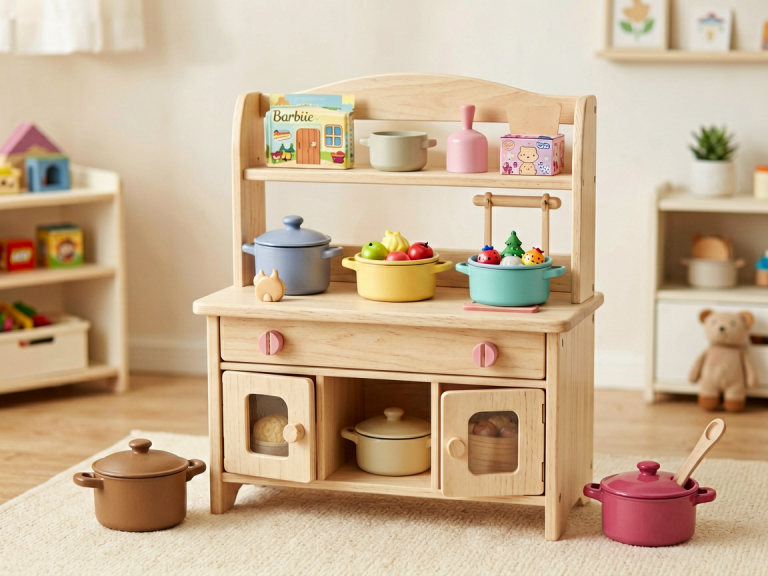
Role-playing toys are another cornerstone of language development. Play kitchens, doctor kits, tool benches, grocery store checkout stands, and dress-up costumes all invite children to step into a character. When a five-year-old pretends to be a cashier, they naturally use transactional language: “That will be five dollars, please,” “Do you have a loyalty card?” “Here is your change.” Similarly, a child playing doctor might say, “Open your mouth and say ‘ah,’” or “I need to listen to your heart.” These scripts are rich with vocabulary specific to the role.
Beyond vocabulary, role-playing builds pragmatic language skills—knowing how to use language appropriately in different social situations. Children learn to take turns speaking, to negotiate roles (“I’ll be the customer first, then you be the customer”), and to adapt their tone and word choice to the scenario. The best toys for this age are those that provide enough realism to spark imagination but not so much detail that they become passive. For example, a simple wooden kitchen with pots and pans encourages more language than an electronic toy that talks by itself. Add props like menus, order pads, and play money to stimulate conversation. When adults participate, they can introduce new vocabulary (“Could I have a subscription to the newspaper?”) and model more complex sentences.
4. Puzzle and Word Games: Developing Phonemic Awareness and Literacy
As five-year-olds become aware that words are made of sounds, toys that focus on letters, sounds, and word construction become powerful tools. Alphabet puzzles, magnetic letters, and simple word-building games like “Boggle Jr.” or “Zingo!” encourage children to match letters to sounds and blend them into words. For example, a puzzle where a child must find the missing letter to complete a picture’s name (e.g., the _ _ t for “cat”) forces them to think about initial and final sounds.
Rhyming games are particularly effective at this age. Toys that ask children to match rhyming pictures (e.g., “What rhymes with ‘hat’?”) strengthen phonemic awareness, which is a strong predictor of reading success. Board games that incorporate oral language, like “Spot It!” or “The Game of Things,” can also be adapted—ask the child to describe a picture without using certain words, or to tell a story about the image. The key is to keep these activities playful and low-stress; forced drilling can backfire. When a child successfully builds a word or finds a rhyme, celebrate their effort, and ask them to use that word in a sentence. This bridges the gap between isolated sound work and meaningful language use.
5. Music and Sound Toys: Enhancing Auditory Discrimination and Pronunciation
Music is a natural vehicle for language. Songs expose children to rhyme, rhythm, and repetition, all of which support phonological development. Toys like simple musical instruments (drums, shakers, xylophones) encourage children to play with tempo and loudness, which can be paired with language games. For example, clap out the syllables in a word together (“di-no-saur” = three claps) or sing a familiar song and pause for the child to supply the next word.
More targeted sound toys include puzzles that play animal noises, letter sounds, or simple phrases when a button is pressed. While electronic toys can be engaging, the best ones demand an active response from the child, such as “What sound does a cow make?” followed by the child repeating it. Avoid toys that passively play long monologues; instead, seek those that require the child to imitate or answer. Additionally, listening to audiobooks or story recordings with accompanying sound effects can help children connect auditory cues with narrative—and later, retell the story in their own words. Parents can also create homemade instruments (e.g., rice in a container) and sing rhyming songs, modeling clear pronunciation and exaggerated mouth movements to help children hear and replicate sounds.
6. Building Blocks and Construction Kits: Promoting Descriptive Language and Collaboration
Construction toys like wooden blocks, LEGO Duplo, magnetic tiles, and large building bricks are often overlooked for language development, yet they are exceptionally rich in linguistic opportunities. When a five-year-old builds a tower or a castle, they must plan, describe, and problem-solve verbally. “I need the red block next,” “This piece is too big for that spot,” “Let’s make a ramp so the car can go down.” These utterances involve spatial vocabulary (above, below, beside, through), adjectives (long, short, heavy, light), and verbs (stack, balance, attach, tumble).
If two children are building together, they must negotiate, share ideas, and explain their designs: “How about we put the door here?” “No, the door should be in front so the knights can come out.” This collaborative language is crucial for social communication and perspective-taking. Adults can guide the play by asking descriptive questions: “Tell me about your creation,” “Why did you choose that shape?” “What will happen if we add another block on top?” Such prompts push the child to use more complex syntax and to elaborate their thinking. Construction toys also lend themselves to storytelling—a tower becomes a princess’s castle, a few blocks become a spaceship—and children will naturally narrate the action as they build.
7. Choosing the Right Toys: Tips for Parents and Educators
Not all toys marketed as “educational” truly support language development. Here are practical tips for selecting the best toys for a five-year-old:
- Prioritize open-ended toys. Toys that can be used in multiple ways (blocks, puppets, play dough) generate more language than those with a single, predetermined function.
- Look for opportunities for back-and-forth interaction. Avoid toys that talk at the child; choose toys that require the child to talk back.
- Include story elements. Toys that come with characters, settings, or props naturally inspire narrative creation.
- Encourage physical manipulation. Moving pieces, arranging objects, and building with hands reinforces vocabulary associated with action and space.
- Mix alone time and social play. Some language skills (like private speech during solitary building) are just as valuable as conversational skills learned with peers.
- Rotate toys regularly. A fresh selection keeps a child’s curiosity alive and prevents boredom, which in turn maintains their willingness to talk and explore.
8. Conclusion: The Lasting Impact of Play-Based Learning
Language development in five-year-olds does not require expensive screens or structured lessons; it thrives on meaningful, joyful interactions with the people and objects around them. By choosing toys that encourage storytelling, role-playing, word play, musical exploration, and collaborative construction, parents and educators can turn every play session into a language-building adventure. The words a child learns while pretending to be a chef or negotiating a block tower will stick far more than any flashcard drill. Moreover, these playful experiences foster confidence, creativity, and a love of communication that will serve the child for a lifetime. So the next time you shop for a five-year-old, remember: the best toy is one that starts a conversation.