The Thoughtful Parent’s Guide to Choosing Age‑Appropriate Toys for Preschoolers
Introduction
Walk into any toy store today, and you will be greeted by a dazzling – and often overwhelming – array of colours, sounds, and flashing lights. For parents of preschoolers (children aged roughly three to five), the pressure to pick the “right” toy can be intense. Yet the best toys are not necessarily the loudest or the most expensive. They are the ones that match a child’s developmental stage, spark curiosity, and encourage meaningful play. This guide will help you navigate the toy aisle with confidence, ensuring that every purchase supports your preschooler’s growth in safe, engaging, and age‑appropriate ways.
1. Understanding the Preschooler’s Developmental Landscape
Before selecting any toy, it helps to step back and consider what is happening inside a three‑ to five‑year‑old’s mind and body. At this stage, children are moving beyond simple sensorimotor play into more symbolic, imaginative, and social forms of interaction.
- Cognitive leap: Preschoolers are developing memory, problem‑solving skills, and the ability to think about things that are not immediately present (what psychologists call “representational thought”). They love pretend play, sorting objects, and simple board games that require turn‑taking.
- Language explosion: Their vocabulary grows rapidly, and they begin to tell stories, ask endless “why” questions, and use language to negotiate with peers. Toys that prompt conversation – such as puppets, picture books, and playsets with figures – are especially valuable.
- Motor skills: Large muscle skills (running, jumping, climbing) are becoming refined, while fine motor control (using scissors, drawing, buttoning) is still developing. Toys that challenge both areas – like tricycles for gross motor and threading beads for fine motor – are ideal.
- Social‑emotional growth: Preschoolers start to understand sharing, empathy, and cooperation – though not always consistently. They also wrestle with big emotions such as frustration and jealousy. Toys that allow for cooperative play (e.g., simple board games or building sets) and toys that help them express feelings (e.g., dollhouses or animal families) can be powerful tools.
2. Safety First: Non‑Negotiable Criteria
Age‑appropriateness is also a safety matter. The U.S. Consumer Product Safety Commission and similar agencies worldwide issue strict guidelines, but parents need to look beyond the label.
- Avoid small parts: Children under three are still prone to mouthing objects. For preschoolers, small parts remain a choking hazard, especially for three‑year‑olds. The golden rule: if a toy can fit inside a toilet paper roll, it is too small for a young preschooler.
- Check for sharp edges and toxic materials: Look for toys made from non‑toxic, BPA‑free plastics or sustainably sourced wood. Ensure that painted surfaces are lead‑free and that fabric toys are flame‑resistant. If the toy has batteries, the battery compartment should be secured with a screw – not a sliding door that a curious child can open.
- Consider durability: Preschoolers are not gentle. Toys that break easily can create sharp pieces. Invest in well‑constructed toys that can withstand rough handling and the occasional drop.
3. Categories of Toys That Match Preschoolers’ Needs
Rather than chasing trends, focus on toy categories that align with developmental milestones. Here are four essential types.
3.1. Imaginative & Pretend Play Toys
Pretend play is the engine of a preschooler’s cognitive development. When a child pretends to be a doctor, a chef, or a superhero, she practices language, empathy, and problem‑solving.
- Dress‑up costumes (simple hats, capes, vests) allow children to step into different roles.
- Play kitchens, tool benches, and doctor kits provide a framework for storytelling.
- Puppets and dollhouses invite dialogue and emotional exploration.
3.2. Construction & Building Toys
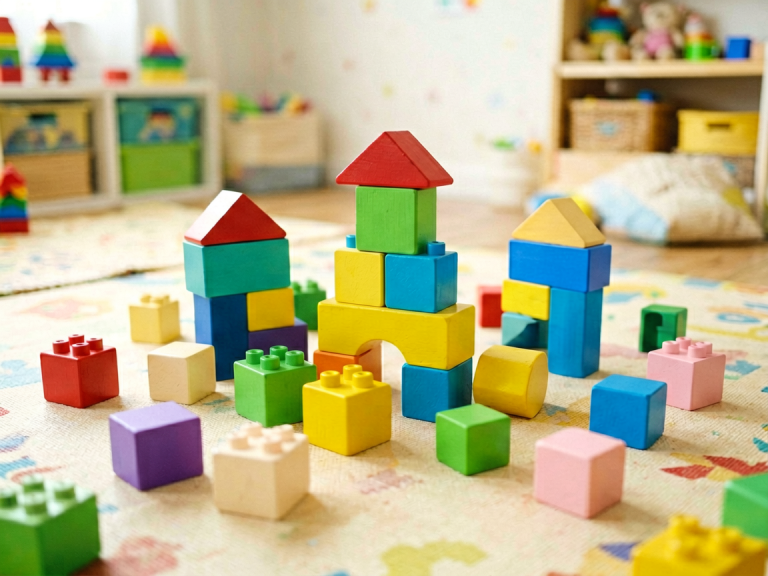
Building toys teach spatial awareness, cause and effect, and persistence. A preschooler learns that a tower must have a broad base to stay upright – a lesson in physics that feels like pure fun.
- Large wooden blocks (e.g., unit blocks) encourage open‑ended building.
- Duplo‑style bricks (larger than standard LEGO) are perfect for small hands.
- Magnetic tiles (such as Magna‑Tiles) offer bright colours and easy assembly.
3.3. Art & Fine Motor Materials
Fine motor coordination is being honed daily. Art activities also foster creativity, self‑expression, and decision‑making.
- Washable crayons, markers, and finger paints – always opt for non‑toxic.
- Child‑safe scissors and play dough allow cutting and moulding.
- Beads with thick strings or lacing cards help with hand‑eye coordination.
3.4. Active & Gross Motor Toys
To balance all the seated play, preschoolers need opportunities to move. Active play strengthens muscles, improves balance, and releases energy.
- Tricycles, balance bikes, and scooters (with proper safety gear).
- Soft balls, beanbags, and parachutes for throwing and catching.
- Indoor or outdoor tunnels that invite crawling and hiding.
4. The Pitfall of “Educational” Marketing
Many toys are marketed as “educational” or “STEM,” but the label alone does not guarantee developmental value. A toy that claims to teach the alphabet but only flashes letters while the child passively watches may do more harm than good. True learning occurs when the child actively engages – manipulating, experimenting, and creating.
Ask yourself: Does the toy have a single “right” answer, or does it allow multiple outcomes? A puzzle has a single solution and that is fine for building logical skills. But a set of building blocks has infinite possibilities; that open‑endedness is what fuels a preschooler’s curiosity. The best toys are 90% child and 10% toy – meaning the child’s imagination does most of the work.
5. Avoiding Over‑Stimulation: Less Screen, More Interaction
Flashy electronic toys that light up and talk can captivate a preschooler’s attention, but they often do so by overwhelming the senses. When a toy makes all the decisions (telling the child what to do, when to press a button, and what sound follows), the child becomes a passive recipient. This can hinder the development of attention span and self‑directed play.
Instead, choose toys that require the child to be the active agent. A simple wooden train set, for example, lets the child decide where the tracks go, how fast the train moves, and what story unfolds. The toy does not sing – the child sings. For screen‑based play, if you do introduce an educational app, limit it to 15–20 minutes per day and always participate alongside your child to talk about what is happening.
6. Practical Tips for the Shopping Trip
- Read reviews from other parents and occupational therapists. They often highlight whether a toy is truly durable and engaging.
- Look for open‑ended toys that grow with the child. A set of colourful scarves can be used for dancing, for building nests in pretend play, or for learning colours – and it costs very little.
- Resist buying too many toys at once. Studies show that children play more creatively with fewer options. A cluttered playroom can overwhelm a preschooler, leading to shorter play sessions. Rotate toys every few weeks to keep them fresh.
- Involve your child in the choice – but within limits. You can say, “We are going to pick one building toy today. Do you want the magnetic tiles or the wooden blocks?” This gives the child a sense of agency while keeping you in control of appropriateness.
7. Conclusion: Play Is the Work of Childhood
Choosing age‑appropriate toys for a preschooler is not about finding the perfect item that will turn your child into a genius overnight. It is about providing the raw materials for joy, discovery, and connection. A toy is a tool – and the most important part of preschool play is the relationship between the child and the adult who plays alongside them. Whether you are building a tower of blocks that topples with a laugh, or acting out a tea party with stuffed animals, you are building something far more lasting than any toy: a foundation of curiosity, confidence, and love for learning.
Remember the golden principle: The best toy is one that invites your child to ask “what if…” and then gives them the freedom to find out. Choose wisely, play wholeheartedly, and watch your preschooler flourish.
*Word count: approximately 1,280 words (including title and structure).*