Building Early Foundations: Playful Activities for Babies to Develop Number Sense
Introduction
The early years of life are a period of extraordinary neural growth, with the brain forming up to one million new connections every second. While many parents focus on language development, motor skills, and social bonding, a less obvious but equally vital domain is mathematical thinking. Number sense — the intuitive understanding of quantities, comparisons, patterns, and order — does not require formal lessons or worksheets. For babies, the most powerful learning tool is play. Through simple, joyful, and repetitive interactions, caregivers can plant the seeds of numerical intuition long before a child can speak or count. This article explores the concept of number sense in infancy and provides a comprehensive guide to age-appropriate play activities that build this fundamental cognitive skill.
Why Number Sense Matters for Babies
Number sense is not about rote memorization of digits. It is a deep, instinctive grasp of how numbers work: recognizing “more” versus “less,” understanding one-to-one correspondence, detecting patterns, and eventually grasping concepts like addition and subtraction in concrete form. Research shows that early number sense is a stronger predictor of later academic success in mathematics than early reading skills. Babies as young as six months can distinguish between sets of one and two objects, and by twelve months, they notice when an unexpected number of objects appears. By embedding number-rich experiences into daily play, caregivers help babies build the neural pathways necessary for future mathematical reasoning. Moreover, these activities strengthen bonding, language development, and sensory awareness — all while being delightfully fun.
Practical Play Activities for Building Number Sense
The following activities are organized by developmental stage and incorporate common household items and routines. They are designed to be simple, low-cost, and easily integrated into a baby’s natural day.
1. Sensory Counting Games (0–6 Months)
Even the youngest babies are sensitive to quantity and rhythm. Newborns can perceive patterns in sound and movement, laying the groundwork for number sense.
Activity: Gentle Finger Counting
Lay your baby on a soft mat or hold them in a comfortable position. Take their tiny hand and gently touch each finger one at a time while softly saying, “One little finger, two little fingers, three little fingers…” up to five. Repeat with toes. The combination of tactile sensation, rhythmic speech, and one-to-one touch introduces the concept that each finger is a separate “unit.” Over time, babies begin to anticipate the sequence — a precursor to ordering.
Activity: Alternating Sounds and Silences
Use a rattle or a soft shaker. Shake it once, pause, then shake it twice in quick succession, saying “one… one, two.” Shake it three times, saying “one, two, three.” This helps babies detect changes in quantity through auditory input. Even if they cannot see the objects, their brains are comparing the number of sound events.
2. Object Permanence and Quantity (6–9 Months)
At this age, babies begin to understand that objects continue to exist even when hidden. They also show a clear preference for looking at sets with a typical number of items (e.g., two biscuits) versus an unexpected number (e.g., three biscuits when only two were shown). Exploit this natural curiosity.
Activity: Magic Cup Reveal
Take three identical cups and a small soft toy or a few blocks. Place one block under one cup, two blocks under another, and three under the third. Let your baby watch as you hide them. Then encourage them to lift each cup. Exclaim with delight: “Wow! One block! Look, two blocks! And here — three blocks!” Do not force counting; instead, emphasize the visual difference between one, two, and three. Repeat with different objects, keeping the quantities small (one to three). This activity reinforces the idea that different quantities look different.
Activity: “More” vs. “Less” on the High Chair
During snack time, place a few puffs or soft berries on the tray. Put two pieces on one side and five on the other. Point to the side with fewer pieces and say, “This side has a little.” Then point to the side with more: “This side has a lot!” Let your baby grab from either side. Over time, they will develop an intuitive sense of relative quantity. You can vary the contrast: one vs. three, two vs. six. Avoid using numbers as labels at first; focus on the concepts of “more” and “less.”
3. Pattern and Sequence through Songs and Movement (9–12 Months)
Patterns are the building blocks of mathematics. Recognizing sequences — such as the order of verses in a song or the rhythm of a dance — develops the same cognitive structures used for number sequencing and algebraic thinking.
Activity: Counting Rhymes with Body Motions
Songs like “One, Two, Buckle My Shoe” are classic for a reason. Sing them while moving your baby’s arms or legs in time with each number. For example, for “One, two,” lift their left arm then right arm. For “Three, four,” tap their feet. The physical enactment creates a multisensory map of the counting sequence. Another powerful rhyme is “Five Little Ducks” — hold up one finger for each duck as it disappears. Babies love the repetition and the visual disappearance of each “duck,” which reinforces subtraction in a concrete way.
Activity: Simple Pattern Clapping
Sit facing your baby. Clap your hands once, then twice, then once, then twice — a simple AB pattern. Pause and look expectantly. Many babies will try to mimic the pattern, even if clumsily. Celebrate their attempts. You can also use drumming on a pot lid or tapping on a table. Patterns of sound and movement help babies understand order and repetition, fundamental to number sense.
4. Everyday Routines Turned into Number Play (0–12 Months)
The most effective learning happens in authentic contexts. Diaper changes, bath time, and feeding offer endless opportunities for number-rich interactions.
Diaper-Changing Counting
Count your baby’s toes or fingers while changing them: “One toe, two toes, three toes… let’s count them all!” Use the same sequence every time. Soon your baby will recognize the rhythm of counting even before understanding the words. You can also describe quantities in the environment: “Look, there is one duck on the wall. Now I see two ducks. Where is the third one?”
Bath Time Pouring and Filling
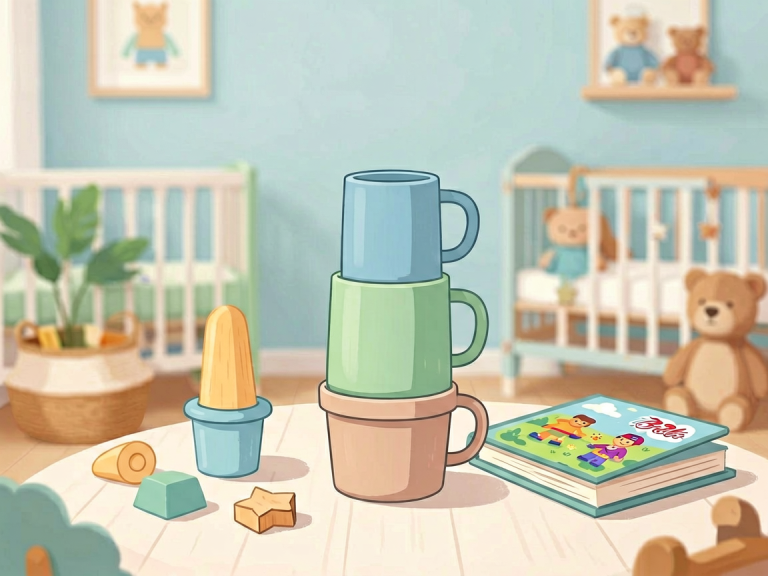
Provide a set of stacking cups or measuring cups of different sizes. Let your baby pour water from one cup to another. Use words like “full,” “empty,” “more,” and “less.” When they fill a small cup and then a larger cup, narrate: “Oh, the big cup holds more water. The small cup holds less.” These comparative words lay the foundation for understanding magnitude and measurement.
Mealtime Sorting
Around 9–12 months, babies enjoy sorting. Offer a tray with two compartments. Place a few pieces of soft fruit in one and a few pieces of cereal in the other. As your baby picks up an item and moves it, say, “You are moving the banana piece. Now there is one less banana on the tray.” Simple commentary about change in quantity is more powerful than formal counting.
5. Nature and Object Exploration (6–12 Months)
The natural world is filled with patterns, quantities, and symmetries. Taking learning outdoors enriches number sense through diverse stimuli.
Leaf and Stone Collections
While on a walk, collect a few leaves or small stones. Sit with your baby and lay them out. Count them aloud: “One leaf, two leaves, three leaves.” Then ask, “Can you give me one leaf?” If they hand you one, celebrate. If they hand you more, simply say, “That’s two leaves! I asked for one. Let’s put one back.” This teaches one-to-one correspondence in a gentle, unpressured way.
Stacking and Nesting Toys
Classic stacking rings or nesting cups are invaluable. They naturally teach sequences of size — a form of ordinality (first, second, third). As your baby tries to stack rings, narrate: “The big ring goes on first. Then the medium ring. Then the small ring.” Even if your baby cannot yet do it independently, they absorb the language of order.
6. Board Books with Number Themes (6–12 Months)
High-contrast board books that feature one object per page are excellent. Choose books where the images are simple and the quantity clearly visible — for example, one cat, two dogs, three hats. Read slowly, pointing to each object as you count. Encourage your baby to touch the page. The combination of visual, tactile, and auditory input solidifies the concept that each object is a separate “unit.”
Interactive Counting Books
Books with flaps, textures, or holes (e.g., “Ten Little Fingers and Ten Little Toes” or “Counting Kisses”) invite participation. As you lift a flap, say, “How many bears are hiding? One, two!” Let your baby feel the raised textures. The multisensory engagement deepens memory.
Conclusion
Building number sense in infancy is not about producing a prodigy; it is about creating a rich cognitive environment where patterns, quantities, comparisons, and sequences are woven into the fabric of daily life. The activities described above are gentle, joyful, and developmentally appropriate. They require no expensive materials, only a caregiver’s presence and intention. By counting toes, singing rhythmic songs, exploring “more” and “less” during snacks, and marveling at the way three blocks fit inside a cup, parents and caregivers offer their babies a gift that will serve them for a lifetime: a confident, intuitive relationship with numbers. Remember, the goal is not to test or drill but to play with purpose. Every giggle, every repeat, every curious grab for one more object is a small step toward mathematical understanding. In these quiet, everyday moments, the seeds of number sense are planted — and they will flourish.