The Power of Play: Selecting Toys to Foster Language Development in Toddler Girls
Introduction
Language development in the toddler years is a remarkable journey, marked by rapid vocabulary expansion, the emergence of simple sentences, and a growing ability to express thoughts and emotions. For toddler girls, who are often socialized to engage in more verbal and relational play, toys can serve as powerful catalysts for this linguistic growth. However, not all toys are created equal. To truly support language development, toys must invite conversation, storytelling, imitation, and problem-solving—activities that naturally build vocabulary, syntax, and pragmatic skills. This article explores how carefully chosen toys can transform playtime into a rich language-learning experience for toddler girls, offering practical guidance for parents, educators, and caregivers.
The Critical Window of Language Acquisition in Toddlerhood
From around 12 to 36 months, a child’s brain is exceptionally receptive to language input. During this period, toddlers learn an average of two to three new words per day, and their ability to understand and produce speech grows exponentially. For girls, research suggests slightly earlier verbal milestones on average, with more advanced vocabulary and sentence length by age two compared to boys—though individual variation is vast. This early advantage is often linked to environmental factors, including the types of interactions and toys they encounter.
Toys that encourage back-and-forth communication—what developmental psychologists call "serve and return" interactions—are especially valuable. When a toddler offers a toy phone to her parent and says “Hello,” the parent’s response (“Hi! Who are you calling?”) models conversational turn-taking. Similarly, toys that require labeling, describing, or narrating actions help cement new words. Understanding this developmental window helps us select toys that align with the child’s current abilities while gently stretching them toward the next stage.
Characteristics of Effective Language-Building Toys
Not every colorful, musical, or popular toy supports language acquisition. Effective language-building toys share several key characteristics:
- Open-endedness: Toys that can be used in multiple ways (e.g., blocks, dollhouses, play food) encourage diverse vocabulary and creative narratives. A simple wooden block can become a “house,” a “car,” or a “cake” depending on the child’s imagination, prompting her to label and explain.
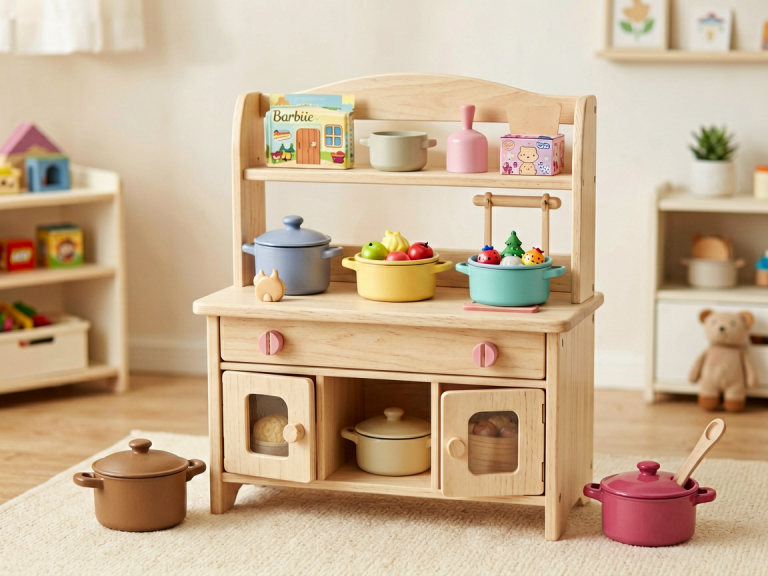
- Real-world relevance: Toys that mimic everyday objects—kitchen sets, doctor kits, telephones, shopping carts—allow toddlers to practice the language of daily routines. A toddler girl pretending to cook might say, “I need milk,” “Stir the soup,” or “Hot, careful!”—all rich language moments.
- Interactive and responsive: Toys that react to the child’s actions (e.g., a talking doll that repeats phrases, a toy cash register that says “Thank you”) can model language patterns, though they should not replace human interaction. The best interactive toys are those that prompt the child to respond verbally.
- Social facilitation: Toys designed for two or more players—such as simple board games, puppets, or tea sets—naturally foster dialogue, negotiation, and shared stories.
- Sensory variety: Toys with different textures, sounds, and visuals engage multiple senses, which can enhance word retention (e.g., a plush animal with a squeaker that the child names and describes).
Top Toy Categories for Enhancing Vocabulary and Communication
- Role-Play and Pretend Play Sets
Dollhouses, kitchen sets, doctor kits, and dress-up costumes are goldmines for language development. When a toddler girl puts her stuffed bunny to bed, she might say, “Night-night, bunny, sleep,” or “Cover you up.” These scenarios require her to recall and use words related to daily routines: “blanket,” “pillow,” “hungry,” “boo-boo.” Role-play also encourages the use of verbs (feed, rock, brush) and prepositions (in, on, under). For optimal effect, adults can join the play and ask open-ended questions: “What does the baby need next?” or “Where should we put the plate?”
- Picture Books and Storytelling Props
Board books with simple text, clear illustrations, and repetitive phrases are classics for a reason. Touch-and-feel books, lift-the-flap books, and books with sound buttons add interactive elements that reinforce vocabulary. Beyond reading aloud, parents can use puppets or felt-board figures to act out stories, encouraging the toddler to narrate. For example, after reading *Brown Bear, Brown Bear*, a child might point to a stuffed bear and say “Brown bear!”—then giggle when Mom responds, “Yes! What does the brown bear say?” This repeated exposure builds both comprehension and expressive language.
- Musical Instruments and Sing-Along Toys
Rhythm and melody are natural language catalysts. Simple instruments like shakers, drums, and xylophones invite toddlers to create sounds and sing along. Songs and nursery rhymes (e.g., “Twinkle, Twinkle, Little Star,” “Itsy Bitsy Spider”) have predictable patterns and rhymes that help children anticipate words and learn phonetic awareness. A toddler girl who chants “Rain, rain, go away” while shaking a rain stick is practicing intonation, rhythm, and vocabulary. To maximize language benefits, parents can sing together, pause for the child to fill in a word (“Twinkle, twinkle, little ____”), and then celebrate the correct response.
- Puzzles and Matching Games
While often classified as cognitive toys, puzzles and matching games indirectly support language by requiring children to name objects, colors, shapes, and positions. A “beginner” floor puzzle of farm animals invites the child to say “pig,” “cow,” “horse” as she places each piece. Add prompts like “Where does the chicken go? Next to the barn?” to introduce spatial vocabulary. Memory card games with familiar images (fruits, animals, toys) encourage the child to request specific cards: “I want the apple,” or “You found the cat!” The act of requesting and describing is fundamental to conversational competence.
- Construction and Building Sets
Large interlocking blocks (e.g., Duplo, Mega Bloks) or magnetic tiles encourage toddlers to build and talk about their creations. A girl stacking blocks might announce, “I make a tall tower!” When it falls, she says, “Uh-oh, crash.” An adult can extend the language by asking questions: “Which color block is on top?” or “How many blocks did you use?” These exchanges teach number words, color names, and cause-and-effect vocabulary.
- Interactive Electronic Toys (Used Judiciously)
Some electronic toys—such as tablets with educational apps designed for toddlers, or talking storybooks that highlight words as they read—can supplement language learning. However, the American Academy of Pediatrics recommends limiting screen time for toddlers and prioritizing hands-on, interactive play. When used thoughtfully (e.g., a parent co-using the device, asking the child to repeat a word that the toy said), electronic toys can reinforce vocabulary. But they should never replace the rich, responsive back-and-forth of human conversation.
Role of Interactive Play and Adult Engagement
The most expensive or sophisticated toy is useless without a caring adult who engages with the child. Language development thrives in a social context. When a parent sits on the floor with her toddler girl and a tea set, she can model language: “Would you like some tea? It’s hot, blow on it.” The toddler will imitate, and over time, her utterances will become more complex. Research shows that the number of conversational turns—not just the number of words a child hears—is a strong predictor of later language and cognitive outcomes.
Adults can scaffold language by using techniques such as:
- Expansion: Repeating the child’s utterance and adding a word or two. Child: “Doggy eat.” Parent: “Yes, the doggy is eating his food.”
- Open-ended questions: Instead of “Is the car red?” ask, “What color is the car? Where is it going?”
- Narration: Describing what the child is doing as she plays. “You’re putting the doll in the bath. Now you’re pouring water.” This reinforces vocabulary in context.
- Choice questions: “Do you want the blue cup or the red cup?” encourages the child to use words to make decisions.
Equally important is letting the child lead the play. When a toddler girl picks up a toy phone and pretends to call Grandma, the adult can follow her lead: “Oh, you’re calling Grandma? Tell her what we had for lunch.” This validates the child’s initiative and expands the conversation organically.
Addressing Gender Stereotypes: Choosing Inclusive Toys
While the phrase “toys for toddler girls” may evoke pink aisles filled with dolls and kitchen sets, it is crucial to avoid reinforcing limiting gender stereotypes. Language development benefits from a range of experiences, including blocks, trains, puzzles, and science-themed toys. Girls who are encouraged to play with a variety of toys develop broader vocabulary and problem-solving skills. For instance, playing with a simple construction set introduces words like “balance,” “tilt,” “stack,” and “foundation,” which are less likely to appear in dramatic play with dolls alone.
Therefore, when selecting toys for a toddler girl, consider her individual interests rather than assuming she will prefer traditionally “feminine” toys. A girl who loves animals might thrive with a set of plastic zoo animals and a matching book; a girl who enjoys movement might love a push-along train or a toy lawn mower. The key is to offer diverse options and follow her cues. Language acquisition is most robust when the child is genuinely engaged, regardless of the toy’s gender marketing.
Practical Tips for Parents and Caregivers
- Rotate toys regularly to maintain novelty and interest. A small selection of well-chosen toys is more effective than a cluttered playroom.
- Create a language-rich environment by labeling toy bins (“Blocks,” “Animals,” “Books”) and talking about what you see during cleanup.
- Read toy reviews that specifically mention language development features, such as sets with multiple accessories that inspire storytelling.
- Avoid toys that talk too much in ways that prevent the child from speaking. Some electronic toys produce constant noise or only require pressing a button, which can discourage the child’s own vocalizations. Look for toys that pause for a response.
- Incorporate everyday objects as toys. A cardboard box can become a car, a house, or a spaceship, generating endless language about directions, destinations, and adventures.
- Model patience and celebration when the child makes language errors. Instead of correcting directly, repeat the correct form naturally. Child: “I goed store.” Parent: “You went to the store? What did you see?”
Conclusion
Toys are not merely distractions; they are tools for discovery, connection, and growth. For toddler girls, the right toys—combined with attentive, responsive adults—can unlock the doors to language development, building a strong foundation for literacy, social skills, and self-expression. Whether it’s a wooden dollhouse that inspires a story about a family, a set of musical instruments that turns a living room into an orchestra, or a stack of colorful blocks that becomes a tower to talk about, every playful moment holds the potential to add new words to a child’s world. By choosing toys intentionally and engaging in the play ourselves, we nurture not only language but also the joy of communication that will last a lifetime.