The Timeless Value of Screen-Free Educational Toys: Nurturing Minds Beyond the Digital Glow
In an era where children’s bedrooms are increasingly outfitted with tablets, smartphones, and interactive screens, the quiet hum of a spinning top or the satisfying click of interlocking wooden blocks may seem almost archaic. Yet the case for screen-free educational toys has never been stronger. Neuroscience, developmental psychology, and classroom practice all converge on a simple truth: the most profound learning often happens when a child’s hands are busy, their imagination is unscripted, and their attention is not hijacked by an algorithmically curated feed. Screen-free educational toys are not merely nostalgic relics; they are essential tools for cultivating deep concentration, fine motor skills, social collaboration, and creative resilience. This article explores why these analogue treasures remain indispensable, how they support holistic development, and which types of toys offer the richest learning experiences.
## The Cognitive Benefits of Hands-On Play
Cognitive development in early childhood is anything but passive. When a child manipulates physical objects—stacking blocks, fitting puzzle pieces, threading beads—their brain forms neural pathways that are fundamentally different from those activated by swiping a screen. The reason lies in the multisensory nature of tangible toys. Touching, grasping, lifting, and balancing engage the somatosensory cortex, the motor cortex, and the visual-spatial system simultaneously. This integrated activity strengthens the connections between brain regions responsible for planning, sequencing, and cause-and-effect reasoning.
Research in developmental neuroscience has shown that open-ended, screen-free toys promote what psychologist Jean Piaget called “constructive play.” In constructive play, children create something new—a tower, a bridge, a story told through figurines—and in doing so, they build mental models of how the world works. A simple set of wooden unit blocks, for example, teaches intuitive physics: a wide base offers stability, a tall column is prone to toppling, and a well-placed arch distributes weight. No animated app can replicate the kinesthetic feedback of a collapsing block tower, nor the pride of rebuilding it just a little bit stronger.
Furthermore, screen-free educational toys encourage sustained attention. Unlike digital games that bombard children with rapid rewards—dings, sparkles, level-ups—a physical toy offers slower, more predictable feedback. A child threading a lace through a wooden bead must focus sequentially: hold the lace steady, align the hole, push through. This process trains executive functions such as inhibitory control (resisting the urge to yank the lace) and working memory (remembering the pattern). A 2019 study published in *Pediatrics* found that toddlers who played with traditional blocks, puzzles, and shape sorters demonstrated stronger language and math readiness scores than those who used electronic learning devices. The researchers attributed this to the “contingent, reciprocal, and socially rich interactions” that occur with tangible toys—interactions that screens, even the most interactive ones, fail to fully replicate.
## Social and Emotional Development Through Tangible Interaction
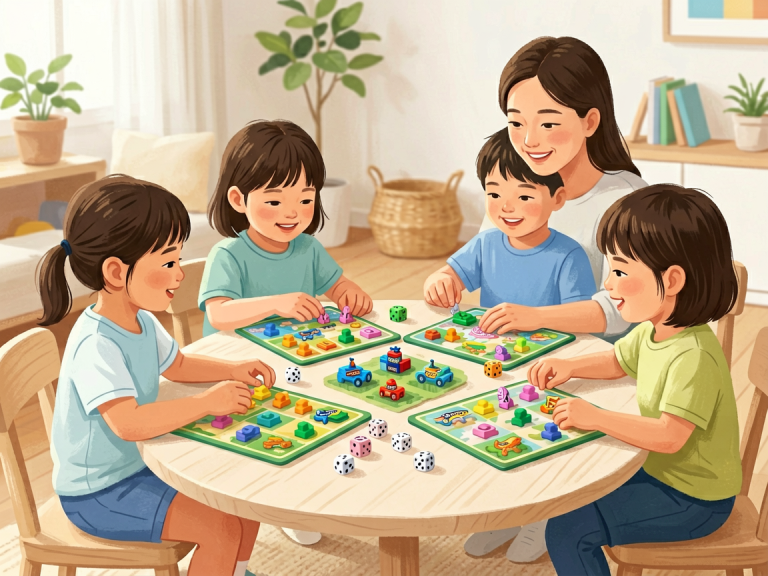
One of the most overlooked advantages of screen-free toys is their ability to foster genuine human connection. When children play together with a physical toy, they must negotiate, share, take turns, and read each other’s nonverbal cues. A magnetic building set demands that two children agree on where the next piece goes; a board game requires them to manage frustration when they lose; a puppet theater invites them to co-construct a narrative, assigning roles and resolving conflicts in the plot. These are the raw materials of emotional intelligence.
In contrast, screen-based play is often solitary or parallel. Even multiplayer video games mediated by a screen reduce face-to-face contact. Children may shout commands at a headset, but they miss the subtle signals—a furrowed brow, a hesitant hand, a small smile of triumph—that teach empathy. Screen-free toys, by their very nature, anchor children in the same physical space. A simple wooden train set placed on a carpet becomes a social microcosm: one child lays track, another pushes the engine, a third suggests adding a bridge made of blocks. The negotiation over which piece goes where, or who drives the train first, is a miniature lesson in collaboration and compromise.
Moreover, screen-free toys offer emotional safety that digital environments often lack. A child who fails to balance a row of dominoes feels a disappointment that is immediate yet private—there is no leaderboard, no friend count, no algorithm judging their performance. This kind of low-stakes failure teaches resilience. The child can simply try again, adjusting their hand or angle, without the anxiety of a permanent digital record. Over time, this builds a growth mindset: the understanding that effort, not innate talent, leads to improvement.
## Encouraging Creativity and Problem-Solving
Creativity flourishes best in conditions of constraint and freedom—a paradox that screen-free toys resolve beautifully. An open-ended toy like a set of magnetic tiles or a collection of natural loose parts (rocks, shells, fabric scraps) provides no predetermined outcome. There is no “right answer” that the toy expects. This absence of a prescribed script forces children to become authors of their own play. They must decide: Does this shape become a rocket, a castle, a tree, or a dragon? Can I combine these pieces to make a working pulley? What happens if I switch the order of these gears?
Problem-solving, too, is sharpened by the physicality of screen-free toys. Consider a classic wooden marble run. The child must plan the trajectory of the marble, test different inclines, adjust the placement of ramps, and troubleshoot when the marble jumps the track. This trial-and-error process mirrors the scientific method: hypothesis, experiment, observation, revision. Digital versions of marble runs exist, but they lack the embodied cognition of actually holding the pieces, feeling the weight, and seeing the marble roll in three-dimensional space. The physical toy demands that the child’s mind work in tandem with their hands, a synergy that doctoral-level research on embodied cognition confirms is vital for deep understanding.
Additionally, screen-free toys encourage divergent thinking—the ability to generate multiple solutions to a single problem. A set of geometric puzzle pieces can be arranged into countless patterns. A child might first attempt the picture on the box, then decide to create an original design, then realize that two pieces together form a new shape. This flexibility is the hallmark of creative intelligence. By contrast, many digital educational apps present closed problems: match the shape, count the apples, choose the correct answer. While such apps can be useful for drill and practice, they rarely challenge a child to invent their own rules or redefine the play space.
## Types of Screen-Free Educational Toys and Their Unique Roles
Not all screen-free toys are created equal. The most effective ones are thoughtfully designed to align with developmental stages and learning goals. Below is a taxonomy of key categories, each serving a distinct educational purpose.
Building and Construction Toys
Wooden blocks, magnetic tiles, LEGO bricks, and interlocking gears are the workhorses of spatial reasoning and engineering thinking. For toddlers, large chunky blocks encourage gross motor skills and balance. For older children, complex sets with gears, axles, and pulleys introduce mechanical cause and effect. A child who builds a bridge must think about symmetry, load distribution, and material strength—principles that later appear in physics and geometry.
Puzzles and Pattern Toys
Jigsaw puzzles, tangrams, mosaic tiles, and logic mazes develop visual-perceptual skills, pattern recognition, and logical sequencing. A jigsaw puzzle requires the child to hold a mental image of the whole while examining individual pieces—a skill that underpins reading comprehension (seeing how parts fit into the full story). Tangrams, with their set of seven geometric shapes, teach spatial rotation and fraction concepts.
Sensory and Natural Loose Parts
Sensory bins filled with rice, beans, sand, or water, along with scoops, funnels, and containers, provide rich tactile exploration. Natural loose parts like pinecones, acorns, sticks, and pebbles invite open-ended creativity and connection to the outdoors. These toys are especially valuable for young children whose brains are rapidly forming sensory-processing systems. They also support language development as children describe textures, sounds, and actions.
Pretend Play and Role-Playing Sets
Dollhouses, kitchen sets, tool benches, cash registers, and puppet theaters foster narrative thinking, empathy, and social scripting. When a child pretends to be a shopkeeper or a doctor, they practice language conventions—greetings, questions, explanations—and explore emotional scenarios in a safe context. The unstructured nature of pretend play means that children can revisit and revise the story, building deeper understanding of cause and effect in human relationships.
Fine Motor and Manipulative Toys
Lacing beads, pegboards, sewing cards, tweezers-and-basket games, and threading activities strengthen the small muscles of the hand and improve hand-eye coordination. These are crucial pre-writing skills. The repetitive, focused movements also have a calming effect, helping children regulate their own emotional states.
Board Games and Strategy Games
Classic board games like *Candy Land*, *Chutes and Ladders*, *Scrabble Junior*, *Chess*, and *Settlers of Catan* teach turn-taking, counting, reading, strategic forward-planning, and graceful losing. Board games are inherently social and require sustained attention across an entire game session—an increasingly rare skill in a world of short video clips.
## The Role of Parents and Educators in Facilitating Toy-Based Learning
A screen-free toy is only as educational as the context in which it is used. Without adult guidance, a pile of blocks may be simply thrown across the room; with a thoughtful parent or teacher, it becomes a laboratory for physics, collaboration, and perseverance. The key is not to direct the play but to scaffold it.
Parents can enrich play by asking open-ended questions: “What would happen if you put a bigger block underneath?” or “How else could you use these pieces?” They can model problem-solving by talking through their own thinking: “I wonder if this arch will hold. Let me try a different angle.” They can also create a “play invite”—a thoughtfully arranged tray of toys that suggests a theme or challenge without prescribing a specific outcome. For example, placing a set of wooden rainbow blocks next to a picture of a cathedral, along with a book about bridges, invites exploration without dictating the answer.
Educators can integrate screen-free toys into curriculum in powerful ways. A first-grade classroom learning about symmetry can use pattern blocks to build symmetrical designs. A middle school engineering unit can start with a challenge to build a weight-bearing bridge from popsicle sticks and glue, then move on to digital modeling. The physical manipulation creates a concrete anchor for abstract concepts.
It is equally important to limit screen time. The American Academy of Pediatrics recommends no screens for children under 18 months, and no more than one hour per day for children aged 2–5. Screen-free toys fill the gap left by that restriction, offering engaging, developmentally appropriate alternatives that do not overstimulate the developing brain.
## Addressing the Screenification of Childhood: A Balanced Approach
This article is not a blanket condemnation of screens. Well-designed digital tools can teach coding, provide access to information, and connect children with distant relatives. The problem lies in the *proportion*. In many homes, screens have become the default babysitter, the instant pacifier, the sole source of entertainment. The result is a generation of children who may be digitally literate but lack the fine motor control to tie shoelaces, the patience to complete a 100-piece puzzle, or the social grace to negotiate a turn with a physical toy.
A balanced approach reserves time for screen-free, hands-on play every day. It treats the digital device as one tool among many, not the centerpiece of childhood. It values the messiness of play—the scattered blocks, the damp sensory bin, the half-finished fort—over the neatness of a game app. This balance is not easy to achieve in a world where screens are everywhere. But parents and educators who consciously choose screen-free toys are making an investment in their children’s attention spans, creativity, and social-emotional health.
## Conclusion
Screen-free educational toys are far more than quaint artifacts from a pre-digital past. They are precision tools for building the cognitive, social, emotional, and physical foundations that children need to thrive. From the first time a baby pushes a wooden block towards a caregiver and watches it fall, to the moment a ten-year-old carefully adjusts the gear ratio on a homemade lift, tangible toys teach lessons that no app can deliver. They teach cause and effect through direct experience. They teach patience through failure. They teach connection through shared play. And they teach creativity through freedom.
As we navigate the complexities of a technology-saturated world, it is worth remembering that the most powerful learning technology ever invented is still the human hand, guided by a curious mind, engaging with real objects in real space. Screen-free educational toys are not a retreat from the future; they are a foundation for it—a foundation of deep thinking, true collaboration, and unbounded imagination. Let us keep building with them.