The Ultimate Guide to the Best Early Science Toys: Sparking Curiosity in Young Minds
Introduction
In a world increasingly driven by technology and scientific discovery, the foundation of a child’s intellectual growth often begins not in a classroom, but on the living room floor with a handful of colorful blocks, a magnifying glass, or a simple magnet set. Early science toys are more than just playthings; they are the keys that unlock a child’s natural curiosity, encouraging exploration, experimentation, and critical thinking from the very first years of life. The best early science toys transform abstract concepts into tangible, hands-on experiences, making learning feel like an adventure rather than a chore. But with countless options flooding the market, how do parents and educators identify the truly effective tools that nurture a lifelong love for science? This article delves deep into the world of early childhood STEM education, examining the criteria for selecting the best early science toys, exploring the most impactful categories, and offering practical recommendations that balance fun, safety, and educational value. Whether you are a parent of a toddler just beginning to grasp cause and effect or a preschool teacher seeking to enrich your classroom, understanding the power of these toys is the first step toward raising a generation of innovators and problem-solvers.
Why Early Science Toys Matter
The developmental years from birth to age seven are a critical window for cognitive growth. During this period, children’s brains form neural connections at an astonishing rate, and their capacity for absorbing new information is unparalleled. Early science toys capitalize on this plasticity by providing sensory-rich, interactive experiences that lay the groundwork for scientific reasoning. Unlike passive entertainment such as television or apps, these toys require active engagement: a child must push, pull, stack, observe, and question. This active learning process fosters essential skills such as observation, hypothesis formation, experimentation, and logical deduction. For instance, when a two-year-old repeatedly drops a ball from different heights and watches it bounce, they are not just playing—they are unconsciously exploring gravity, energy transfer, and cause-and-effect relationships. The best early science toys are designed to amplify these natural learning moments, scaffolding them into more structured understanding over time.
Moreover, early exposure to science toys helps demystify complex subjects. Children who play with magnifying glasses, simple microscopes, or bug catchers develop a familiarity with the natural world that reduces fear and increases wonder. They learn that asking “why” and “how” is not only acceptable but encouraged. This mindset is invaluable in an era where scientific literacy is essential for informed citizenship. Research from the American Association for the Advancement of Science indicates that children who engage in hands-on science activities before kindergarten demonstrate stronger problem-solving skills and greater enthusiasm for STEM subjects later in school. Additionally, these toys often promote fine motor development, spatial reasoning, and even social skills when played with peers or caregivers. In short, investing in the right early science toys is an investment in a child’s entire intellectual future.
The Best Categories of Early Science Toys
Not all science toys are created equal. The most effective ones align with a child’s developmental stage, offer open-ended play possibilities, and encourage repeated exploration. Below are the five most impactful categories of early science toys, each with specific recommendations that have earned praise from educators, scientists, and parents alike.
Building and Engineering Toys
Building and engineering toys are the undisputed champions of early STEM education. They teach foundational principles of physics, geometry, and structural integrity while simultaneously developing fine motor skills and creativity. The best options in this category go beyond simple stacking blocks; they introduce concepts like balance, leverage, and load distribution through design.
Top Pick: Magzix Magnet Tiles
These translucent magnetic tiles come in various shapes—squares, triangles, rectangles—and snap together easily with built-in magnets. Unlike traditional building blocks that can topple with a slight bump, magnet tiles provide a satisfying click that reinforces spatial awareness. Children as young as 18 months can connect two tiles, while older preschoolers can build elaborate castles, towers, or geometric structures. The tiles also double as light play panels when placed on a light table, introducing concepts of color mixing and transparency. Why do they make the list? Because they grow with the child: a toddler learns fine motor control and cause-and-effect; a four-year-old experiments with symmetry and stability; a six-year-old explores angles and 3D geometry. They are also exceptionally durable and easy to clean—a practical bonus for parents.
Runner-Up: Tegu Magnetic Wooden Blocks
For families who prefer natural materials, Tegu’s sustainably sourced wooden blocks contain hidden magnets. The soft, tactile feel of wood combined with magnetic connectivity offers a unique sensory experience. These blocks encourage imaginative play—a child might build a dinosaur, a rocket ship, or a house—while secretly teaching magnetic polarity (since magnets only attract in certain orientations). The sets are pricey, but their longevity and open-endedness justify the cost. Many parents report that Tegu blocks become heirloom toys passed down through siblings.
Honorable Mention: Learning Resources Gears! Gears! Gears!
This construction set uses interlocking plastic gears, axles, and cranks to create moving machines. Turning a crank rotates a chain of gears, demonstrating how gear ratios affect speed and direction. It’s an excellent introduction to mechanical engineering for children ages three and up, and it pairs well with discussions about cause-and-effect (“What happens when I add a bigger gear?”). The colorful pieces also appeal to young children who may not yet show interest in more abstract building toys.
Nature and Observation Toys
Observation is the bedrock of the scientific method, and nature toys encourage children to slow down, look closely, and ask questions about the world around them. These toys are particularly valuable in an age of screen saturation, as they draw children outside and into direct contact with living things.
Top Pick: GeoSafari Jr. Talking Microscope
Unlike a standard microscope that requires adult supervision and precise focusing, the GeoSafari Jr. Talking Microscope is designed for independent use by children as young as three. It comes with 60 pre-loaded slides featuring high-quality images of insects, plants, and household objects, and it “talks” to the child, providing fun facts and guiding questions. The magnification is modest (up to 5x) but perfectly suited for small hands. It also has a light and a large, easy-to-adjust focus knob. This toy excels because it combines visual exploration with auditory learning, reinforcing vocabulary and curiosity. It’s the perfect first microscope for a budding biologist.
Runner-Up: Nature Bound Bug Catcher with Magnifying Viewer
This simple but ingenious device consists of a clear plastic container with a built-in magnifying lid and air holes. Children can catch bugs, examine them up close, and then release them unharmed. It teaches respect for living creatures while satisfying the natural urge to observe. The magnification is decent (about 3x), and the container is large enough for a caterpillar or a beetle. Parents can use it to spark discussions about insect anatomy, habitats, and life cycles. For families living in urban areas, it also works for examining leaves, rocks, or even snowflakes.
Honorable Mention: Thames & Kosmos Kids First Science Kit: Big Bugs
This kit introduces entomology through hands-on activities like casting insect footprints, making a butterfly feeder, and building a bug mansion. It comes with a detailed full-color manual that guides experiments, but children are encouraged to deviate and try their own ideas. The kit is recommended for ages 5–8, but with adult help, younger children can participate. It’s a wonderful step up from pure observation, moving into experimental science.
Chemistry and Experiment Kits
Chemistry sets for young children have come a long way from the intimidating glass beakers and toxic chemicals of the past. Modern early chemistry toys focus on safe, colorful, and messy fun that teaches basic concepts of chemical reactions, states of matter, and mixtures.
Top Pick: Playz Explosive Kitchen Lab 26+ Experiments
Don’t let the word “explosive” alarm you—this kit uses common household items like baking soda, vinegar, and food coloring to create fizzing, foaming, and erupting reactions. It includes child-safe goggles, test tubes, pipettes, and a detailed instruction book. The experiments are designed to be done in the kitchen with minimal setup, and each one explains the underlying science in simple terms. For example, the “lava lamp” experiment teaches about density and polarity. The kit is recommended for ages 8 and up, but with close supervision, a four-year-old can enjoy the sensory spectacle while an older sibling or parent explains the science. The key strength is its accessibility: no special chemicals required, and the mess is easy to clean (mostly baking soda and vinegar).
Runner-Up: Learning Resources Primary Science Lab Set
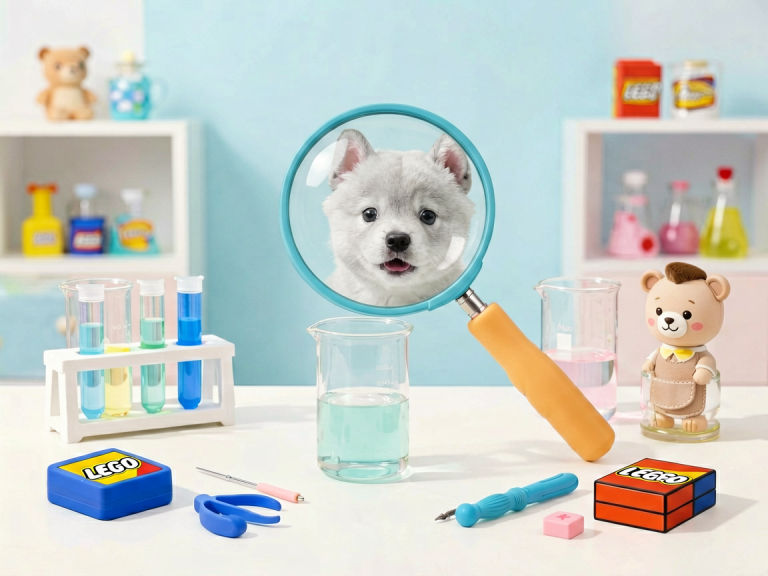
Aimed at preschoolers ages 3–6, this set includes large, chunky plastic beakers, flasks, a magnifying glass, a test tube, and a set of activity cards. It’s not a chemistry set in the traditional sense; rather, it encourages pretend play that mimics real scientific practices. Children can mix colored water, “dissolve” sugar, or use the magnifying glass to examine toy bugs. The real value lies in building confidence and familiarity with lab equipment. When they later encounter real science tools, they will already feel comfortable handling them.
Honorable Mention: National Geographic Mega Science Series – Glow in the Dark Science Kit
This kit is all about luminescence: making slime that glows, creating glowing crystals, and experimenting with ultraviolet light. It captures children’s imaginations while teaching about light absorption and emission. The glow effect is dramatic, making it a hit for playdates and parties. It’s recommended for ages 8+, but younger children can assist with adult guidance. The kit includes safety materials and clear instructions, though some activities require patience for crystal growth.
Magnetism and Physics Toys
Magnetism is one of the most intuitive physical concepts for young children; they can see and feel the invisible force at work. Physics toys that focus on gravity, motion, and simple machines provide endless fascination.
Top Pick: Melissa & Doug Magnetic Wand with Counters
This classic toy consists of a plastic wand with a strong magnet inside and a set of 20 wooden “counters” with metal centers. Children use the wand to pick up the counters, sort them by color, or create patterns. It’s deceptively simple: the act of attracting and repelling objects teaches about magnetic fields, polarity, and the fact that magnets can work through materials (the wand’s plastic casing doesn’t block the magnetism). Recommended for ages 3 and up, it also develops hand-eye coordination and counting skills. Many parents use it as a quiet travel activity.
Runner-Up: SmartLab Toys Squishy Human Body
While technically a biology toy, this kit also incorporates physics principles through its assembly of organs and skeleton. The “squishy” organs are soft and tactile, making the learning process fun. Children disassemble and reassemble the human torso, learning about organ placement, the skeletal system, and how body systems work together. It comes with a detailed, child-friendly book. Recommended for ages 8+, but with adult help, curious 5-year-olds can enjoy the hands-on parts. It’s a fantastic gateway to anatomy and physiology.
Honorable Mention: Brio Builder Construction Set
Although Brio is known for train sets, their Builder line offers screwdrivers, bolts, and planks for creating simple machines like levers and pulleys. Children can build a crane that actually lifts objects, or a windmill that spins in the breeze. The real tools and screws provide authentic fine motor challenges, and the open-ended nature means no two creations are alike. It’s appropriate for ages 3–7.
Coding and Logic Toys
In the digital age, early exposure to coding concepts—without screens—is invaluable. The best early science toys in this category use tangible blocks or cards to teach sequencing, pattern recognition, and problem-solving.
Top Pick: Fisher-Price Code ‘n Learn Kinderbot
This robotic toy is designed specifically for preschoolers ages 3–6. It comes with a set of “code cards” that children arrange in a sequence. When the sequence is entered into the robot (by pressing buttons on its head), the robot follows the instructions: move forward, turn left, spin, etc. It introduces the concept of algorithms in a physical, dramatic way. The robot also has a “free play” mode and a “challenge” mode where children must navigate obstacles. It’s screen-free and incredibly engaging. The only downside is that it requires three AAA batteries.
Runner-Up: Learning Resources Botley 2.0 the Coding Robot
Botley is a more advanced option for ages 5 and up. It can be programmed using a remote programmer that sends commands (forward, backward, turn, loop) up to 120 steps. It also has object detection, so it can avoid walls. Children learn about debugging when their program doesn’t work correctly—for example, if Botley bumps into a chair, they must adjust the sequence. Botley comes with detachable arms and accessories for added play. It’s robust, screen-free, and can be used indoors or outdoors.
Honorable Mention: ThinkFun Roll & Play
This is a non-digital logic game for toddlers. A large inflatable die with six colored pockets contains activity cards. When a child rolls the die, they pick a card of that color and perform the action (e.g., “Make a happy face,” “Stomp your feet”). While not explicitly “coding,” it teaches following sequences, pattern recognition, and cause-effect. It’s perfect for ages 18 months and up, providing an early foundation for logical thinking.
How to Choose the Right Science Toy for Your Child
With so many options, selection can feel overwhelming. The best early science toys share a few common traits: they are safe, durable, open-ended, and aligned with the child’s developmental stage. Here are key factors to consider:
Age Appropriateness
Always check the manufacturer’s recommended age range, but also consider your child’s individual development. A three-year-old with advanced fine motor skills may handle a toy labeled for 4+, while a cautious child might need simpler toys longer. For infants and toddlers (0–2), focus on sensory toys like textured balls, rattles, and simple shape sorters that introduce basic concepts. For preschoolers (3–5), building sets, magnets, and simple observation tools are ideal. For early elementary (6–7), experiment kits and coding robots provide deeper engagement.
Safety First
Look for non-toxic materials, rounded edges, and no small parts that could pose choking hazards for children under three. Check for certifications like ASTM or CE. Avoid toys with strong magnets that could be swallowed (especially for toddlers who mouth objects). Always supervise chemistry experiments and use of tools like screwdrivers.
Open-Ended vs. Structured Play
Open-ended toys, like building blocks and magnet tiles, allow for infinite possibilities and encourage creativity. Structured toys, like specific experiment kits, provide guided learning. The best early science toy collection includes both. A child who builds freely with magnets develops divergent thinking; a child who follows an experiment recipe learns to follow procedures and make predictions.
Parental Involvement
Many early science toys are designed for independent play, but the most impactful learning happens when an adult engages with the child. Ask questions: “What do you think will happen if we add more vinegar?” or “Why do you think that tower fell over?” These conversations cement the scientific mindset. Choose toys that you feel comfortable using alongside your child—for instance, if you dislike mess, avoid the most explosive chemistry kits.
Durability and Longevity
Children are rough on toys. Invest in brands known for robust construction—Melissa & Doug, Learning Resources, Magzix, and Thames & Kosmos all have strong reputations. Toys that can be used in multiple ways (e.g., building blocks that also work for pretend play) provide better long-term value.
Conclusion
The best early science toys are not about creating little geniuses overnight. They are about nurturing a sense of wonder, resilience in the face of failure, and the joy of discovery. From a toddler stacking magnetic tiles to a kindergartner programming a robot to navigate a maze, each play session plants a seed of scientific thinking that will grow throughout a lifetime. By choosing toys that are safe, developmentally appropriate, and engaging, parents and educators can give children the greatest gift: the confidence to ask questions and the tools to find answers. The journey of a thousand discoveries begins with a single toy—so choose wisely, play alongside your child, and watch their world expand.