Unlocking Potential: The Ultimate Guide to Educational Toys as Gift Ideas
Introduction: The Power of Play
In a world increasingly dominated by screens and passive entertainment, the humble toy remains one of the most powerful tools for childhood development. Yet not all toys are created equal. While a flashy, battery-operated gadget might capture a child’s attention for a few minutes, a thoughtfully designed educational toy can ignite curiosity, foster critical thinking, and build skills that last a lifetime. This is why educational toys have become more than just a niche category – they represent a philosophy of intentional gifting. When you choose a present that stimulates the mind, you are not merely handing over an object; you are offering an experience, a challenge, and an invitation to learn through joy.
The search for the perfect gift can be overwhelming, especially with the endless array of products marketed as “educational.” Parents, grandparents, aunts, uncles, and family friends all want to give something that will be cherished, not abandoned after a single use. This guide is designed to transform that search into a rewarding journey. By understanding the principles behind effective educational toys and matching them to a child’s developmental stage, you can select gifts that are both delightful and deeply meaningful. From building blocks that teach physics to puzzles that sharpen logic, the possibilities are vast. Let’s explore how to navigate this exciting landscape and make your next gift truly unforgettable.
Why Choose Educational Toys?
The concept of learning through play is not new. Pioneers like Maria Montessori and Friedrich Froebel recognized centuries ago that children absorb knowledge most naturally when they are actively engaged and having fun. Educational toys capitalize on this insight. Unlike passive entertainment, these toys require participation: a child must manipulate, question, experiment, and solve problems. This active engagement strengthens neural connections, enhances memory retention, and develops a growth mindset.
Moreover, educational toys often target multiple domains of development simultaneously. A simple set of wooden blocks, for example, can improve fine motor skills as a child grasps and stacks; spatial awareness as they visualize structures; mathematical thinking as they count and compare sizes; creativity as they design unique shapes; and social skills when they collaborate with others. In an era where academic pressure sometimes trickles down to the youngest learners, educational toys provide a gentle, pressure-free way to build foundational competencies. They teach resilience because trial and error is part of the play. They teach focus because the challenge is intrinsically rewarding. And they teach the most valuable lesson of all: that learning is not a chore but an adventure.
Another critical advantage is the reduction of screen time. While technology certainly has its place, many educational toys return to tactile, screen-free experiences that engage the senses. This is especially important given growing concerns about excessive digital exposure in early childhood. By offering hands-on alternatives, these toys encourage deep, immersive play that supports attention spans and reduces overstimulation. For gift-givers, this means you are not just giving a toy – you are giving a healthier, more balanced form of engagement.
Age-Appropriate Educational Toy Ideas
Selecting the right toy depends heavily on the child’s age and developmental stage. A toy that is too advanced can cause frustration; one that is too simple may lead to boredom. The following sections break down ideal choices for different age groups, with detailed explanations of why each category works.
For Infants and Toddlers (0–2 Years)
At this earliest stage, the brain is developing at a staggering rate. Infants are learning about cause and effect, sensory input, and their own physical capabilities. The best educational toys for this age group focus on sensory stimulation, motor skills, and basic cognitive connections. High-contrast black-and-white books and cards help focus developing vision, while soft rattles and crinkle toys introduce sound and texture. A simple activity gym with hanging objects encourages reaching, grasping, and spatial awareness.
As babies become mobile, push-and-pull toys like wooden cars on a string develop balance and coordination. Nesting cups and stacking rings are timeless classics that teach size relationships and problem-solving. For toddlers just beginning to speak, shape sorters and simple puzzles with large knobs promote vocabulary (colors, shapes) and fine motor dexterity. Music-making toys, such as xylophones or maracas, introduce rhythm and cause-effect (shake to make sound). Always ensure that toys are free of small parts and made from non-toxic materials, as mouthing is still a primary way of exploration.
For Preschoolers (3–5 Years)
The preschool years are characterized by explosive language development, imaginative play, and the emergence of logical thinking. This is the golden age for pretend play sets, which provide fertile ground for social-emotional growth. A wooden kitchen set with play food, a doctor’s kit, or a simple puppet theater allows children to act out scenarios, develop empathy, and practice narrative skills. Construction toys like Duplo bricks or magnetic tiles (e.g., Magna-Tiles) enable open-ended building, teaching geometry, balance, and creativity.
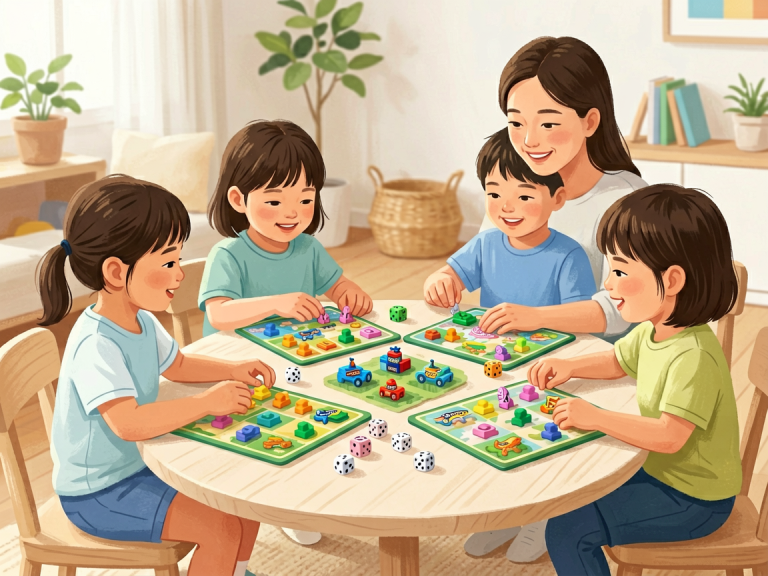
Puzzles become more complex – 12 to 24 pieces – and introduce themes like animals, letters, or numbers. Matching games and memory card games sharpen attention and recall. For early literacy, alphabet puzzles or magnetic letters can accompany hands-on activities. Simple board games that involve counting spaces or following a sequence (e.g., Candy Land or a simplified version of Snakes and Ladders) teach turn-taking and sportsmanship. Art supplies such as washable markers, scissors with safety edges, and modeling clay encourage fine motor development and self-expression. The key at this age is to offer toys that stimulate imagination while subtly introducing academic concepts.
For Early Elementary (6–8 Years)
Children in this age range are increasingly capable of systematic thinking, reading, and following multi-step instructions. They become fascinated with how things work, so science and engineering kits make excellent gifts. Classic options include a magnifying glass and bug-catching kit for nature exploration, a simple circuit-building set (like Snap Circuits), or a beginner’s microscope. These toys not only teach scientific principles but also instill curiosity about the natural world.
Strategy and logic games come into their own. Chess sets designed for children with simplified rules, checkers, or games like Rush Hour Jr. (a sliding puzzle game) develop planning and problem-solving. Building systems like LEGO Classic or K’NEX allow children to follow instructions or create their own designs, reinforcing engineering and creativity. For language arts, word-building games such as Scrabble Jr. or Bananagrams promote spelling and vocabulary in a playful context. Art kits that offer more advanced techniques – weaving looms, origami paper, or sewing cards – refine hand-eye coordination and patience. Chapter books with interactive companion activities can also be considered educational gifts when paired with a reading journal or comprehension games.
For Older Children (9–12 Years)
As children approach adolescence, their interests become more specialized, and their cognitive abilities allow for sophisticated reasoning. Educational toys for this group should challenge them and respect their growing independence. Robotics kits, such as LEGO Mindstorms or beginner Arduino kits, combine coding, engineering, and creativity. These can lead to long-term projects that teach perseverance and technical skills. Science kits that involve chemistry experiments (with proper safety gear) or crystal-growing sets are also popular.
Board games with complex rules, like Settlers of Catan or Ticket to Ride, teach resource management, negotiation, and strategic planning. Logic puzzles such as Rubik’s Cubes, sudoku books, or logic grid puzzles sharpen analytical thinking. For creative expression, high-quality art supplies like professional-grade colored pencils, calligraphy sets, or digital drawing tablets (if the child shows interest) allow for advanced skill development. Memory and trivia games, especially those focused on science or history, can make learning facts fun. Older children also benefit from subscription kits (e.g., KiwiCo or Little Passports) that deliver monthly projects, maintaining engagement over time.
Key Factors to Consider When Selecting Educational Toys
Beyond age, several other considerations can help you choose the perfect gift. First, think about the child’s individual interests. A child who loves dinosaurs will be thrilled by a fossil-digging kit or a dinosaur encyclopedia with 3D models, whereas a budding artist might prefer a high-quality set of watercolors or a how-to-draw book. Aligning the toy with existing passions increases the likelihood that it will be used and cherished.
Second, consider the open-endedness of the toy. Toys that allow for multiple outcomes – such as building blocks, loose parts, art supplies, or modular construction sets – encourage creativity and extended play. In contrast, toys with a single correct answer or a fixed script might be enjoyed briefly but lose their appeal quickly. Open-ended toys grow with the child, offering new challenges as abilities develop.
Third, prioritize quality and safety. Educational toys often involve small parts, so always check age recommendations and safety certifications. Wooden toys from sustainable sources, non-toxic paints, and sturdy construction not only last longer but also provide a safer play environment. Avoid toys with excessive noise or flashing lights unless they serve a specific educational purpose; such features can be distracting and hinder focused play.
Fourth, look for toys that encourage social interaction. While independent play is valuable, many of the best learning experiences happen when children play with siblings, friends, or adults. Cooperative board games, building projects that require teamwork, or science experiments that can be done together foster communication, collaboration, and patience. As a gift-giver, you might even include a note suggesting a family activity to accompany the toy.
Finally, do not underestimate the power of simplicity. Some of the most effective educational tools are remarkably basic. A set of wooden blocks, a deck of cards, a jar of marbles, or a box of crayons and paper – these deceptively simple items can inspire hours of creative, self-directed learning. Sometimes the best gifts are those that leave room for the child’s imagination to do the heavy lifting.
Conclusion: A Gift That Keeps on Giving
Choosing an educational toy as a gift is an act of investment – in a child’s intellect, creativity, and love of learning. It moves beyond the fleeting excitement of a new possession and plants seeds that will grow over time. The right toy can spark a lifelong interest in science, art, language, or mathematics. It can build confidence as a child masters a challenging puzzle. It can strengthen bonds as families play and learn together.
In a consumer landscape awash with disposable novelties, educational toys stand out as meaningful alternatives. They respect the child’s developmental journey and offer a gentle nudge toward growth. Whether you are shopping for a first birthday, a holiday, or just because, let this guide be your compass. Consider the child’s age, interests, and the kind of learning you wish to encourage. Remember that the best gifts are not always the most expensive or the most technologically advanced – they are the ones that invite a child to wonder, to test, to fail, and to try again.
So the next time you face a gift list, think beyond the ordinary. Give the gift of curiosity. Give the gift of a challenge. Give the gift of play that teaches. In doing so, you are not merely presenting an object; you are unlocking a child’s potential, one joyful, thoughtful toy at a time.