The Power of Science Play: Nurturing Young Minds Through Hands-On Discovery
Introduction
In a world increasingly driven by technology and standardized testing, the simple joy of science play for kids often gets overlooked. Yet this very form of unstructured, curiosity-driven activity holds the key to developing critical thinking, creativity, and a lifelong love for learning. Science play is not about memorizing formulas or conducting complex laboratory experiments; it is about giving children the freedom to ask “what if” and “why” while their hands are immersed in water, mud, magnets, or baking soda. Through playful exploration, children naturally absorb scientific concepts that would otherwise seem abstract and intimidating. This article delves deep into why science play is essential for child development, how to design effective play experiences, and practical activities that parents and educators can implement immediately. By the end, you will understand that science play is not just a pastime—it is a powerful vehicle for building the next generation of innovators, problem-solvers, and curious citizens.
The Neuroscience Behind Science Play
How Play Rewires the Young Brain
Children are born scientists. From the moment they can grasp objects, they begin testing hypotheses: “What happens if I drop this spoon? Will it make a sound? Will Mom pick it up?” This trial-and-error behavior is the essence of the scientific method. Neuroscientists have discovered that play—especially unstructured, self-directed play—activates the prefrontal cortex, the brain region responsible for executive functions like planning, decision-making, and impulse control. When a child builds a tower of blocks and watches it tumble, she is not just having fun; she is training her brain to predict outcomes, learn from failure, and adjust strategies. Stress hormones like cortisol decrease during play, while dopamine, the reward neurotransmitter, surges, making learning feel intrinsically rewarding. This neurological cocktail ensures that lessons learned through play are remembered longer and more deeply than those delivered through rote instruction.
The Role of Sensory Input in Conceptual Understanding
Science play is inherently multisensory. Children touch, smell, hear, see, and sometimes even taste their experiments. For example, mixing cornstarch and water to create a non-Newtonian fluid (oobleck) engages tactile receptors, visual observation, and cause-effect reasoning simultaneously. This sensory richness creates stronger neural connections because multiple brain regions are activated at once. When a child feels the oobleck solidify under pressure and then melt away, she is building an intuitive understanding of states of matter that no textbook can replicate. The concrete experience becomes a mental scaffold upon which later abstract concepts—like viscosity, pressure, and polymers—can be hung. Therefore, science play is not merely a “fun” alternative to formal education; it is a neurological necessity for deep learning.
Key Principles of Effective Science Play
Child-Led Exploration with Gentle Guidance
The most powerful science play is child-led, not adult-directed. When a parent says, “Let’s do this experiment to learn about density,” the child may comply, but the sense of ownership is lost. Instead, an effective facilitator provides open-ended materials and then steps back. For instance, placing a tray of water, an empty bottle, a funnel, and some floating toys invites the child to discover volume and displacement on her own terms. Adults should resist the urge to correct or explain immediately. Let the child pour too much water, watch it overflow, and then try again. Only after several attempts might the adult ask, “I noticed that when you filled the bottle completely, the water spilled. What do you think would happen if you left some air inside?” This Socratic questioning respects the child’s agency while nudging her toward deeper understanding.
Embracing Uncertainty and Failure
One of the greatest gifts science play offers is the normalization of failure. In traditional classrooms, wrong answers are punished with low grades. In science play, a failed experiment is simply data. A volcano that doesn’t erupt? “What could we change? More vinegar? More baking soda? A different shape of container?” This iterative process teaches resilience and the scientific virtue of skepticism: one must question one’s own hypotheses. Parents and educators must model this mindset. When an experiment flops, instead of showing frustration, exclaim, “Wow! That wasn’t what I expected! Let’s figure out why!” Over time, children internalize the belief that mistakes are stepping stones, not stop signs. This emotional safety is critical for fostering the risk-taking necessary for scientific discovery.
Balancing Structure and Open-Endedness
While child-led play is ideal, some structure is helpful, especially for younger children. A “science invitation” might consist of a themed bin: “Sink or Float” with objects like a cork, a stone, a plastic lid, and a metal spoon, accompanied by a simple chart where the child can record predictions and outcomes. This provides a framework without dictating the exact procedure. Too much structure turns play into a chore; too little can overwhelm. Finding the sweet spot requires observing the child’s engagement: if they lose interest, the challenge is either too hard or too easy. Adjust the materials accordingly. The goal is to create a “flow” state where the child is fully absorbed, time disappears, and learning happens effortlessly.
Practical Science Play Activities for Home and Classroom
Kitchen Chemistry: Edible Experiments
The kitchen is a treasure trove for science play. One classic activity is making homemade ice cream in a bag. Ingredients: milk, sugar, vanilla, ice, salt, and two ziplock bags. The child seals the milk mixture in a small bag, then places it inside a larger bag filled with ice and salt. As they shake vigorously, they experience firsthand how salt lowers the freezing point of ice, allowing the mixture to freeze. While shaking, ask: “Why is the bag getting so cold? Why does the mixture turn solid?” The child may not articulate “freezing point depression,” but the embodied memory will serve as anchor when they encounter the concept later. Another activity: baking soda and vinegar volcanoes—a perennial favorite. But go deeper by using different ratios: “What happens with twice as much vinegar? Less baking soda?” Record results on a simple chart. The child becomes a data analyst without knowing it.
Outdoor Physics: Water, Ramps, and Wind
Take science play outside. A simple ramp made from a cardboard box and a series of objects (marbles, toy cars, balls) allows children to explore gravity, incline, and friction. Challenge: “Can you make the marble go the farthest? What happens if we change the ramp’s height? What if we add a rough surface like sandpaper?” This is pure physics experimentation. Similarly, water play in a tub or with hoses teaches volume, flow, and pressure. Provide different containers—cups with holes, plastic bottles with caps removed, funnels—and let the child orchestrate water’s movement. Add food coloring for visual tracking. Ask, “Why does the water come out faster when the bottle is held higher?” The child begins grasping potential and kinetic energy intuitively.
Biology and Observation: Backyard Exploration
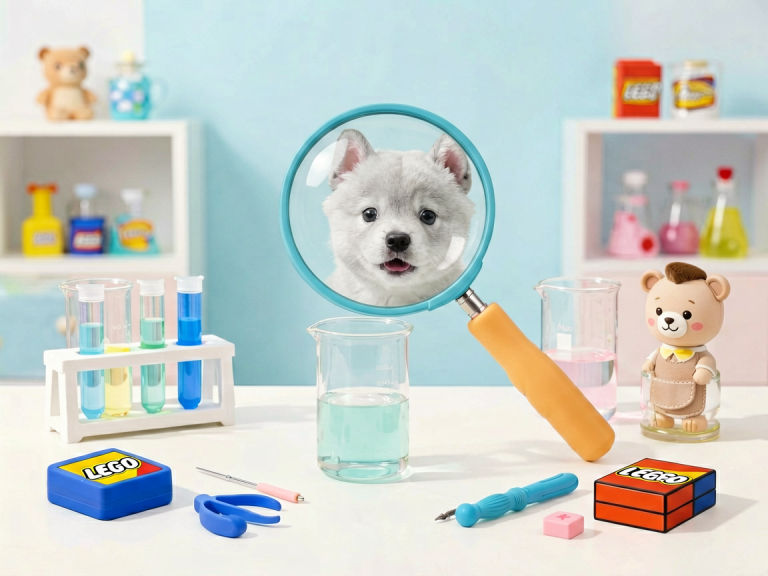
Even a small balcony can be a biology lab. Give the child a magnifying glass and a notebook. Their mission: find three different bugs or plants and draw them. Then ask simple questions: “How many legs does this ant have? Is it moving fast or slow? Why do you think it’s going that way?” Over time, they can collect leaves, press them, and classify by shape or color. Plant a seed in a clear cup against the window so roots are visible. Let the child water it, chart its growth, and guess what will happen if they deprive it of light for a week. These activities build observational skills, patience, and the crucial understanding that living things have needs and cycles.
Engineering Challenges: Building and Breaking
Introduce construction-based science play with items like LEGOs, popsicle sticks, marshmallows, and tape. Challenge: “Build a bridge that can hold a toy car. But you can only use ten sticks and five marshmallows!” The engineering design process (ask, imagine, plan, create, improve) unfolds naturally. When the bridge collapses, resist fixing it. Instead, ask, “Which part broke? What could make it stronger—more supports? Different placement?” This is structural engineering in miniature. Another popular activity: building the tallest tower using only newspaper and tape. Children learn about stability, balance, and the properties of paper under compression. Every broken tower is a lesson in physics and resilience.
The Role of Parents and Educators in Facilitating Science Play
Becoming a Co-Learner, Not a Teacher
Adults often feel pressure to be experts. But the most effective science play facilitators admit ignorance. “I don’t know why this pepper floats and this coin sinks. Let’s find out together!” This models intellectual humility and the joy of discovery. Use technology wisely: if a question arises like “Why do some clouds look gray and others white?”, you can say, “Great question! Let’s look it up in that children’s science book we have, or let’s watch a short video together.” The child learns that not knowing is the beginning of learning, not a failure. Also, avoid over-praising. Instead of “Good job!”, comment on the process: “You tried three different ways to get the boat to float—that shows real persistence.”
Creating a “Science-Friendly” Environment
Designate a low-risk area for mess—a corner of the kitchen, a plastic tablecloth, or a backyard space. Have basic supplies always accessible: baking soda, vinegar, cornstarch, food coloring, magnets, a magnifying glass, measuring cups, string, tape, and recycled containers. Rotate materials to maintain novelty. Keep a “Wonder Journal” where children can draw or dictate questions: “Why is the sky blue?” “How do birds fly?” Revisit the journal weekly and try to investigate one question through an activity. Also, display children’s work—photos of their experiments, charts, drawings—to validate their efforts and spark conversations with visitors.
Integrating Science Play into Daily Routines
Science play does not require a dedicated “lab time.” Cooking dinner is chemistry: “Why does baking soda make the pancakes fluffy?” Bath time is fluid dynamics: “Why does the rubber duck float but the toy car sinks?” A walk to the park can be a nature observation walk: “How many different kinds of leaves can we collect?” Bedtime can include a shadow puppet show exploring light and opacity. By weaving scientific thinking into everyday moments, parents normalize curiosity. The child begins to see the world not as a collection of static facts, but as a grand, ongoing experiment.
Overcoming Common Obstacles to Science Play
The “Mess” Factor
Many adults avoid science play because of the anticipated cleanup. The solution is twofold: first, embrace the mess as a sign of deep engagement. Lay down newspapers or washable tablecloths, use aprons, and involve the child in cleanup—a learning opportunity in itself (sorting, wiping, drying). Second, choose activities with low mess potential when necessary. For example, magnetic explorations on a cookie sheet contain the mess. Outdoor water play eliminates indoor spills. With preparation, chaos becomes manageable and the benefits far outweigh the inconvenience.
Lack of Time
In busy schedules, science play can feel like another task to schedule. The key is integration. A 10-minute activity counts: fill a bottle with water and an oil, add a drop of food coloring, shake, and watch the separation. That’s chemistry, physics, and art in ten minutes. Also, remember that unstructured free play with natural materials—sticks, stones, mud—is often more valuable than a Pinterest-perfect experiment. Let the child dig in the dirt and observe worms. This is biology play at its purest. Time spent on science play is not wasted; it is an investment in executive function, problem-solving, and enthusiasm for learning that pays dividends in school and life.
Age-Appropriate Expectations
Toddlers will not understand density; they will pour water and splash. That’s fine! For ages 2–4, focus on sensory exploration without explanation. For ages 5–7, introduce simple cause-effect questions. For ages 8–12, encourage hypothesis-making, prediction, and recording. Adjust accordingly. The goal is never to “teach” a concept prematurely, but to build a reservoir of experiences that later formal instruction can draw upon. A child who played with magnets at age 4 will have a visceral understanding when a teacher explains magnetic fields at age 11.
Long-Term Benefits of a Science Play-Rich Childhood
Cultivating Future Innovators and Critical Thinkers
The skills developed through science play—observation, questioning, hypothesis testing, analysis, communication—are precisely those listed by employers and universities as essential in the 21st century. Children who grow up engaged in playful science are more likely to persist in STEM fields because they have positive early associations. They are also better equipped to evaluate claims critically in an age of misinformation. When a child has experienced firsthand how changing one variable alters an outcome, they are less likely to accept pseudoscientific claims at face value. They have an internal bullshit detector calibrated through thousands of small experiments.
Emotional and Social Development
Science play is often collaborative. Siblings or friends building a ramp together must negotiate, share materials, and communicate ideas. When an experiment fails, they must manage frustration and encourage each other to try again. These social-emotional skills are as important as the scientific ones. Furthermore, children who engage in open-ended play develop greater creativity because they are accustomed to generating multiple solutions rather than seeking a single “right” answer. They become more comfortable with ambiguity—a hallmark of mature thinkers.
Lifelong Love of Learning
Perhaps the most profound benefit of science play is that it repositions learning as a joyous, never-ending adventure. A child who associates science with laughter, mess, and discovery will enter a biology class or a chemistry lab not with dread but with excitement. They will see the world as full of puzzles waiting to be solved. In an educational landscape that often squeezes the wonder out of learning, science play preserves and protects that precious spark. It reminds us that science is not a collection of facts in a textbook—it is a way of being curious, a way of playing with reality itself.
Conclusion
Science play for kids is not a luxury; it is a fundamental building block of childhood development. Through hands-on, child-led exploration of the natural and physical world, children acquire not only scientific knowledge but also the habits of mind that lead to lifelong learning: curiosity, resilience, creativity, and critical thinking. Whether it is mixing kitchen ingredients, building ramps with cardboard, or simply observing a worm in the garden, every moment of science play is a seed planted in fertile soil. As parents, educators, and community members, our role is to provide the soil—the materials, the time, the emotional safety—and then let the seeds grow. The harvest will be a generation of children who see questions instead of problems, possibilities instead of obstacles, and who carry the spirit of play and discovery with them into every endeavor. Start today. Pick up a baking soda box, a magnet, or a measuring cup. Invite a child to wonder with you. The universe is waiting to be played with.