Igniting Curiosity: The Role of Early Science Toys at Home in Shaping Young Minds
Introduction
From the moment a toddler spills a cup of water to watch it pool on the floor, or a preschooler asks "why is the sky blue?" for the hundredth time, the seeds of scientific thinking are already being sown. Children are natural-born scientists: they observe, question, experiment, and draw conclusions. Yet in a world dominated by screens and passive entertainment, nurturing that innate curiosity requires intentional effort. Early science toys for home offer one of the most effective and joyful ways to keep the flame of discovery alive. These are not just playthings; they are tools that transform living rooms into laboratories, kitchens into chemistry stations, and backyards into ecosystems. This article explores why early science toys matter, what types are available, how to choose them wisely, and how families can use them to foster a lifelong love of learning.
Why Early Science Toys Matter
Child development research consistently underscores the importance of hands-on, exploratory learning in the early years. The brain undergoes rapid growth between ages two and seven, forming neural connections at an astonishing rate. During this window, experiences that engage multiple senses—touch, sight, sound, and even smell—strengthen cognitive pathways more effectively than passive instruction. Early science toys capitalize on this plasticity by encouraging active manipulation, problem-solving, and cause-and-effect reasoning.
For instance, a simple set of magnetic building blocks does more than entertain. When a child discovers that two magnets repel each other, they are not just playing—they are internalizing the abstract concept of magnetic force. When they stack blocks to build a tower that eventually topples, they learn about gravity, balance, and structural integrity. These lessons are not taught through lectures; they are discovered through trial and error, which builds resilience and a growth mindset. Moreover, early exposure to scientific concepts reduces the "science anxiety" that many older students experience, because children learn that science is not a distant, intimidating subject but a natural part of everyday life.
Categories of Home Science Toys
The market for early science toys is vast, but they generally fall into a few key categories, each targeting different aspects of scientific inquiry.
*Physical Science Toys*
These toys introduce concepts like force, motion, energy, and magnetism. Classic examples include marble runs, ramps, pulleys, and magnetic construction sets. A ball rolling down a curved track teaches potential and kinetic energy. A simple lever made from a ruler and a pencil demonstrates mechanical advantage. These toys are especially good for developing spatial reasoning and understanding of cause and effect. They often require trial-and-error adjustments, which teaches persistence.
*Chemistry and Reaction Kits*
For slightly older children (ages 4 and up), safe chemistry sets allow exploration of chemical reactions. Baking soda and vinegar volcanoes are a perennial favorite, but modern kits go further: growing crystals, making slime, or testing pH with red cabbage juice. These activities introduce the scientific method: making a hypothesis (what will happen if I add more vinegar?), performing an experiment, and observing the result. Crucially, they also teach safety and following instructions.
*Biology and Nature Exploration*
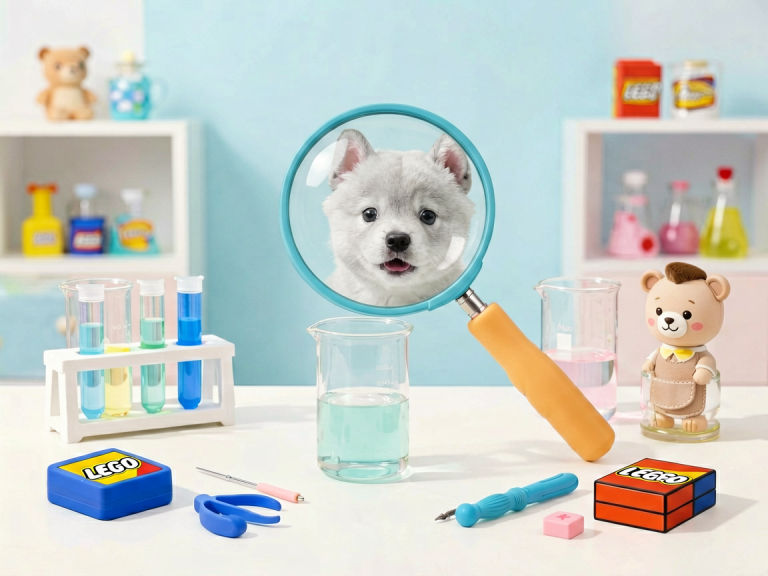
Encouraging observation of living things is one of the most accessible forms of science at home. Simple tools like magnifying glasses, bug catchers, and ant farms open windows into the natural world. A child who watches a caterpillar transform into a butterfly learns about metamorphosis firsthand. Plant-growing kits (e.g., herb gardens in a windowsill) teach photosynthesis, germination, and responsibility. For older children, a basic microscope can reveal the hidden universe of cells and microorganisms, sparking endless questions.
*Engineering and Construction*
Building toys such as LEGO, K'NEX, or wooden block sets are foundational engineering toys. They require planning, spatial visualization, and problem-solving. More advanced options include snap circuits that allow children to create working lights, fans, and alarms by connecting wires and batteries. Such toys demystify electricity and circuitry, giving children a sense of accomplishment when their creation actually works. They also teach the iterative design process: build, test, fix, improve.
*Observation and Measurement Tools*
Junior-sized versions of real scientific instruments are invaluable. A child-sized microscope, a telescope for moon watching, a rain gauge, a thermometer, or a simple balance scale all encourage measurement and data collection. These tools shift the child’s role from passive recipient to active investigator. Recording daily temperature changes or charting the phases of the moon turns science into a personal project.
Choosing the Right Science Toys for Different Ages
Not all science toys are appropriate for every age. Safety is paramount, but so is developmental alignment. A toy that is too advanced will frustrate; one that is too simple will bore.
For toddlers (18 months to 3 years), the focus should be on sensory exploration and simple cause-effect. Water tables, sand play, large wooden puzzles, and stacking rings are excellent. They introduce basic physics (sinking, floating, stacking) without any small parts. At this age, adult supervision is essential, and the "toy" is often more about process than product.
Preschoolers (ages 3–5) are ready for more structured play. Simple magnet kits, bug catchers, and beginner snap circuits (with large, easy-to-handle parts) work well. They can follow two-step instructions and begin to ask "what if" questions. Avoid kits with chemicals that require precise measurements; instead, opt for sensory play like making dough or mixing colors.
Early elementary children (ages 5–8) can handle more complex kits. Chemistry sets with safe, non-toxic materials, crystal-growing kits, and basic microscopes are good choices. At this stage, children can start keeping a simple science journal with drawings and observations. They also enjoy construction toys that require following diagrams, like LEGO Technic or marble run sets.
Older elementary children (ages 8 and up) are ready for genuine experimentation. Snap circuits with more components, robotics kits (like simple programmable robots), and dissection kits (with synthetic or safe specimens) challenge them. They can understand concepts like variables and controls. Encourage them to design their own experiments—for example, testing how different surfaces affect the speed of a toy car.
Maximizing Learning Through Guided Play
Owning early science toys is only half the battle. The way parents engage with children during play dramatically influences learning outcomes. Passive observation—handing a child a kit and walking away—yields limited benefits. Instead, parents should adopt the role of a "playful facilitator."
First, ask open-ended questions. Instead of announcing "that magnet sticks to metal," ask "what do you notice about the things the magnet picks up?" or "why do you think this one doesn't stick?" This encourages the child to articulate observations and form hypotheses. Second, allow for failure. When a marble run collapses or a circuit doesn't light up, resist the urge to fix it immediately. Let the child troubleshoot. Ask, "what could we try differently?" This builds problem-solving skills and resilience. Third, connect play to real-world phenomena. If a child is fascinated by a prism creating rainbows, take them outside on a sunny day and look for rainbows in puddles or through a garden hose. If they love growing crystals, discuss how icicles form or how salt crystals appear on roads in winter.
Another powerful technique is to keep a "science journal" or scrapbook where children can draw what they observed, paste a photo of their experiment, or dictate a sentence about what they learned. This reinforces literacy skills alongside scientific thinking. Finally, avoid the temptation to over-schedule. The best science learning happens when a child is deeply engaged in self-directed play—not when a parent is rushing from one structured activity to the next.
Real-World Examples and Success Stories
The impact of early science toys is not theoretical. Many successful scientists and engineers trace their initial spark to a childhood toy. For instance, NASA engineer and advocate for STEM education, Dr. Aprille Ericsson, has spoken about how building model rockets with her father ignited her passion for aerospace. Similarly, Nobel laureate in physics, Dr. Carl Wieman, credits a childhood chemistry set with introducing him to the joy of discovery.
On a more everyday level, consider the story of a family who introduced a simple magnifying glass to their four-year-old. The child spent an entire afternoon examining the texture of leaves, the veins in a flower petal, and the tiny hairs on a caterpillar. That single object transformed a walk in the park into a scientific expedition. Another family purchased a cheap plastic microscope for their seven-year-old. Within weeks, the child was collecting samples of pond water, examining salt crystals, and even looking at the skin on her own finger. Her vocabulary expanded to include words like "cell," "nucleus," and "magnification." She began asking questions about why things looked different under a microscope, which led to conversations about the difference between living and non-living things.
In communities where families have access to quality science toys, the benefits extend beyond individual learning. Parent-child bonding deepens as they work together on experiments. Screen time often decreases because hands-on activities are more engaging. And children develop a sense of agency—they realize they can figure things out on their own, which boosts confidence in all academic areas.
Conclusion
Early science toys for home are far more than entertainment. They are the building blocks of critical thinking, creativity, and curiosity. In an era when standardized tests and digital distractions often crowd out genuine exploration, these toys offer a return to the basics: asking questions, making mistakes, and discovering the world with wonder. Whether it is a set of magnets, a growing garden, or a simple bug jar, every science toy carries the potential to shape a young mind. The key is not the cost or the complexity, but the willingness of parents and caregivers to step into the role of co-explorer. By investing in these tools and, more importantly, in the time to use them together, families can transform their homes into vibrant learning environments. And who knows—the next great scientist might just be the child building a wobbly tower in your living room, asking, "What if I try this?"