The Cognitive Compass: The Transformative Power of Early Logic Toys for Preschoolers
Introduction: Laying the Foundation for Lifelong Thinking
In the vibrant, chaotic world of a preschooler, every moment is a lesson. A spilled cup of juice teaches cause and effect; a tower of blocks that collapses reveals gravity and balance. Yet, in an age where screens dominate and passive entertainment is just a swipe away, the deliberate introduction of structured, yet playful, learning tools has never been more critical. Among these tools, early logic toys hold a unique and powerful position. These are not mere distractions; they are the silent architects of a child’s cognitive infrastructure. Logic toys for preschoolers – puzzles, sorting games, sequencing blocks, and simple mazes – are the training grounds where young minds first learn to recognize patterns, solve problems, and make reasoned decisions. This article explores the profound impact of these toys, delving into their developmental benefits, the various types available, and how parents and educators can best harness their potential to nurture a generation of critical thinkers. The journey from a toddler’s first puzzled frown over a shape sorter to a five-year-old’s triumphant completion of a 24-piece jigsaw is a journey of mental growth that echoes through a lifetime of learning.
The Cognitive Catalyst: Why Logic Toys Matter in Early Childhood
The preschool years, typically ages 2 to 5, are a period of explosive brain development. Synapses are forming at an astonishing rate, and the brain is exceptionally plastic, meaning it is highly receptive to new patterns and experiences. Logic toys are specifically designed to engage the prefrontal cortex – the area responsible for executive functions such as planning, working memory, and inhibitory control. When a child struggles to fit a square peg into a round hole, they are not just failing; they are actively practicing hypothesis testing (“This doesn’t fit. Maybe I need to turn it. Or maybe I need a different shape.”). This process, repeated thousands of times through play, strengthens neural pathways associated with logical reasoning.
Moreover, logic toys help develop categorization skills – a fundamental building block of mathematics and science. A simple toy that requires sorting colored bears by size or by type teaches the child to observe attributes, compare them, and group them according to a rule. This is the same cognitive operation that later helps them classify animals into species or group numbers into odd and even sets. Similarly, sequencing toys – such as threading beads in a specific pattern (red, blue, red, blue) – foster the ability to detect and replicate patterns, which is a precursor to understanding algebra and music.
Crucially, these toys also promote persistence and frustration tolerance. A challenging puzzle does not yield instant gratification. A child must learn to manage the emotional discomfort of being “stuck.” With gentle guidance, they discover that a setback is not a failure but a step in the problem-solving process. This resilience, cultivated through hands-on logical play, is arguably more valuable than any specific piece of knowledge. In a world that increasingly demands adaptability and grit, early logic toys are the quiet teachers of tenacity.
A Taxonomy of Thought: Types of Early Logic Toys and Their Unique Benefits
The world of early logic toys is surprisingly diverse. To understand their value, it is helpful to categorize them by the specific cognitive skills they target.
1. Puzzle Play: The Art of Spatial and Sequential Reasoning
Puzzles are the quintessential logic toy. For preschoolers, floor puzzles with large wooden pieces or chunky knob puzzles for toddlers are ideal. A child learning to complete a puzzle must engage in visual scanning – looking at the shape and color of a piece and comparing it to the empty space on the board. This hones attention to detail. More advanced puzzles, such as those that depict a sequence of events (e.g., a caterpillar turning into a butterfly), introduce temporal logic – the understanding that events occur in a specific order. The mental rotation required to flip a puzzle piece to fit is a powerful spatial reasoning exercise, which correlates strongly with later success in STEM fields, particularly geometry and engineering.
2. Sorting and Classifying Toys: The Roots of Mathematical Logic
From the classic Montessori-inspired wooden shape sorters to more elaborate color-and-size sorting sets, these toys are foundational. They teach the concept of sets – a group of objects that share a common attribute. A child sorting plastic animals into farm animals and wild animals is performing a basic logical operation. Some toys incorporate rule-based thinking. For instance, a toy might instruct: “Put all the red circles in the red bowl, but only if they are small.” This introduces a conditional rule (“if… then”), which is a cornerstone of computational thinking. These toys also build vocabulary as children learn names of shapes, colors, sizes, and the comparative words like “bigger,” “smaller,” “same,” and “different.”
3. Construction and Building Sets: Physics, Prediction, and Problem-Solving
Building blocks, magnetic tiles, and interlocking bricks are not just for towers. They are laboratories for intuitive physics. When a preschooler tries to build a bridge that spans two supports, they must consider balance, weight distribution, and structural integrity. They learn that a block cannot float in mid-air unless it is supported. This is early cause-and-effect logic. More advanced building kits, such as those with gears or simple levers, introduce mechanical logic – understanding that turning one gear causes another to turn in the opposite direction. Failures in construction become rich opportunities for logical deduction: “Why did it fall? Maybe the base is too narrow. Let me try a wider base.”
4. Memory and Matching Games: Working Memory and Pattern Recognition
Simple card games like “Memory” (where players flip over cards to find pairs) are excellent for developing working memory – the ability to hold and manipulate information temporarily. A child must remember the location of a picture and later recall it when the matching card is flipped. This is a conscious, effortful logical process. Pattern-recognition games, such as “What comes next?” with colored beads or picture cards, train the brain to identify sequences. Some logic toys for this age group include simple mazes – either physical mazes with a marble or finger mazes on a board. Navigating a maze requires planning ahead and making decisions based on a mental map, a sophisticated logical skill.
5. Simple Board Games: Social Logic and Turn-Taking
While not always considered “logic toys” per se, simple preschool board games that involve following rules, rolling dice, and moving along a path are profoundly logical. They teach sequential logic (first you roll, then you move), probability (you cannot control the dice, but you can plan your moves), and rule adherence. Games like “Candy Land” or “Chutes and Ladders” also require children to accept outcomes logically, even when they are unfavorable. This emotional regulation is a key component of mature logical reasoning.
Choosing the Right Spark: How to Select Developmentally Appropriate Logic Toys
Not all logic toys are created equal, and the wrong toy – one that is too easy or too hard – can lead to boredom or frustration, respectively. Selecting the right toy requires a careful assessment of the child’s developmental stage.
For Ages 2–3 (Toddlers): Focus on toys that emphasize simple cause-and-effect and basic sorting. Shape sorters with large pieces, stacking rings, and simple one-piece puzzles are ideal. At this age, the goal is not mastery but exploration. Look for toys that are made of safe, durable materials and are large enough to prevent choking hazards. Avoid toys with many small pieces that require extended concentration. The logical challenge should be simple: “This round peg goes into the round hole.” Parental interaction is crucial; narrating the actions (“You put the blue circle in the blue bowl. Good job!”) reinforces the logic behind the action.
For Ages 3–4 (Young Preschoolers): Children at this stage are developing the ability to think symbolically. They can engage with puzzles of 4–12 pieces, simple memory games with 6–8 pairs, and sorting toys with multiple attributes (e.g., sorting by both color and shape). Construction toys like large LEGO Duplo blocks or magnetic tiles are excellent. At this age, children begin to enjoy simple mazes – you can create them with tape on the floor or use floor puzzles. They are also ready for pattern cards where they copy a sequence of colored beads. The key is to offer toys that require a few minutes of focused effort, but not so long that attention wanes.
For Ages 4–5 (Older Preschoolers): Logic skills blossom rapidly. Children can handle puzzles of 24–48 pieces, more complex memory games, and multi-step logic puzzles such as “The Very Hungry Caterpillar” sequencing games. Building sets become more intricate; some children can follow simple picture instructions to build a specific model. This is the age to introduce preschool logic board games (e.g., “Hoot Owl Hoot,” a cooperative game that requires strategic planning). Also consider toys that involve grids and coordinates, like simple “Battleship”-style games adapted for preschoolers. Learning to classify by two or three attributes (e.g., “Find all the small, red, round objects”) becomes a fun challenge.
A universal rule: Watch the child. If a toy elicits sustained interest with moderate effort, it is a good fit. If the child cries, throws pieces, or walks away immediately, the toy is likely too difficult. If they complete it in seconds and ask for something harder, it is too easy. The “zone of proximal development” – where a child can succeed with a little help – is the sweet spot.
The Invisible Hand: The Role of Parents and Educators in Logical Play
A toy is just an object until a child interacts with it meaningfully. The adult’s role is not to instruct but to scaffold the learning. When a child struggles with a puzzle, the parent might say, “Let’s look at this piece. What shape is it? Do you see a space that looks like that?” This verbal coaching helps the child internalize the problem-solving language. Asking open-ended questions – “What did you try? What happened? What could you do differently?” – encourages metacognition, the ability to think about one’s own thinking.
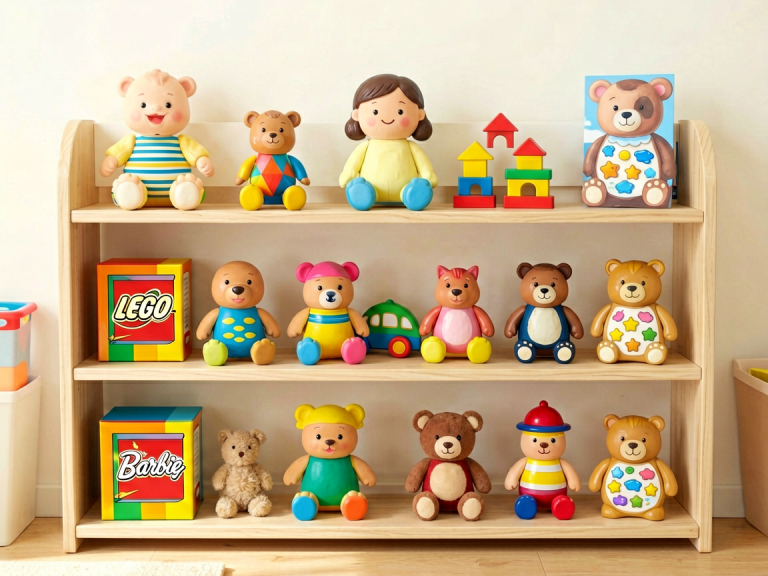
Equally important is the environment. A clutter-free, organized play space where toys are displayed by category allows children to see patterns and make choices. Rotating toys regularly – putting away some and bringing out others – maintains novelty and challenge. Parents should also model logical thinking in daily life: “I’m putting the milk in the fridge because the fridge keeps it cold. If I left it out, it would spoil.” This natural integration of logic into everyday routines reinforces what children learn through toys.
There is also a delicate balance between free play and guided play. While open-ended play with blocks is valuable, pure free play may not always push logical boundaries. A child who always builds the same tower is not exercising new logical muscles. Occasionally, a gentle challenge from an adult – “Can you build a tower that is taller than this chair? What will you do to make it stable?” – can stretch their thinking. However, overt teaching can be counterproductive. The goal is to preserve playfulness while subtly raising the cognitive stakes.
Conclusion: Beyond the Toy Box – A Legacy of Logical Thinking
Early logic toys are far more than entertainment. They are the training wheels for the reasoning mind. In the simple act of fitting a shape into a hole, matching a pair of pictures, or building a stable tower, a child learns the fundamental principles of order, causality, and analysis. These cognitive skills form the bedrock for reading comprehension (understanding story sequence), mathematical problem-solving (seeing patterns in numbers), and scientific inquiry (forming and testing hypotheses). In an era where information is abundant but critical thinking is scarce, the ability to reason logically is a superpower.
Investing in a thoughtful collection of early logic toys is investing in a child’s future capacity to navigate complexity, to question assumptions, and to approach problems with confidence and creativity. The preschooler who learns to persist through a difficult puzzle today is the adult who will tackle difficult problems with determination tomorrow. As parents and educators, we have the privilege – and the responsibility – to provide these small, profound tools. Let every shape sorter, every pegboard, and every matching game be a step on that journey, a tiny victory in the grand adventure of learning to think.