The Foundations of Thought: How Early Logic Toys at Home Shape Young Minds
Introduction
In the quiet corners of a living room, a toddler stacks wooden blocks, a preschooler fits a shape into its matching hole, and a kindergartner arranges colorful pattern cards. These seemingly simple acts are far from trivial. They represent the first steps into a world of reasoning, problem-solving, and structured thinking. Early logic toys for home use are not mere pastimes; they are the unsung architects of cognitive development. For decades, parents and educators have recognized that the home environment, when equipped with age-appropriate logic toys, can lay a robust foundation for mathematical, linguistic, and scientific reasoning. This article explores the historical roots, pedagogical principles, practical benefits, and modern innovations of early logic toys designed for the home, demonstrating why they remain indispensable in a digital age.
The Historical Emergence of Logic Toys for the Home
Long before educational psychologists coined terms like "executive function" or "spatial reasoning," parents instinctively used everyday objects to teach logic. The earliest logic toys were natural materials: stones arranged in patterns, sticks laid out to form geometric shapes, or shells sorted by size. In ancient China, the Tangram—a dissection puzzle consisting of seven flat pieces—emerged as a classic home logic toy, requiring players to recreate silhouettes using spatial visualization and geometry. Similarly, in Europe during the 18th century, building blocks became popular among aristocratic families as tools for teaching symmetry, balance, and cause-and-effect.
The modern era of early logic toys for home began with the work of pioneers like Friedrich Fröbel, who invented the "gifts" for his kindergarten system in the 1830s. Fröbel’s sets included soft woolen balls, wooden spheres, cylinders, and cubes, each designed to help children grasp abstract concepts like dimension, division, and unity through hands-on manipulation. These toys were meant for home use as much as for school, encouraging parents to engage in guided play. Later, Maria Montessori developed materials such as the pink tower, the brown stair, and the knobbed cylinders, all tailored for home environments to foster sensory discrimination, seriation, and logical sequencing. Montessori stressed that the prepared home—with carefully selected logic toys—could train a child’s mind to observe, compare, and reason independently.
Why Early Logic Toys at Home Matter More Than Ever
In today’s world, where screens dominate children’s attention, the tactile, interactive nature of physical logic toys offers unique cognitive benefits. Research in developmental psychology consistently shows that hands-on manipulation of concrete objects activates multiple brain regions simultaneously, enhancing memory, attention, and problem-solving skills. Early logic toys for home serve as a bridge between the concrete and the abstract. For instance, a child stacking rings from largest to smallest is not merely playing—she is internalizing the concept of ordering, a foundational skill for mathematics and logic.
Moreover, the home environment provides a low-pressure, intimate setting where children can explore at their own pace. Unlike school, where group dynamics and time constraints can create anxiety, home-based play with logic toys allows for repetition, trial-and-error, and self-correction. This autonomy builds confidence and a growth mindset. Studies have shown that children who engage regularly with logic toys at home demonstrate stronger performance in tasks involving pattern recognition, analogical reasoning, and strategic planning by the time they enter elementary school.
Key Categories of Early Logic Toys for Home
To understand how these tools operate, it is helpful to categorize them by the cognitive skills they target.
1. Shape Sorters and Nesting Toys
Classic shape sorters—boxes with cutouts for triangles, squares, and stars—teach early classification and shape recognition. Nesting cups or stacking rings require children to order objects by size, building an intuitive grasp of seriation and hierarchy. These toys are among the first logic challenges for infants and toddlers, often appearing in home playrooms from the age of 12 months.
2. Puzzles and Tangrams
Jigsaw puzzles, from simple two-piece wooden frames to complex 100-piece puzzles, demand visual-spatial reasoning and logical deduction. Tangrams, in particular, challenge children to reassemble a square into hundreds of other shapes, fostering geometric thinking and creativity. Home use of puzzles has been linked to improved mental rotation skills and spatial memory.
3. Pattern Blocks and Construction Sets
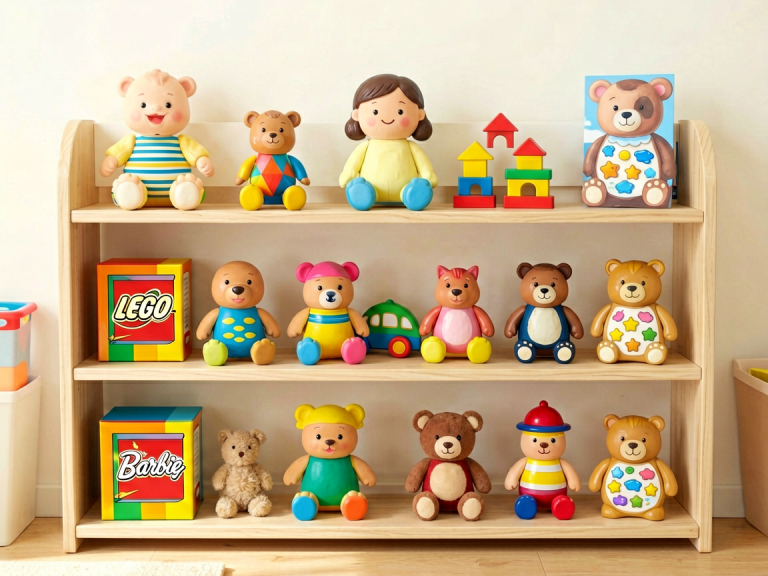
Colored wooden pattern blocks (triangles, rhombuses, hexagons) allow children to replicate designs or invent their own, teaching symmetry, fractions, and proportional reasoning. Construction sets like LEGO or unit blocks encourage planning, sequencing, and understanding of structural integrity. These toys are ideal for collaborative home play, where siblings or parents can discuss strategies.
4. Memory and Matching Games
Card games like Concentration (memory match) require children to hold and recall spatial locations, training working memory and attention to detail. Matching games that pair objects by color, texture, or category (e.g., animal families) teach classification and one-to-one correspondence, early steps toward logical reasoning.
5. Sequencing and Story Cards
Sets of picture cards that depict a simple sequence (e.g., a seed growing into a plant) help children understand temporal order and cause-effect relationships. These logic toys for home are particularly effective for language development, as children narrate the steps, connecting logical sequences to verbal expression.
The Parent’s Role in Maximizing Learning from Logic Toys
While early logic toys are designed to be self-correcting and independently explorable, the quality of adult interaction significantly amplifies their benefits. Parents who engage in "scaffolding"—asking open-ended questions, offering minimal guidance, and modeling reasoning—transform play into deep learning. For example, when a child struggles to fit a puzzle piece, a parent might ask, "What shape is that hole? Can you turn the piece around?" rather than simply placing it correctly. This verbal reasoning helps the child internalize logical steps.
It is also essential to rotate toys and introduce increasing complexity. A toddler might begin with large, simple shape sorters, then progress to puzzles with more pieces, then to pattern blocks with design cards. The home environment should offer a variety of logic toys that challenge different faculties—spatial, numerical, linguistic—without overwhelming the child. Too many toys at once can hinder focus; a curated, minimalist approach often yields better results.
Cognitive and Academic Outcomes of Early Logic Play at Home
The benefits extend far beyond playtime. Longitudinal studies have found that children who engage in structured logic play at home during the preschool years exhibit higher scores in mathematics and reading comprehension in primary school. Why? Logic toys train the brain to recognize patterns, make predictions, and test hypotheses—skills that underpin all academic disciplines. For instance, a child who has practiced sequencing with story cards will find it easier to follow the plot of a book; a child who has worked with tangrams will more readily grasp fractions and geometry.
Furthermore, early logic toys foster executive function: the ability to inhibit impulses, shift attention, and hold information in mind. A child assembling a complex LEGO structure must plan steps, resist distractions, and adjust when pieces don’t fit—a microcosm of real-world problem-solving. These skills are predictive of future success in careers ranging from engineering to medicine.
Modern Innovations: Combining Tradition with Technology
The 21st century has seen a resurgence of interest in early logic toys for home, now enhanced by smart materials and digital integration. Wooden blocks with embedded magnets allow for more stable structures. Augmented reality puzzles overlay digital animations on physical pieces, rewarding correct placements with interactive stories. Some logic toys now feature apps that track a child’s progress, suggesting new challenges. However, experts caution that the core value remains in the tactile manipulation and offline exploration. The best modern logic toys preserve the hands-on essence while offering subtle technological boosts.
For example, "coding" toys like robotic mice or programmable building blocks introduce early computational logic—sequencing, loops, conditionals—through physical play rather than screens. Children can plan a path for the mouse to reach a cheese, debugging errors by rearranging command cards. These toys bring abstract algorithmic thinking into the home living room, preparing children for a digital world without sacrificing sensory engagement.
Challenges and Considerations for Parents
Despite the clear benefits, not all logic toys marketed for home are equally effective. Parents should prioritize open-ended materials that allow multiple solutions over toys with a single "right answer." Flashy, battery-operated toys that beep for correct answers often short-circuit the child’s thinking process, reducing opportunities for genuine problem-solving. Simplicity is key: a set of wooden shapes can engage a child for years, while a single-purpose electronic device may be abandoned after a week.
Cost and accessibility are also factors. Fortunately, many effective early logic toys can be made at home using craft supplies—cardboard shape sorters, homemade tangrams, or sticker patterns. The home environment itself offers logic challenges: sorting laundry by color, arranging plates by size, or matching socks encourages logical thinking with zero expense.
Conclusion
Early logic toys for home are far more than playthings; they are the foundational tools that shape a child’s ability to reason, analyze, and create. From the ancient Tangram to modern coding robots, these toys have evolved to meet the needs of developing minds in a nurturing home setting. By providing children with opportunities for hands-on exploration—guided but not dominated by adults—parents can cultivate a love for logical thinking that lasts a lifetime. In an age of information overload, the focused, tactile, and self-paced nature of early logic toys remains a powerful antidote, proving that sometimes the best preparation for the future lies in the simplest blocks, puzzles, and patterns that have delighted children for generations.
*(Word count: approximately 1,450 words)*