Taming the Toy Tornado: Practical Strategies for Parents Overwhelmed by Playroom Clutter
Introduction: The Silent Burden of Too Many Toys
Every parent knows the scene: you walk into the living room and it looks as though a plastic, stuffed, and battery-operated tornado has swept through. Blocks are scattered under the sofa, doll clothes are draped over the lamp, and half a dozen board games are missing crucial pieces. Toy clutter is more than just an eyesore; it is a source of daily stress, financial waste, and even developmental friction. Research in developmental psychology suggests that an overabundance of toys can actually hinder a child’s ability to focus, foster creativity, and learn to care for their belongings. Yet, as parents, we are often caught between the desire to give our children happy, stimulating childhoods and the very real need to maintain a home that does not drive us to the brink of insanity.
This article offers a comprehensive, evidence-informed, and compassionate roadmap for parents who want to reclaim their living spaces—and their sanity—without making their children feel deprived. The goal is not to create a sterile, toy-free zone, but to establish a sustainable system that respects both the child’s developmental needs and the parent’s need for order. We will explore the psychology behind toy accumulation, practical decluttering methods, strategies for managing gifts and hand-me-downs, and ways to maintain a toy environment that encourages deep play rather than chaotic distraction.
Section 1: Understanding Why Toy Clutter Happens
Before diving into solutions, it is vital to understand the root causes of toy clutter. Many parents are surprised to learn that the sheer volume of toys in a typical Western household has doubled or tripled over the last two generations. Several factors contribute to this explosion.
First, there is the “grandparent effect.” Loving grandparents often express affection through gifts, and they rarely consult with parents about the child’s existing collection. Second, there is the “goody bag culture.” Birthday parties, holidays, and even trips to the doctor often yield small plastic objects that quickly accumulate. Third, parents themselves are susceptible to impulse buys—a cute stuffed animal at the checkout, a “developmental” toy on sale, or a themed playset that promises hours of quiet amusement.
Crucially, many parents experience guilt when they try to reduce the toy collection. They worry that throwing away or donating a toy will make them seem ungrateful or will disappoint the child. This emotional attachment—both to the idea of childhood abundance and to the memory each toy represents—keeps clutter alive long after the toy’s functional life is over. Recognizing that a toy’s purpose is to be played with, not merely to exist in a bin, is the first step toward liberation.
Section 2: The Ten-Minute Toy Audit – A Low-Stress Starting Point
Most parents feel overwhelmed by the very idea of “decluttering the playroom.” The secret is to start tiny. I recommend a “Ten-Minute Toy Audit,” which can be done once a week. Set a timer for ten minutes, grab a laundry basket, and walk through the main play areas. Without overthinking, pick up any toys that are obviously broken beyond repair (crayons snapped in half, puzzles missing multiple pieces, a stuffed animal with a torn seam that cannot be sewn). Place these directly into a trash bag or a recycling bin if appropriate. Do not show them to the child; just dispose of them silently.
Next, pick up any toys that your child has not touched in at least three months. This does not include seasonal favorites (snow toys in summer, for instance) or beloved comfort items. Place these into the basket and move them to a “quarantine zone”—a closet shelf or a garage bin. Label the container with the date. If your child does not ask for a single item from the quarantine zone within the next four to six weeks, those toys can be donated without guilt. This method is gentle because it does not require immediate farewells; it gives both parent and child a grace period to grieve or rediscover.
Section 3: The Rotation System – Less Is More for Focused Play
One of the most effective strategies for managing toy clutter is not to eliminate toys entirely, but to rotate them. The concept is simple: instead of having all toys available all the time, you keep a “active set” of 15–20 items (or fewer for younger children) and store the rest in labeled bins out of sight. Every two to four weeks, swap the active set with a new batch from storage.
Why does this work? Young children, especially those under six, can become overstimulated by too many choices. When a child faces a mountain of toys, they often flit from one to another, never settling into deep imaginative play. With a smaller curated selection, they are forced to engage more creatively with what is available. Moreover, when a toy returns after a few weeks, it feels fresh and exciting again—almost like a new gift. Parents report that their children spend longer stretches of focused time with rotated toys than they ever did with an open closet.
To implement rotation, invest in stackable, clear plastic bins. Categorize toys by type (building toys, pretend play, art supplies, puzzles, etc.) or by theme (animals, vehicles, kitchen). Label each bin with a photo or simple text so older children can help with the swap. Schedule a “toy exchange day” on the same day every month, perhaps a Sunday afternoon. Make it a ritual: your child helps you carry the bins, and you spend ten minutes together arranging the new set on the shelves. This turns decluttering into a fun, empowering activity rather than a chore.
Section 4: The Gift-Giving Game – How to Handle Incoming Toy Flow
Even the most disciplined parent cannot control every source of toy inflow. Birthdays, holidays, and well-meaning relatives will continue to send new objects. The key is to manage this inflow with a proactive, gentle policy.
First, create a “one-in, one-out” rule with your child. Explain it in terms the child can understand: “Whenever we bring a new toy into the house, we find a different toy that we no longer play with, and we thank it for its service and pass it on to another child.” For younger children, you might physically remove an old toy together before the new one is unwrapped. This teaches a lesson about abundance and gratitude without invoking loss.
Second, talk to grandparents and close friends ahead of the holiday season. You can say something like, “We are trying to keep our home more manageable for the kids. We would love for you to give experiences instead—museum memberships, cooking classes, or even a trip to the zoo with you.” Many relatives will be relieved to have a specific suggestion. If they insist on a physical gift, you can suggest consumables (art supplies, play dough, stickers, bath bombs) that have a natural end-of-life. You can also ask them to contribute to a savings account for a larger item, such as a bicycle or a tablet, rather than buying multiple smaller objects.
Third, establish a “toy donation bin” in your home. Place a medium-sized basket in the playroom or near the door. Encourage your child to place toys they have outgrown into it whenever they notice them. When the bin is full, you take it to a local charity or a shelter together. This normalizes the act of giving and prevents the toys from clogging your storage.
Section 5: Zoning Your Play Space – Functional Areas Reduce Visual Chaos
Clutter often feels overwhelming because toys are scattered across every surface. A simple way to regain control is to create designated zones in your play area. Even if you only have a corner of the living room, you can define three zones: a quiet zone, a building zone, and a creative zone.
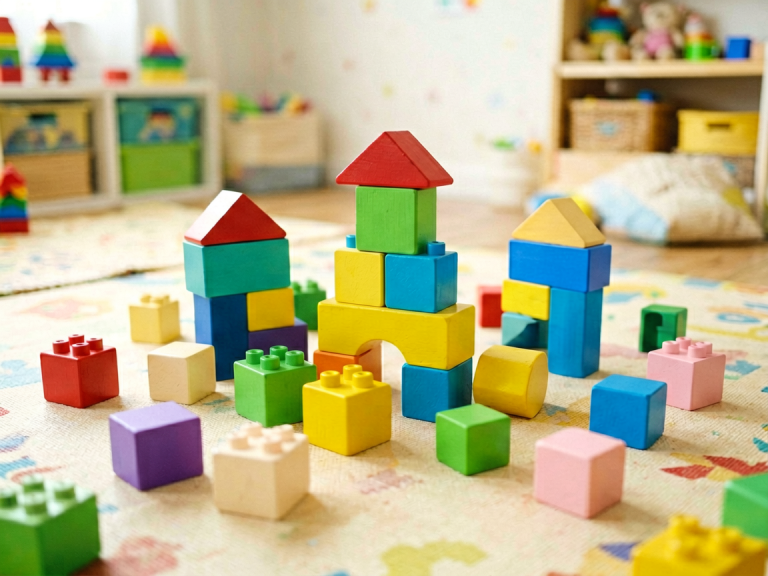
The quiet zone contains books, puzzles, a cozy cushion, and calm toys like stuffed animals or a sensory bottle. The building zone holds blocks, LEGO, Magna-Tiles, and construction sets. The creative zone is for art supplies, craft kits, and dress-up clothes. Use low shelves, bins, and rugs to visually separate these areas. Teach your child that blocks stay in the building zone, and art supplies remain on the table in the creative zone. While this may sound rigid, it actually gives children a sense of predictable order. They know exactly where to find what they need and, equally important, where to return it.
For toys that are inherently messy—like Play-Doh, finger paints, or kinetic sand—designate a special “messy play” time and a specific tray or plastic tablecloth. After the activity, the tray is cleaned and put away. This prevents the spills and sticky residue that contribute to overall clutter.
Section 6: Digital Detox for Toys – Managing Electronic Clutter
In the modern home, toy clutter is not limited to physical objects. Electronic toys with batteries, screens, and sound effects add a layer of auditory and visual clutter that can be exhausting. Many of these toys have a short attention span—they repeat the same phrases, they require batteries that die quickly, and they often inhibit imaginative play because they direct the child rather than being directed by the child.
Consider applying a “no batteries” rule for a trial period. Remove all electronic toys from the active rotation for two weeks. Observe how your child plays. Most parents report that children initially protest but soon adapt by using their own voices and imaginations to create sounds and stories. If you do keep a few electronic toys, set strict limits: one electronic item available at a time, and only for a limited duration. This reduces the visual and auditory noise of the playroom and encourages more calmer, self-directed play.
Section 7: Maintenance Rituals – The Daily and Weekly Reset
No system will work if it is not maintained. Toy clutter is like dust: it accumulates naturally. The key is to have simple, consistent reset routines.
Every evening, before bath or bedtime, spend five minutes doing a “toy sweep” with your child. Put on a favorite song and race to see how many toys can be returned to their homes. Even toddlers can participate if you make it a game. For older children, a reward chart can work—each successful week of toy-returning earns a small privilege, like choosing a family movie or staying up fifteen minutes later on Friday.
Weekly, on the same day you rotate toys, do a deeper clean. Wipe down shelves, check for broken pieces, and revisit the quarantine zone. This weekly reset prevents the gradual creep that makes a room feel cluttered again.
Conclusion: The Gift of Less
Ultimately, tackling toy clutter is about more than a tidy home. It is about teaching our children that they do not need endless possessions to be happy, that they can take care of the things they love, and that generosity—letting go of toys so others can use them—is a sign of strength, not loss. It is about giving ourselves permission to say no to the constant pressure of consumer culture. Every toy we remove from the floor is a small act of mental freedom. Every organized shelf is a breath of calm in a busy day.
As parents, we cannot control everything, but we can control the environment we create for our families. Start small, be consistent, and remember that the ultimate goal is not perfection but a home where play is joyful, deep, and—most importantly—manageable. Your children will play better with fewer toys, and you will find more energy to be present with them instead of buried under plastic dinosaurs. That is the true win.