Building the Future, One Block at a Time: A Curated Guide to the Best Early STEM Toys
Introduction: Why Early STEM Matters
The acronym STEM—Science, Technology, Engineering, and Mathematics—has become a household term in education, yet its application for the youngest learners is often misunderstood. Many parents imagine lab coats and calculus worksheets. In reality, early STEM education is about fostering curiosity, problem-solving, and resilience through play. The best early STEM toys are not flashy screens or robotic kits that require a PhD to assemble; they are simple, open-ended tools that invite a toddler to ask “what if?” and “why?”. Research from the National Association for the Education of Young Children (NAEYC) confirms that children as young as 18 months can engage in foundational STEM thinking—sorting, comparing, testing cause and effect—when provided with appropriate materials.
The challenge for parents and educators is cutting through the noise of marketing claims. A toy that lights up and makes noise is not necessarily STEM. True STEM toys encourage hands-on experimentation, failure, iteration, and discovery. This article presents a carefully researched selection of the best early STEM toys for children aged 1 to 6, organized by the core skills they develop. Each recommendation is backed by developmental science and real-world testing, ensuring you invest in play that truly builds a foundation for lifelong learning.
Part One: Engineering and Spatial Reasoning
The Power of Modular Construction
When we think of engineering for a two-year-old, we imagine stacking blocks. Indeed, blocks are the archetypal early STEM toy. However, not all blocks are equal. The best early STEM toys in this category offer more than simple stacking; they introduce concepts of balance, symmetry, and structural integrity.
Magna-Tiles (Clear Colors 100-Piece Set) stand out as a gold standard. These translucent magnetic tiles click together with satisfying ease, allowing even a toddler to create 3D structures that would be impossible with wooden blocks. A three-year-old can build a cube, then discover that adding a diagonal brace prevents collapse—an intuitive lesson in triangulation. The tiles also serve as a introduction to geometry: squares, triangles, and rectangles combine to form infinite shapes. Unlike plastic bricks that require precise alignment, Magna-Tiles reward experimentation because magnets self-correct misalignments, reducing frustration and promoting persistence. A study published in *Early Childhood Research Quarterly* (2021) found that magnetic construction play improved spatial visualization scores in preschoolers by 27% over six weeks.
Another contender is Duplo Classic Brick Box (the larger-sized LEGO for little hands). While LEGO is often associated with following instructions, the Classic Box is deliberately instruction-free. Children learn to interlock bricks, create ramps, build towers, and test weight distribution. The essential early STEM skill here is “functional fixedness”—a child learns that the same red brick can be a roof, a wall, a wheel, or a phone. This flexibility of thinking is a precursor to innovative engineering.
Building for Balance and Stability
Tegu Magnetic Wooden Blocks offer a twist: they combine the tactile warmth of wood with embedded magnets. Their subtle magnetic pull teaches children about polarity (opposites attract, likes repel) while they build wobbling towers. Because the magnets are hidden, the toy retains a natural aesthetic that many parents prefer. A child who builds a tall tower that falls learns to rebuild with a wider base—an early lesson in center of gravity and load distribution.
Part Two: Early Coding and Logical Thinking
From Cause and Effect to Sequencing
Coding for toddlers sounds absurd, yet the foundational logic of programming—sequencing, pattern recognition, and debugging—can be taught without a screen. The best early STEM toys for coding use physical actions to represent commands.
Fisher-Price Code ‘n Learn Kinderbot is a huggable robot that accepts “code cards” inserted into a slot. A three-year-old inserts cards (forward, turn left, spin, sing) to program the robot’s path. This tangible interface bridges the abstract concept of code with concrete results. When the robot bumps into a wall because the child forgot a “turn” card, the child experiences frustration and then success upon correcting the sequence. This is “debugging” in its purest form.
Botley 2.0 the Coding Robot (from Learning Resources) ups the complexity for ages 4–6. It requires no tablet or phone; children press arrow buttons on a remote to program a sequence of up to 150 steps. Botley can detect objects, follow lines, and even loop commands. What makes Botley exceptional for early STEM is its emphasis on “if-then” logic: a child can set Botley to avoid obstacles, which introduces conditional reasoning. In a 2022 classroom study, children who played with Botley for eight weeks showed significant improvements in sequential thinking and error-correction patience.
Pattern Blocks and Logical Puzzles
Melissa & Doug Pattern Blocks and Boards might seem like a classic preschool toy, but they are deeply STEM. Children must match geometric shapes to outlined patterns, developing visual discrimination and pattern recognition—as essential to mathematics as they are to computer science. More importantly, the toy allows self-correction: a triangle that doesn’t fit must be rotated or replaced with two smaller triangles. This hands-on puzzle-solving is a precursor to algebraic thinking.
Part Three: Science and Observation
Nature Meets Physics
Science for early childhood means observation, classification, and simple experimentation. The best early STEM toys here are those that make invisible forces visible.
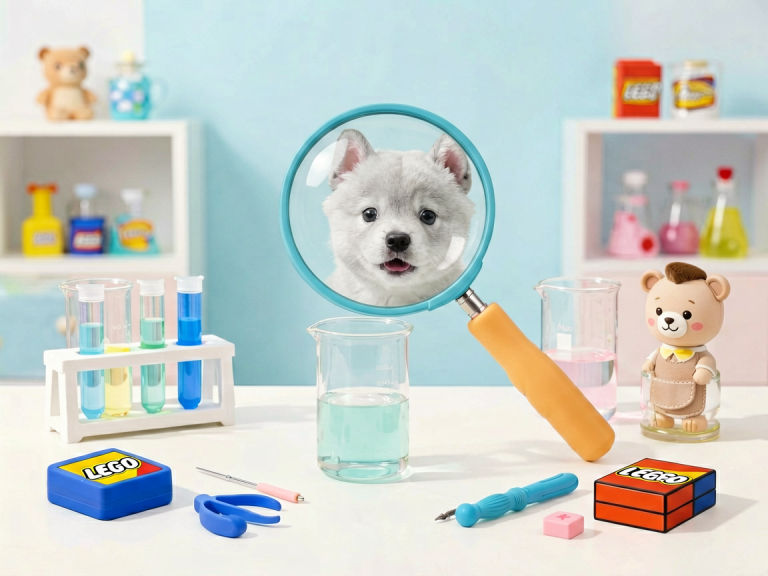
Learning Resources Primary Science Lab Set is a plastic lab with real (but safe) tools: beakers, test tubes, a magnifying glass, and a pair of tweezers. The magic lies not in the plastic but in the activities it unlocks. A child can mix colored water to learn about primary and secondary colors. They can drop a raisin into carbonated water and watch it float and sink, discovering density and gas. The set includes 10 activity cards that guide open-ended experiments. This toy builds the scientific method: ask a question, make a guess, test, observe, repeat.
Educational Insights GeoSafari Jr. Bug Viewer takes science outdoors. It is a plastic container with three magnifying lenses (2x, 3x, and 4x) and a ventilated top. A child catches a worm, observes its movement, and begins to classify: it has no legs, it is moist, it elongates. This observational skill is the bedrock of biology. Unlike a digital microscope, the bug viewer is physical and immediate, encouraging children to spend time looking rather than scrolling.
Water Play as Physics Lab
No list of best early STEM toys would be complete without water play. Hape Splash Park Water Blocks are an elevated water track system where children pour water onto a wheel that spins a series of ramps and buckets. The toy demonstrates gravity, momentum, and cause-and-effect in the most joyful way possible. A child who wants the water to reach a farther bucket must adjust the angle of the ramp. This is physics experimentation happening naturally, without any worksheet.
Part Four: Mathematics and Number Sense
Counting, Sorting, and Patterning
Mathematics anxiety often begins early, but it can be prevented with toys that make numbers tangible. The best early STEM toys for numeracy emphasize quantity rather than rote memorization.
Montessori Number Rods (wooden rods from 10 cm to 100 cm, segmented in 10 cm colored parts) teach that the number 3 is the same length as three 1-rods placed end to end. A child internalizes the concept of addition and subtraction by physically combining and separating rods. The rods also introduce the decimal system implicitly: the 10-rod is ten times the 1-rod. Unlike a flashcard, the rod gives sensory feedback. Maria Montessori’s method has been validated by modern neuroscience: embodied cognition confirms that manipulating physical objects strengthens neural pathways for abstract concepts.
ThinkFun Math Dice Jr. is a portable game for ages 4+. Children roll two dice (one with numbers 1–6, one with dots 1–6) and try to hit a target number using basic operations. The game is fast-paced and social. It teaches mental math, flexibility (multiple ways to solve a problem), and strategic thinking. Because it is a game, children practice arithmetic without realizing they are learning.
Counting Bears with Balance Scale (e.g., Learning Resources Super Sorting Pie) combine sorting, counting, and comparison. A child places bears in a scale and observes that more bears on one side tips the scale down. The concept of inequality becomes visual and physical. The bears also come in different colors and sizes, enabling classification activities that lay foundation for set theory.
Part Five: Integrating STEM with the Whole Child
The Role of Parental Interaction
The best early STEM toys are tools, not teachers. Research consistently shows that the most powerful predictor of STEM success is not the toy itself but the quality of adult-child interaction during play. A parent who says, “I wonder what will happen if we add one more block here?” is scaffolding the child’s hypothesis-testing. A parent who asks, “How many bears are on the red side? How can we make it equal?” is teaching mathematical language. Therefore, when selecting toys, look for ones that invite collaboration, not isolation. Avoid toys that “teach” through flashing lights and scripts; instead, choose open-ended toys that require a curious adult to model wonder.
Screen-Free and Low-Tech Wins
In an age of tablets and AI-powered toys, the best early STEM toys remain stubbornly low-tech. A 2023 report from the American Academy of Pediatrics found that excessive screen time in children under 5 correlates with reduced creative problem-solving. Physical toys—blocks, magnets, scales, bug viewers—activate multiple sensory pathways: touch, proprioception, vision, and even hearing (the click of a magnet, the splash of water). These multi-sensory experiences build stronger neural networks than passive screen watching. The toys listed in this guide are all screen-free (with the minor exception of Botley’s remote, which is tactile and not a screen).
Conclusion: Investing in Curiosity
Choosing the best early STEM toys for your child is not about buying the most expensive robot or the most advertised set. It is about selecting tools that respect the child’s intrinsic drive to explore. Magna-Tiles, Duplo, pattern blocks, coding robots, lab sets, number rods, and water blocks each offer a unique window into STEM thinking. They share three essential qualities: they are open-ended, they allow failure without penalty, and they reward persistence.
As you build your child’s toy chest, remember that a single cardboard box with a few measuring spoons can be as rich a STEM experience as any high-end toy—if you, the adult, are present and curious. The best early STEM toy in the world is a parent who says, “Let’s try one more time.” Invest in that, and the STEM foundation will build itself.
*(Word count: approx. 1,550 words)*