From Chaos to Curriculum: How Parents Can Harness Toy Clutter as a Powerful Teaching Tool
Introduction: Rethinking the Mess
If you are a parent, you have likely spent countless evenings stepping over scattered Legos, sorting mismatched puzzle pieces, or tripping over a forgotten stuffed animal in the dark. Toy clutter is often viewed as a household nuisance—a daily reminder of lost battles against entropy. Yet what if this very mess is not a problem to be eliminated but a resource to be utilized? The word “clutter” comes from the Middle English *clotter*, meaning to clot or congeal, but in the hands of a clever parent, toy clutter can become a living, breathing curriculum. This article explores how mothers and fathers can intentionally “use” toy clutter—not just manage it—to teach organization, stimulate creativity, build emotional intelligence, and even introduce foundational academic concepts. The goal is not a spotless playroom but a purposeful one.
1. The Hidden Potential of Toy Clutter: A Parent’s Perspective
Before diving into strategies, it is essential to reframe the mindset. Most parental energy goes into *containment*: bins, labels, rotation systems, and the occasional donation purge. While these methods have their place, they treat clutter as waste. Instead, consider toy clutter as a form of “emergent curriculum.” In early childhood education, the environment is often called the “third teacher.” When toys are spread across a living room floor, they create an organic, child-directed learning space. A pile of blocks can become an impromptu physics lab; a jumble of action figures can spark a complex narrative about justice and teamwork. By resisting the impulse to tidy immediately, parents allow children to explore relationships between objects that a neatly shelved collection would never reveal. The key is intentional observation: what patterns emerge? What questions do the children ask? Toy clutter is not random—it is a map of a child’s current interests and cognitive growth.
2. Using Toy Clutter as a Learning Laboratory: The Montessori-Inspired Approach
One of the most powerful ways to use toy clutter is to transform it into a self-directed learning environment. Maria Montessori famously advocated for a prepared environment where materials are accessible and ordered, but she also understood that children need freedom to manipulate and combine them. A cluttered play space, paradoxically, can mimic the richness of a discovery zone—provided parents serve as guides rather than custodians.
2.1 Encouraging Sensory and Fine Motor Exploration
Young children learn through their senses. A pile of mixed toys—plastic fruits, wooden trains, fabric scraps, and magnetic tiles—offers a tactile symphony. Instead of demanding that everything be sorted, parents can sit with the child and say, “I notice you have three blue items and two red ones. Let’s see how many ways we can group them.” This turns a mess into a sorting lesson. Similarly, a tangle of doll clothes and ribbons provides endless opportunities for buttoning, tying, and lacing—critical fine motor skills. The clutter itself becomes the material for dexterity training.
2.2 Introducing Math and Spatial Reasoning
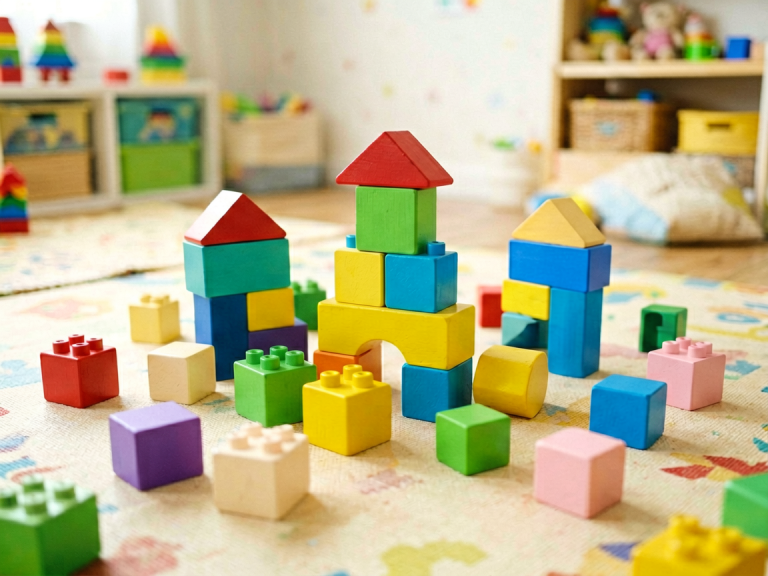
Toy clutter is a goldmine for early math. Ask a child to count how many wheels are on the floor, or to estimate which pile is taller. The irregular arrangement of toys creates problems that a clean, organized shelf never would. For instance, if a child wants to build a tower but cannot find enough same-sized blocks, they must problem-solve: substitute other items, balance a dinosaur on a cup, or redesign the structure. This is engineering thinking in raw form. Parents can scaffold this by asking questions: “How can we make the tower more stable?” or “What happens if we put the heaviest block at the bottom?” The clutter provides the variables.
3. Using Toy Clutter to Teach Organization and Responsibility
Here lies a beautiful irony: to “use” clutter effectively, parents must eventually teach children to manage it. But the lesson should not begin with a command to “clean up.” Instead, the clutter becomes a problem to be solved by the child, with the parent as a coach.
3.1 The “Inventory Challenge”
Once a week, designate a “clutter assessment” time. Gather all toys into a central area and take a photo. Then, ask your child to categorize the items: “Which ones go together? Which ones are broken? Which ones do you never play with?” This simple exercise teaches classification, decision-making, and even early arithmetic (counting, comparing quantities). The child learns that clutter is not a failure but a system that can be redesigned. Over time, they internalize organizational principles because they *chose* them, not because you enforced them.
3.2 The Rotating Museum Method
Toy clutter often results from having too many items out at once. But instead of a one-time purge, use clutter strategically by creating a “museum of the week.” Each week, let your child select five or six toys to display on a special shelf or mat. All other toys are stored away. The “clutter” is now curated, and the child becomes a curator. They must decide which items are most meaningful, which combinations inspire play, and how to arrange them aesthetically. This process teaches prioritizing, care for objects, and spatial planning. When the week ends, the child rotates items, and the “clutter” of last week becomes a new exhibit. The mess is transformed into a deliberate, evolving display.
4. Fostering Creativity and Problem-Solving Through Controlled Chaos
Many parents worry that too many toys reduce creativity because children flit from one item to another. However, research in psychology suggests that moderate environmental complexity actually *boosts* creative thinking. A slightly cluttered play area (as opposed to barren or hyper-organized) encourages children to make novel combinations. Here is how parents can tap into that potential.
4.1 The “Zany Invention” Sessions
Set a timer for 15 minutes and challenge your child to build something new using only the toys currently on the floor—no new items allowed. This constraint forces innovative thinking. A wooden block can become a phone; a scarf can become a superhero cape; a plastic cup can become a rocket nose cone. The clutter is the raw material, and the parent can video the process or ask the child to explain their invention. This is not just play; it is design thinking, iteration, and narrative building.
4.2 Story-Starter Piles
Take a snapshot of the current toy mess. Print it out (or show it on a tablet) and use it as a story prompt. “Look at all these toys. They are all characters in a story. What happened that made them end up here together?” The child creates a narrative that explains the clutter—a hurricane? A party? A rescue mission? This transforms a source of parental frustration into a creative writing exercise. Older children can write or dictate a short story; younger ones can act it out. The clutter becomes the first page of an infinite book.
5. The Emotional and Social Lessons from Toy Clutter
Toy clutter is not just academic; it is deeply emotional. How parents respond to a messy room teaches children about empathy, boundaries, and collaboration.
5.1 Negotiating Shared Space
When siblings play together, toy clutter often leads to conflict: “He took my favorite car!” or “She left her dolls here!” Instead of solving these disputes, use the clutter to teach negotiation. Create a simple rule: “If a toy is left in a common area, it can be used by anyone. If you want to save it, put it in your private bin.” The clutter forces children to communicate, compromise, and respect property. Parents can mediate by saying, “The puzzle pieces are all mixed up. How can you work together to sort them?” The lesson is that clutter is a shared responsibility.
5.2 Building Emotional Resilience
A messy room can feel overwhelming, especially for a sensitive child. Parents can use this feeling as a teachable moment. When a child says, “I can’t find anything,” the parent can say, “Let’s take a deep breath. Clutter is just information that needs to be organized. Let’s start with one square foot.” This models emotional regulation and problem-solving under stress. The child learns that chaos is not a crisis but a problem with a solution. Over time, they develop executive function skills—planning, sustained attention, and impulse control—all while standing in the middle of a toy pile.
6. Practical Strategies for Implementing a “Clutter Curriculum”
To avoid overwhelming yourself, adopt a gradual approach. Here are concrete steps:
6.1 The Weekly Clutter Audit
Every Sunday evening, spend 20 minutes with your child surveying the week’s toy mess. Take a photo. Discuss: “What was the most fun thing you did with these toys? What was the hardest part about cleaning up?” Write down observations in a “clutter journal.” This builds metacognition—children become aware of their own play patterns.
6.2 The “Clutter Buster” Game
Turn cleaning into a data collection exercise. For example, challenge: “How many red toys can you find in two minutes?” or “Can you find five toys that are soft?” This gamifies tidying while reinforcing color recognition, textures, and counting. When cleanup is over, discuss what they learned. The clutter was not just cleaned—it was *used*.
6.3 Introduce a “Clutter Bank”
Create a box labeled “Clutter Bank.” Whenever you find a toy that is rarely used, put it in the bank instead of discarding it. After a month, open the bank together. The child can decide: donate, swap with a friend, or reintroduce to the play area. This teaches the economics of scarcity and the emotional skill of letting go. The bank turns clutter into a currency of choice.
Conclusion: The Gift of the Mess
Parents do not need to become janitors to raise capable, creative children. By reimagining toy clutter as a dynamic educational resource, we can relinquish the pressure to maintain pristine order and instead embrace the power of the pile. Toy clutter is not a sign of failure; it is a sign of life. It is evidence that children are exploring, testing, growing. The question is not “How do I get rid of this mess?” but rather “What can this mess teach us today?” When parents adopt this mindset, every stray Lego becomes a lesson, every tangled dress-up costume a story, and every jumble of plastic animals a miniature ecosystem of learning. The clutter, once an enemy, becomes an ally—messy, unpredictable, and full of potential.