The Power of Play: How Learning Toys Shape Elementary Kids’ Cognitive and Social Development
—
Introduction
In the early years of elementary education—roughly ages 6 to 11—children undergo a remarkable transformation. They move from concrete, egocentric thinking to more logical, cooperative, and abstract reasoning. While formal schooling provides the curriculum, the tools children use during free play can be just as influential. Learning toys, specifically designed to blend fun with educational outcomes, have become a cornerstone of modern child development. But not all toys are created equal. The best learning toys for elementary kids are those that challenge their growing minds, encourage problem-solving, foster creativity, and nurture social skills—all while keeping them genuinely engaged. This article explores the multifaceted role of learning toys, categorizes the most effective types, and offers practical guidance for parents and educators seeking to maximize the benefits of play.
—
The Science Behind Play-Based Learning
Play is not a frivolous pastime; it is the brain’s preferred method of learning. Neuroscientific research shows that when children play, their brains release dopamine, a neurotransmitter associated with motivation and reward. This chemical response strengthens neural pathways, making new information easier to retain. For elementary-aged children, play-based learning aligns with Jean Piaget’s theory of cognitive development, specifically the concrete operational stage (ages 7–11). During this phase, children begin to grasp concepts like cause and effect, classification, and conservation. Learning toys that require sorting, sequencing, or building directly tap into these emerging abilities.
Moreover, Lev Vygotsky’s concept of the “zone of proximal development” highlights the importance of guided play. A toy that is too simple becomes boring; one that is too complex leads to frustration. The ideal learning toy sits just beyond a child’s current skill level, providing a scaffold for new understanding. This is where puzzles, construction kits, and strategy games excel—they offer incremental challenges that children can master with persistence.
—
Types of Learning Toys and Their Specific Benefits
STEM-Based Building Kits
STEM (Science, Technology, Engineering, Mathematics) toys remain a powerhouse for elementary learners. Magnetic tiles, interlocking gears, and modular building blocks (like LEGO Technic or K’Nex) teach spatial reasoning, basic physics, and engineering principles. When a child constructs a bridge that holds weight, they internalize concepts of balance and load distribution. When they design a marble run, they experiment with gravity and momentum. These toys also encourage trial-and-error, a foundational scientific method. Importantly, they are gender-neutral; research shows that early exposure to building toys can close the gender gap in STEM fields by fostering confidence in spatial tasks.
Logic Puzzles and Strategy Games
Board games that require deduction, pattern recognition, or strategic thinking are invaluable. Classics like *Chess*, *Mastermind*, or *Rush Hour* train working memory, planning, and flexible thinking. For younger elementary kids, games like *Blokus* or *Katamino* develop geometric reasoning and turn-taking. Puzzle games—both physical jigsaw puzzles and logic puzzles (e.g., Sudoku for kids)—improve concentration and perseverance. Unlike screen-based alternatives, physical puzzles offer tactile feedback and allow children to physically manipulate pieces, which reinforces hand-eye coordination and fine motor skills.
Creative and Open-Ended Materials
While structured toys have clear goals, open-ended materials like modeling clay, art supplies, and building blocks without instructions foster divergent thinking. Elementary children benefit greatly from activities that have no single “right answer.” A set of wooden blocks can become a castle, a spaceship, or a zoo—depending on the child’s imagination. Similarly, craft kits that combine art with basic math (e.g., bead patterns, symmetry painting) integrate creativity with cognitive skills. The Montessori approach emphasizes such materials because they allow children to self-correct and explore at their own pace, building intrinsic motivation.
Language and Literacy Toys
Reading and writing toys go beyond simple flashcards. Magnetic poetry sets, Scrabble Junior, or word-building tiles (like Bananagrams) make vocabulary acquisition playful. Story cubes—dice with pictures—inspire children to create narratives, enhancing both oral language and sequencing skills. For bilingual or multilingual families, puzzle games that teach foreign words through matching can accelerate language learning. These toys work because they transform a potentially tedious task (memorizing spelling) into a social, hands-on game.
Science Experiment Kits
Elementary kids are natural scientists; they ask endless “why” questions. Science kits—whether chemistry sets, crystal-growing kits, or simple circuits—channel that curiosity into structured discovery. A child who mixes baking soda and vinegar learns about chemical reactions in a memorable, multisensory way. Such kits also introduce scientific vocabulary and the importance of following procedures. Safety is paramount, so kits designed for ages 6+ should avoid hazardous chemicals and include clear, illustrated instructions.
—
Cognitive Skills Enhanced Through Learning Toys
Learning toys are not merely about absorbing facts; they cultivate higher-order thinking. Critical thinking emerges when children must analyze a problem, consider multiple solutions, and choose the most effective one. For instance, a child struggling with a logic puzzle learns to break the challenge into smaller steps—a skill applicable to math word problems and real-life dilemmas. Executive function—the brain’s management system—is strengthened through rule-based games that require impulse control (waiting for a turn) and cognitive flexibility (switching strategies when one fails). Studies show that children who regularly engage with complex board games perform better on tasks measuring self-regulation.
Spatial intelligence is another key area. Toys like tangrams, 3D puzzles, and geoboards improve the ability to visualize and manipulate objects in space—a predictor of success in geometry, architecture, and even surgery. Numeracy also gets a boost. Simple board games that involve counting spaces (e.g., *Chutes and Ladders*) reinforce number sense, while more advanced games like *Monopoly Junior* introduce money management and arithmetic. The key is that learning occurs naturally, without drill or pressure.
—
Social and Emotional Development Through Play
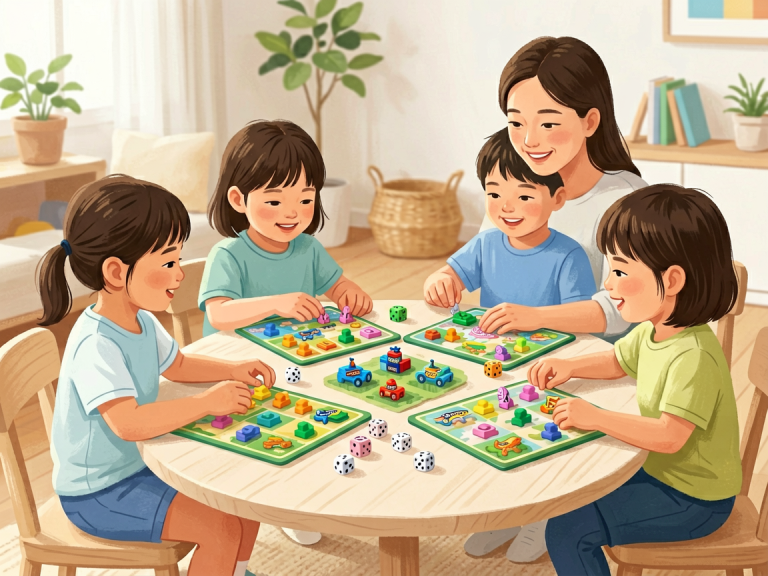
Elementary school is a critical time for social-emotional learning (SEL). Cooperative board games (where players work together against a common challenge, such as *Forbidden Island* or *Outfoxed*) teach teamwork, communication, and empathy. Competitive games, when played with a supportive adult, help children learn to win graciously and lose with resilience. Role-playing toys—such as dress-up costumes, puppet theaters, or play kitchens—allow children to practice real-world scenarios, from going to the doctor to running a restaurant. This pretend play builds perspective-taking and emotional vocabulary.
Furthermore, learning toys can be a bridge for shy or neurodivergent children. A child with autism may find comfort in a structured puzzle, using it as a calm-down tool, while a socially anxious child might engage with a cooperative game that requires low-stakes interaction. Parents and educators can leverage these toys to create inclusive play environments where every child feels capable.
—
How to Choose the Right Learning Toys
With an overwhelming market, choosing effective learning toys requires discernment. First, follow the child’s interests. A child fascinated by dinosaurs will learn more from a dinosaur excavation kit than from a generic science experiment. Second, prioritize durability and simplicity. Toys with too many bells and whistles can overstimulate and distract; the best learning toys often have a single, clear purpose. Third, look for adaptability. Toys that grow with the child—like building sets with increasing complexity—offer better long-term value. Fourth, avoid the “educational” label trap. Some products claim to be educational but merely offer rote memorization. Instead, choose toys that require active participation: questions to answer, problems to solve, or creations to make. Finally, balance screen time. While apps and digital games have their place, physical toys engage multiple senses and promote motor skills that screens cannot replicate.
—
Conclusion
Learning toys for elementary kids are far more than children’s entertainment; they are tools that shape the architecture of a growing mind. From building spatial reasoning with blocks to developing empathy through cooperative games, these toys lay the foundation for lifelong skills. The best approach is not to fill a toy box with expensive gadgets, but to curate a thoughtful collection that challenges, inspires, and delights. When play is purposeful, children not only learn—they love learning. And that love, once kindled, burns brightly through every stage of education.
—
*(Word count: approximately 1,150 words)*