The Ultimate Learning Toys Guide for Parents: How to Choose Toys That Educate and Entertain
—
Introduction
Every parent wants the best for their child, and in a world brimming with colorful plastic gadgets, flashing screens, and ever‑shrinking attention spans, choosing the right toys has never been more important—or more confusing. Learning toys promise to boost cognitive skills, foster creativity, and prepare children for school, but with so many options on the market, how can you separate genuine educational value from mere marketing hype? This guide is designed to help you navigate the toy aisle with confidence. We’ll explore why learning toys matter, break down the best types for different skill areas, offer age‑by‑age recommendations, and highlight the features that make a toy truly worth your investment. By the end, you’ll have a clear framework for picking toys that your child will love playing with—and that will genuinely support their development.
—
Why Learning Toys Matter – The Science Behind Play
Play is not just a pastime; it is the primary way young children learn about the world. Neuroscientific research shows that when children engage in purposeful play, their brains form new neural connections at an astonishing rate. Learning toys are specifically designed to capitalize on this natural process by encouraging problem‑solving, language development, fine‑motor skills, and social interaction. For example, a simple set of building blocks can teach spatial reasoning, cause‑and‑effect, and even basic physics—all while the child believes they are just stacking and knocking things down.
Moreover, high‑quality learning toys promote “flow” – a state of focused concentration that is essential for deep learning. Unlike passive entertainment (e.g., watching a video), active play with a well‑designed toy demands that the child experiment, make mistakes, and try again. This iterative process builds resilience and a growth mindset. As a parent, understanding this science helps you look beyond the product’s flashy packaging and instead evaluate how it engages your child’s mind.
—
Types of Learning Toys by Skill Area
Not all learning toys are created equal. To make informed choices, it helps to categorize toys by the primary developmental domain they support. Here are five key areas:
STEM & Logical Thinking
Toys in this category – such as building sets (LEGO, magnetic tiles), simple coding robots, and math‑based puzzles – encourage analytical thinking, pattern recognition, and early engineering skills. Look for sets that allow open‑ended construction rather than only following a single set of instructions. For example, a marble run lets children experiment with gravity, angles, and momentum, teaching physics concepts through trial and error.
Language & Literacy
Alphabet puzzles, phonics games, story‑telling cards, and “first words” books all fall here. The best language‑learning toys incorporate multiple senses: seeing letters, hearing sounds, and touching textures. For older preschoolers, board games that require reading simple instructions or identifying rhyming words can make literacy practice feel like a fun family activity rather than a drill.
Creative Arts & Self‑Expression
Art supplies (washable markers, playdough, finger paints), craft kits, and musical instruments nourish creativity and emotional intelligence. These toys have no “right” answer, which allows children to explore their feelings and develop a sense of agency. Drums, xylophones, and simple shakers also improve auditory discrimination and rhythm, which are linked to early reading skills.
Social & Emotional Development
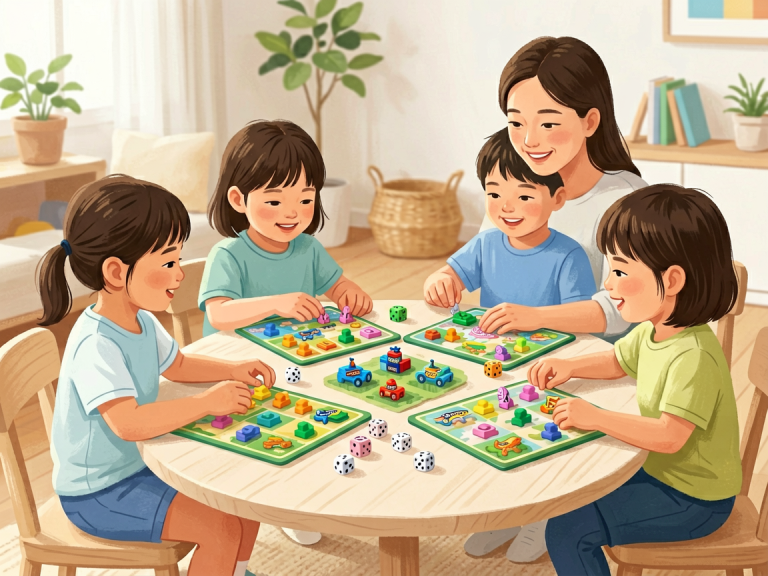
Pretend‑play sets (kitchen, doctor’s kit, puppets), cooperative board games, and emotion‑cards help children learn to share, negotiate, and understand others’ feelings. Unlike competitive games, cooperative games (where everyone wins or loses together) teach teamwork and empathy. Dolls and stuffed animals also provide opportunities for nurturing behavior and role‑playing real‑life scenarios.
Fine & Gross Motor Skills
Puzzles with large knobs, threading beads, stacking cups, and balance boards build dexterity and coordination. For older children, construction toys with small connectors or lacing cards strengthen the finger muscles needed for handwriting. Outdoor riding toys (tricycles, scooters) develop gross motor control and spatial awareness.
—
Age‑by‑Age Guide to Selecting Learning Toys
Choosing a toy that matches your child’s developmental stage is crucial—too advanced will frustrate them, too simple will bore them. Here is a practical breakdown:
Infants (0–12 months)
At this stage, sensory exploration is paramount. Look for toys with contrasting colors, varied textures, and gentle sounds. Rattles, soft fabric books, teething rings, and activity gyms with dangling objects are excellent. Babies also benefit from toys that encourage reaching, grasping, and cause‑and‑effect (e.g., a toy that squeaks when squeezed). Avoid small parts that could become choking hazards.
Toddlers (1–3 years)
Toddlers are natural explorers who love to push, pull, stack, and sort. Shape‑sorters, simple puzzles, nesting cups, and push‑along toys help develop problem‑solving and motor skills. At this age, play is mostly solitary or parallel (playing alongside others), so toys that don’t require complex social rules are ideal. Also introduce crayons and large paper for scribbling – it’s pre‑writing practice!
Preschoolers (3–5 years)
This is the golden age for imaginative play. Dress‑up costumes, play kitchens, building blocks, and art supplies become daily favorites. Preschoolers can handle more complex puzzles (up to 24 pieces) and simple board games that teach counting, colors, or pattern matching. Electronic learning toys, such as tablets with age‑controlled apps, can be used sparingly, but hands‑on, screen‑free toys are still superior for brain development.
School‑Age Children (6+ years)
As children enter formal schooling, learning toys can become more sophisticated. Science kits, advanced construction sets (like robotic arms or circuit kits), strategy board games (checkers, chess, settlers), and chapter‑book series all foster critical thinking and focus. Encourage hobbies – a beginner’s microscope, a keyboard, or a coding robot can spark lifelong interests. At this stage, consider toys that require planning, patience, and reading comprehension.
—
Key Features to Look for in a Learning Toy
When you’re browsing online or in a store, these five features can help you identify a high‑quality learning toy:
- Open‑endedness – A toy that can be used in multiple ways grows with your child. Blocks, playdough, and loose parts (e.g., beads, stones, fabric scraps) have far more educational value than a single‑function electronic gadget.
- Active engagement – Does the toy require the child to do something (build, move, talk, draw) rather than just watch or listen? The more physical and mental activity, the better.
- Adjustable difficulty – Many good toys come with multiple levels or challenge cards so that a child can progress at their own pace. This prevents boredom and frustration.
- Safety and durability – Check for non‑toxic materials, rounded edges, and sturdy construction. Toys that break easily not only waste money but can also cause injury. Look for certifications like ASTM or CE marks.
- Real‑world relevance – Toys that mimic real‑life activities (cooking, gardening, building) teach practical skills and vocabulary. Even a pretend cash register uses math and social interaction.
—
Common Mistakes Parents Make When Buying Learning Toys
Even well‑intentioned parents can fall into these traps:
- Over‑emphasizing “academic” toys – A toy that drills letters or numbers may seem smart, but if it bores your child, they won’t play with it. True learning happens when a child is intrinsically motivated, not forced.
- Ignoring your child’s interests – If your child loves dinosaurs, buy dinosaur‑themed puzzles, books, and figurines. Using their passion as a vehicle for learning is far more effective than imposing a “correct” educational toy.
- Buying toys that are too advanced – A 3‑year‑old cannot benefit from a chemistry set. Pushing a child too fast can damage their confidence and make them resistant to challenging activities.
- Forgetting about simplicity – Sometimes the best learning toys are the simplest. A cardboard box, a ball, or a set of measuring cups can teach as much as a $100 interactive robot.
- Relying too heavily on screen‑based toys – While some educational apps are excellent, they cannot replace physical manipulation, face‑to‑face conversation, and outdoor play. Balance is key.
—
Conclusion
Selecting the perfect learning toy for your child does not require a degree in child development—just a little patience, observation, and the willingness to let your child lead. Remember that the most powerful “learning toy” is you: a parent who sits down on the floor, builds a tower together, asks open‑ended questions, and celebrates mistakes. The best toys are those that spark curiosity, encourage exploration, and most importantly, bring joy. Use this guide as a starting point, but trust your instincts. Watch your child play, notice what makes their eyes light up, and choose accordingly. After all, every child is unique, and the right learning toy is the one that turns play into a world of discovery.