The Power of Play: Choosing and Using Preschool Learning Toys at Home for Optimal Early Development
Introduction: Why Home Learning Matters
The preschool years—typically ages two to five—are a period of extraordinary cognitive, social, emotional, and physical growth. During this window, a child’s brain forms millions of neural connections every second, laying the foundation for all future learning. While formal preschool programs offer structured environments, the home remains the most influential classroom. The toys parents select and the way they facilitate play can either accelerate or hinder this natural development. Preschool learning toys for home are not mere distractions; they are carefully designed tools that transform everyday moments into opportunities for discovery. This article explores the essential criteria for choosing such toys, categorizes them by developmental domain, and provides practical strategies for integrating them into daily routines—all while emphasizing that the best toy is one that sparks curiosity, encourages interaction, and respects a child’s individual pace.
Section 1: The Core Principles of Selecting Effective Home Learning Toys
Not all toys marketed as “educational” deliver genuine learning benefits. Parents must look beyond flashy packaging and instead evaluate toys based on several key principles.
1.1 Open-Endedness Over Prescription
The most valuable preschool toys are open-ended—they can be used in multiple ways, allowing a child’s imagination to lead. A set of wooden blocks, for instance, can become a tower, a bridge, a spaceship, or simply a counting tool. In contrast, a toy that only produces one action (like a plastic dinosaur that roars when a button is pressed) offers limited cognitive engagement. Open-ended toys foster problem-solving, creativity, and resilience, as children learn to adapt when their initial idea doesn’t work.
1.2 Appropriate Challenge Level
A toy should be neither too easy (leading to boredom) nor too difficult (causing frustration). The concept of the “zone of proximal development,” from psychologist Lev Vygotsky, is crucial here. A good preschool toy stretches a child just beyond their current ability, with enough scaffolding—through parent guidance or intrinsic design—to help them succeed. For example, a simple puzzle with four large pieces is perfect for a two-year-old, while a twelve-piece version challenges a four-year-old without overwhelming them.
1.3 Sensory and Motor Engagement
Young children learn through their senses and bodies. Toys that incorporate textures, sounds, colors, and movements engage multiple neural pathways simultaneously. A sensory bin filled with rice, scoops, and small figurines, for example, develops fine motor skills, tactile discrimination, and language as a parent narrates the activity (“Look, you’re scooping the red rice into the blue cup!”). Avoid toys that rely solely on screens or passive observation; physical manipulation remains irreplaceable in early learning.
1.4 Safety and Durability
Preschoolers explore with their mouths as well as their hands. All toys should be made of non-toxic materials, have no small parts that pose choking hazards, and be sturdy enough to withstand enthusiastic play. Check for certifications like ASTM (American Society for Testing and Materials) or EN71 (European safety standard). Moreover, a durable toy can be passed down or resold, adding sustainability to the home learning environment.
Section 2: A Comprehensive Taxonomy of Preschool Learning Toys by Developmental Domain
To maximize learning, it helps to view toys not as isolated objects but as tools that target specific domains. Below, we examine four key areas and the types of toys that best support each.
2.1 Cognitive Development: Logic, Math, and Language
Cognitive toys challenge a child to think, compare, categorize, and solve problems.
- *Puzzles and Pattern Games:* From simple shape-sorters to complex floor jigsaws, puzzles teach spatial reasoning, shape recognition, and persistence. Memory card games boost working memory and attention span.
- *Counting and Number Toys:* Abacuses, number puzzles, and stacking rings with numbered pieces introduce early math concepts like one-to-one correspondence and ordinality. A kitchen scale or measuring cups can turn snack time into a math lesson.
- *Alphabet and Phonics Tools:* Magnetic letters, alphabet puzzles, and simple phonics card games build pre-reading skills. The key is to pair toys with verbal interaction—pointing to the letter “B” while saying “ball” and showing a picture solidifies the connection.
2.2 Fine and Gross Motor Development: Physical Skills Through Play
Physical play is often undervalued in discussions of “learning toys,” yet motor development is a direct precursor to handwriting, self-care, and athletic confidence.
- *Fine Motor Toys:* Lacing beads, threading boards, pegboards, and play dough (with tools like rolling pins and cutters) strengthen the small muscles in fingers and hands. These activities improve dexterity and hand-eye coordination, which are essential for holding a pencil or buttoning a shirt.
- *Gross Motor Toys:* Balance boards, small climbing structures, stepping stones, and soft balls encourage whole-body movement. Riding toys (tricycles, scooters) develop leg strength and balance. Even a simple obstacle course made from pillows and tunnels builds coordination and spatial awareness.
2.3 Social-Emotional Learning: Empathy, Cooperation, and Self-Regulation
Toys that simulate real-life roles and relationships help children understand emotions, practice turn-taking, and develop empathy.
- *Pretend Play Sets:* Kitchen sets, doctor kits, tool benches, and dollhouses allow children to act out scenarios they observe in daily life. Through role-playing, they process experiences (“The baby is sad; I need to give her a bottle”) and experiment with social rules.
- *Board Games for Young Children:* Simple games like “Candy Land” or “Hi Ho! Cherry-O!” teach turn-taking, patience, and handling disappointment (losing gracefully). Cooperative games, where players work together toward a common goal, are particularly effective for reducing competition anxiety.
- *Emotion Flash Cards and Plush Toys:* Cards depicting facial expressions or soft puppets that can “talk” about feelings help children label emotions like happy, sad, angry, or scared. This vocabulary is the first step toward emotional regulation.
2.4 Creativity and Imagination: The Unsung Heroes of Home Learning
Creative play is not a luxury; it is how children synthesize everything they have learned. Toys that encourage open-ended creation support divergent thinking—the ability to generate multiple solutions to a problem.
- *Art Supplies:* Crayons, washable markers, finger paints, play dough, collage materials, and child-safe scissors. The process, not the product, matters. A child’s scribbles are early representations of symbolic thinking.
- *Construction Toys:* In addition to traditional wooden blocks, magnetic tiles (like Magna-Tiles) and interlocking bricks (like Duplo) allow children to build three-dimensional structures, fostering an intuitive understanding of geometry, balance, and cause and effect.
- *Musical Instruments:* Simple drums, shakers, xylophones, and rain sticks introduce rhythm, melody, and the physics of sound. Making music together also strengthens parent-child bonding.
Section 3: Practical Implementation—How to Integrate Learning Toys into Home Life
Owning excellent toys is only half the equation. How parents facilitate play determines whether the toys truly become learning tools.
3.1 Create a Prepared Environment
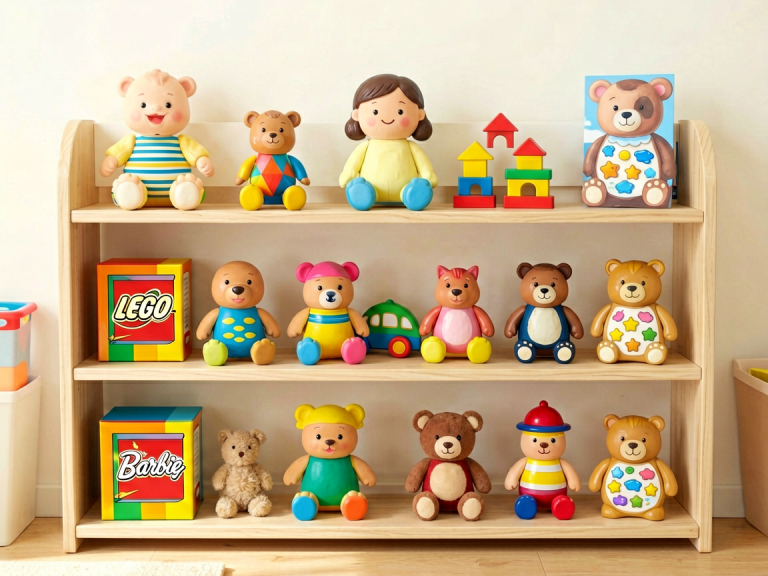
Designate a low shelf or a small area in the living room or child’s bedroom where toys are easily accessible and organized by category. Rotate toys every two to three weeks to maintain novelty. Put away toys that are not currently in use to avoid overwhelming the child. A clean, inviting space signals that play is valued.
3.2 Engage in “Sustained Shared Thinking”
Research shows that the quality of adult-child interaction during play is a stronger predictor of later academic success than the quantity of toys. When playing with your child, follow their lead, ask open-ended questions (“What do you think will happen if we put the blue block on top?”), and narrate their actions (“You’re using the red crayon to draw a circle—that looks like a sun!”). Avoid giving too many instructions; instead, let the child be the director.
3.3 Balance Structured and Unstructured Play
While some guided activities (e.g., sorting shapes) are beneficial, most play should be child-initiated. Resist the urge to constantly “teach.” A child who dumps a box of blocks on the floor and simply stacks them randomly is still learning—about gravity, weight, and their own muscle control. Allow for mess, silence, and repetition. These are signs of deep engagement.
3.4 Use Toys as Bridges to Real Life
The learning from toys transfers best when connected to everyday experiences. After playing with a toy grocery cart, take your child to the supermarket and talk about fruits, numbers on price tags, and weighing items. After building with magnetic tiles, point to real buildings and discuss shapes. This contextualization solidifies abstract concepts.
Conclusion: The Toy Box as a Foundation for Lifelong Learning
Preschool learning toys for home are far more than a consumer purchase; they are investments in a child’s cognitive architecture, emotional intelligence, and physical well-being. The right toys, chosen with intention and used in a climate of warm, responsive interaction, can turn any living room into a laboratory of discovery. Parents need not spend a fortune—some of the best learning tools are found in recycled containers, nature walks, and everyday household items. What matters most is the quality of attention, the willingness to play alongside the child, and the understanding that every block stacked, every doll dressed, and every question asked is part of a grand, unfolding story of learning. In the end, the greatest gift a home can give a preschooler is not a toy that teaches, but a world that invites wonder.