Building Blocks of Communication: How Toys Foster Language Development in Children
—
Introduction
Language development is one of the most remarkable milestones in early childhood, laying the foundation for cognitive growth, social interaction, and academic success. While parents and educators often focus on direct instruction—reading aloud, repeating words, or engaging in conversation—there is a powerful, often underestimated ally in this journey: toys. Far from being mere sources of entertainment, thoughtfully chosen toys can become dynamic tools for building vocabulary, understanding syntax, practicing turn-taking, and nurturing narrative skills. From the simplest rattle to the most elaborate pretend-play set, toys create natural, low-pressure contexts where children experiment with sounds, words, and meanings. This article explores the multifaceted ways in which specific categories of toys support language development, offering practical insights for caregivers and educators who wish to turn playtime into a rich linguistic experience.
—
The Science of Play and Language: Why Toys Work
Before diving into specific toy types, it is essential to understand why play is so effective for language acquisition. Research in developmental psychology highlights that children learn language most efficiently in meaningful, interactive, and emotionally engaging contexts. Toys provide exactly that: they are tangible, manipulable, and often require collaboration or imitation. When a child plays with a toy, they are not passively receiving information; they are actively constructing scenarios, solving problems, and communicating needs or ideas. This active engagement triggers multiple brain regions responsible for language processing, memory, and motor planning. Moreover, toys that encourage joint attention—where a child and an adult focus on the same object—significantly boost vocabulary growth because the adult can label, describe, and expand on the child’s interest. Thus, the right toys are not just fun; they are neurologically aligned with how children naturally acquire language.
—
Interactive and Cause-and-Effect Toys: Building Early Sounds and Words
The earliest stage of language development involves babbling, turn-taking, and connecting sounds with outcomes. Interactive toys that respond to a child’s actions—such as push-button toys that play a spoken word, musical instruments that produce different tones, or simple puzzles where pieces make a sound when correctly placed—are ideal for this phase. For example, a toy telephone that says “Hello!” when a button is pressed encourages a toddler to imitate the word, reinforcing the connection between action and vocalization. Similarly, a shape sorter where each piece is labeled (e.g., “circle,” “star”) introduces basic nouns. The key mechanism here is contingency: the child learns that their action (pressing, shaking, dropping) leads to a predictable verbal response. This feedback loop motivates repetition and experimentation with sounds. Parents can amplify the benefit by narrating the play: “You pressed the button! It said ‘moo’! That’s the cow!” Such joint engagement turns a simple cause-and-effect toy into a rich language lesson.
—
Storytelling and Picture Books: Developing Narrative Skills and Vocabulary
While books are often considered separate from toys, many are designed as interactive toys—board books with flaps, textures, pop-ups, or sound buttons. These “toy books” bridge the gap between object play and literacy. They introduce children to the structure of stories: a beginning, a middle, and an end, with characters, settings, and conflicts. When a child lifts a flap to discover a hidden animal or presses a button to hear a character speak, they are actively participating in the narrative, which builds comprehension and recall. Moreover, picture books expose children to vocabulary that may not appear in everyday conversation—words like “jungle,” “astronaut,” or “adventure.” As children grow, toys that encourage them to create their own stories—such as storytelling dice, magnetic storyboards, or simple puppet sets—take language development to a higher level. These toys require planning, sequencing, and expressing cause and effect: “First the rabbit lost his hat, and then the squirrel found it.” This process cultivates both expressive language and logical thinking.
—
Construction Toys: Building Vocabulary Through Spatial and Descriptive Language
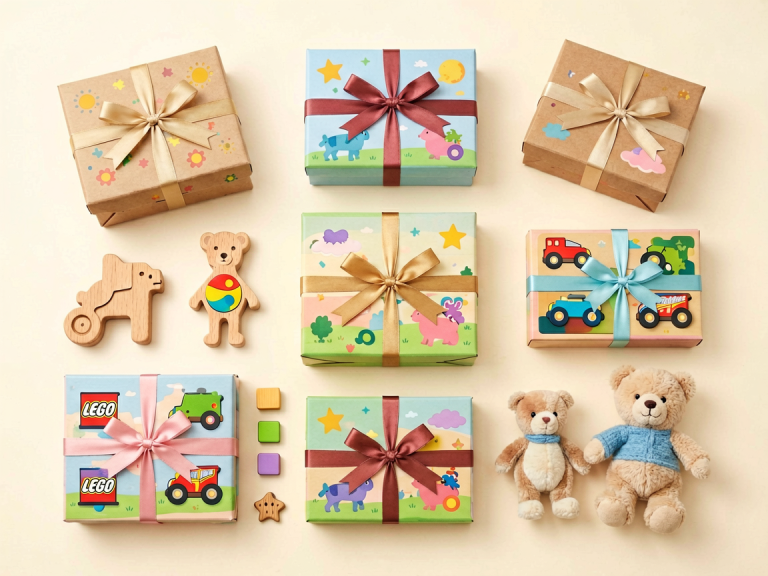
Blocks, LEGOs, magnetic tiles, and other construction toys may seem primarily mathematical or motor skills-oriented, but they are surprisingly potent for language growth. When children build, they must describe their actions and creations: “I need a long blue block,” “This tower is too tall,” “Can you pass me the red one?” Such interactions naturally introduce adjectives (size, color, shape), prepositions (on, under, beside), and comparatives (bigger, shorter). Furthermore, construction play often involves collaboration, prompting children to negotiate, give instructions, and explain their plans: “If we put the triangle here, it will be a roof.” Adults can scaffold this by asking open-ended questions: “What are you making?” “How did you attach that piece?” “What would happen if you added another layer?” These conversations stretch a child’s ability to articulate complex ideas. Additionally, construction toys allow for symbolic representation—a stack of blocks can become a castle, a bridge, or a spaceship—encouraging metaphorical thinking and abstract vocabulary.
—
Role-Playing and Pretend Play Toys: The Heart of Social Language
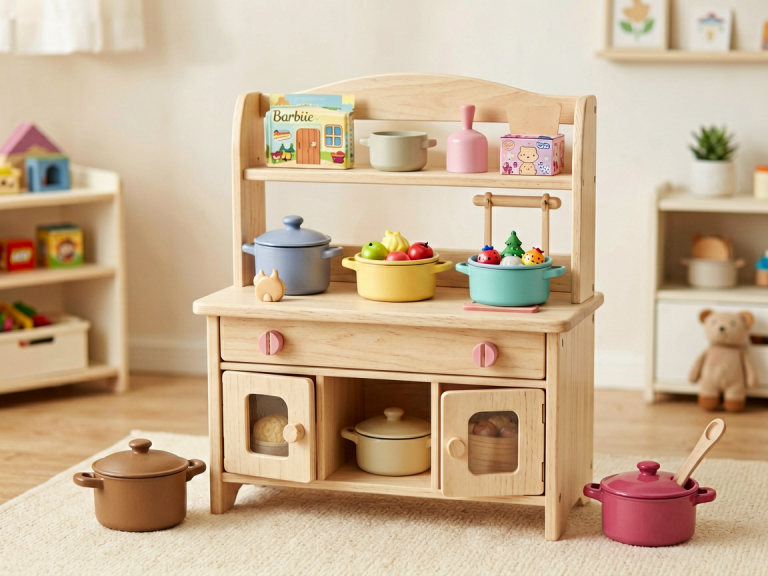
Perhaps no category of toys is more influential for language development than those that facilitate pretend play—kitchen sets, doctor kits, tool benches, dollhouses, costumes, and play food. Pretend play requires children to adopt roles, follow social scripts, and use language in context-appropriate ways. A child playing “restaurant” must greet a customer, take an order, ask “Would you like fries with that?”, and thank them—practicing politeness formulas, question forms, and sequencing. Pretend play also demands decontextualized language, meaning the child talks about objects and events that are not present (the imaginary soup that is “too hot” or the invisible patient with a “broken leg”). This skill is a strong predictor of later reading comprehension. Additionally, when children play together, they must negotiate roles, resolve conflicts, and maintain a shared storyline—all of which rely on sophisticated language use. For example, one child says, “No, you’re the vet today, and I’m the pet owner,” using conditional language and perspective-taking. Parents can enrich this play by participating as a co-player, modeling new vocabulary and extending the narrative.
—
Digital and Electronic Toys: Caution and Strategic Use
In today’s world, many toys incorporate digital elements—tablet apps, interactive robots, talking plushies, or voice-activated devices. While these can be engaging, research shows that passive screen time (e.g., watching a video) does not support language learning as effectively as hands-on, interactive play. However, thoughtfully designed digital toys can be beneficial if they require active participation and joint engagement with a caregiver. For instance, a talking toy that asks the child questions and waits for a response can encourage back-and-forth conversation. Apps that allow a child to record their own voice or create digital stories can stimulate narrative skills. The crucial factor is interactivity with a human companion. A child using a vocabulary-building app alone may memorize words but miss the pragmatic and social nuances that come from live conversation. Therefore, digital toys should supplement, not replace, traditional play. Caregivers should use them as conversation starters: “What did the robot say? How do you think it feels?” This transforms a screen-based toy into a springboard for genuine dialogue.
—
Choosing the Right Toys: Practical Guidelines for Caregivers
Not all toys marketed as “educational” truly foster language development. The most effective toys share several characteristics: they are open-ended, allowing for multiple uses and creative scenarios; they encourage interaction between child and adult or among peers; they are age-appropriate, matching the child’s current linguistic stage; and they provide opportunities for new vocabulary within a meaningful context. For infants, soft books with high-contrast images and simple sounds (e.g., “baa,” “moo”) help build phonemic awareness. For toddlers, shape sorters, simple puzzles, and toy animals that can be named and grouped are excellent. For preschoolers, construction sets, pretend-play kits, and board games that involve following instructions (e.g., “Simon Says”) expand both vocabulary and listening comprehension. For school-age children, more complex games like “I Spy,” word-building tiles, or storytelling card decks refine literacy and grammar. Importantly, the adult’s role cannot be overstated. A toy alone does not teach language; it is the conversation around the toy—the questions, labels, expansions, and playful repetitions—that builds the child’s linguistic foundation. A simple set of wooden blocks can become a language powerhouse when an adult says, “Look, you stacked three blocks! One, two, three. That’s a tall tower. Can you make it taller? What color is the top block?”
—
Conclusion: Play as the Natural Classroom
Language development does not require expensive gadgets or formal lessons. The most powerful linguistic experiences happen naturally when children are engaged, curious, and joyful—precisely the state that play induces. Toys, when chosen with intention and accompanied by responsive adults, become catalysts for words, sentences, stories, and conversations. They transform abstract language into concrete, manageable, and memorable experiences. From the first babble inspired by a squeaky toy to the complex negotiation of roles in a pretend superhero game, toys build more than skills—they build confidence, connection, and a lifelong love of communication. As caregivers and educators, our task is not to replace play with instruction, but to recognize the profound language-learning potential already present in the toys we offer. In the end, the best language-building toy is not the one with the most lights or sounds, but the one that invites a child to speak, listen, imagine, and share. And in that sharing, language truly comes alive.