The Best Toy Path for Independent Play: A Guide to Nurturing Self-Directed Exploration
Introduction
In an era of flashing lights, talking dolls, and subscription boxes promising “educational” magic, many parents find themselves overwhelmed by the sheer volume of toys on the market. Yet the most valuable plaything is often the simplest one: a toy that invites a child to lead, imagine, and persist without adult direction. Independent play — the ability for a child to engage deeply and joyfully on their own — is not only a relief for caregivers but a cornerstone of cognitive, emotional, and social development. However, fostering this skill does not happen by accident. It requires a thoughtful “toy path”: a curated sequence of objects and environments that gradually build a child’s capacity for self-directed engagement. This article explores what the best toy path for independent play looks like, from underlying principles to age-specific strategies, and offers practical guidance for creating a home that supports autonomous exploration.
Understanding Independent Play and Its Developmental Benefits
Independent play refers to any activity a child initiates, sustains, and concludes without continuous adult input. It is not about isolation — a child may play near a caregiver or even with a sibling — but about self-governance. When children play alone, they practice decision-making, problem-solving, emotional regulation, and creativity. Neuroscientific research shows that during unstructured play, the prefrontal cortex develops executive function skills, such as planning, impulse control, and flexible thinking. Moreover, independent play builds a sense of competence: “I can do this myself” becomes an internal mantra that fuels confidence.
The best toy path for independent play does not simply occupy a child; it *invites* them to create, fail, try again, and discover. Toys that do too much — for example, a battery-operated robot that moves and sings at the push of a button — often leave little room for the child’s imagination. In contrast, a set of wooden blocks requires the child to decide whether to build a tower, a bridge, or a castle. The toy provides the raw material; the child provides the meaning. This shift from passive consumption to active creation is the heart of independent play.
The Core Principles of Toy Selection for Independent Play
To build a successful toy path, we must first understand the principles that separate truly independent-play-friendly toys from those that create dependency. Four key principles stand out:
- Open-endedness: The best toys have no single correct use. A set of magnetic tiles can become a house, a rocket, a car park, or a geometric sculpture. Open-ended toys adapt to the child’s current interests and developmental stage, allowing the same object to be “new” again and again.
- Simplicity: Toys with few moving parts, no batteries, and minimal instructions leave more room for the child’s imagination. A simple wooden train set, for instance, invites a child to decide the track layout, the destination, and the story — whereas a pre-programmed train that follows a fixed route leaves little to decide.
- Durability and Safety: When children play independently, they need toys that can withstand repeated use, occasional drops, and vigorous experimentation. Cheap plastic that breaks easily frustrates a child and often requires adult intervention. Durable materials like wood, metal, or high-quality plastic signal to the child that the toy is “serious” and worth their attention.
- Gradual Challenge: A toy path should progress from very simple interactions (e.g., grasping a rattle) to complex ones (e.g., building a multi-level marble run). Toys that are too easy bore the child; toys that are too hard frustrate them. The sweet spot is a *just-right challenge* that the child can master with effort but without adult scaffolding.
Age-Appropriate Toy Pathways
No single set of toys works for every age. A thoughtful toy path respects developmental stages and provides the right level of challenge at each step.
*For infants (6–12 months)*, independent play begins with sensory exploration. Toys such as textured cloth balls, wooden rings, and unbreakable mirrors invite grasping, mouthing, and looking. The best toys here require no batteries and no instructions: a simple rattle that makes noise when shaken teaches cause and effect. At this stage, the “path” is about providing safe, interesting objects within reach and then stepping back to let the baby explore.
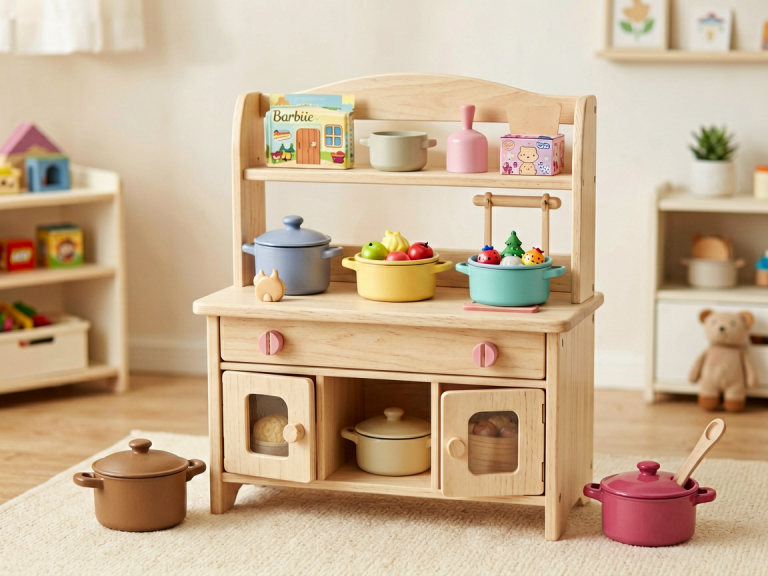
*For toddlers (1–3 years)*, the focus shifts to cause-and-effect and simple construction. Push-and-pull toys (like a wooden duck on wheels), stacking cups, and large wooden blocks are ideal. Toddlers also love “real” objects scaled to their size: a small broom, a play kitchen, or a set of plastic dishes. These toys encourage imitation of daily life, which is a form of independent narrative play. A key rule: place only a few items out at a time to avoid overwhelming the child.
*For preschoolers (3–5 years)*, symbolic play blossoms. This is the golden age for pretend play, and the best toy path includes items that support storytelling: a dollhouse with simple furniture, a set of animal figurines, dress-up clothes, and art supplies like crayons, paper, and playdough. Open-ended building sets (e.g., wooden unit blocks, magnetic tiles) become more complex as children build structures and then act out scenarios within them. At this stage, the path also benefits from “loose parts” — items like pinecones, fabric scraps, or cardboard tubes — that children can repurpose in countless ways.
*For school-age children (6–10 years)*, independent play often becomes more systematic and project-based. Construction kits (e.g., marble runs, K’Nex, or simple Lego sets without instructions), science experiment kits, and complex puzzles can sustain attention for long periods. Board games that a child can play alone (e.g., some solitaire games or logic puzzles) also promote independent problem-solving. However, the path must still prioritize open-ended options: a set of high-quality art supplies (watercolors, clay, sketching pencils) allows a child to develop their own project over days or weeks.
Crafting an Independent Play Environment
Toys alone are not enough. The environment in which a child plays can either support or sabotage independent play. The best toy path is embedded in a thoughtfully arranged space.
First, accessibility is crucial. Toys should be stored at the child’s eye level on low, open shelves. When a child can see and reach their own toys, they are empowered to choose. Baskets or clear bins help, but avoid deep toy boxes where items get buried. Second, rotation keeps the toy path fresh. Rather than dumping every toy in one room, rotate a selection every two to three weeks. A smaller number of toys reduces decision fatigue and deepens engagement. Third, zones can help: a quiet corner with a rug and a few books, a “building area” with blocks and tiles, and an art table with supplies always available. These zones signal to the child: “This is a place where your ideas matter.”
Importantly, the caregiver’s role shifts during independent play. Adults should model absorption in their own activities (reading, cooking, gardening) rather than hovering. When a child struggles, resist the urge to jump in immediately. A gentle “I see you’re working hard” can be more empowering than a solution.
Common Pitfalls to Avoid
Even the best toy path can fail if certain traps are not avoided. One common mistake is overloading the environment. A room stuffed with toys may look generous, but it actually inhibits deep play. Children flit from one toy to another, never settling into the sustained focus that independent play requires. Another pitfall is choosing toys that require adult participation. Someboard games, craft kits that come with tiny pieces and complex instructions, or electronic toys that need batteries changed frequently can undermine independence. A third error is undervaluing repetition. Children often want to play with the same toy in the same way for days or weeks. This is not boredom; it is mastery. Resist the urge to introduce new toys constantly.
Finally, rescue too quickly is perhaps the biggest trap. When a block tower collapses, a child’s frustration is real — but so is their learning. Intervening too early teaches them that problems are solved by adults, not by their own efforts. The best toy path includes toys that allow for mistakes, and the best environment allows children to experience and recover from those mistakes.
Real-World Examples of the Best Toy Path
To bring these ideas to life, consider a concrete toy path for a three-year-old. The core collection might include: a set of 40 wooden unit blocks, a small basket of neutral-colored play scarves, a wooden dollhouse with two rooms and four figures, a set of magnetic tiles (approx. 30 pieces), and a tray with washable markers and paper. During the first week, the child may simply stack blocks. Over time, they start wrapping the scarves around the figures to make “beds” or use the tiles to build a fence for the house. The caregiver rotates these items: after two weeks, the dollhouse is put away and a set of animal figurines emerges, allowing the child to create new stories. The path is not rigid — it responds to the child’s cues — but it remains consistently open-ended and simple.
For a seven-year-old, the path might include: a 500-piece set of magnetic building rods and balls, a science kit for making crystals (with clear, child-friendly instructions), a sketchbook and charcoal pencils, and a solo logic puzzle like Rush Hour. The child is now capable of following simple written steps alone, so the crystal kit becomes a multi-day project. The building rods allow complex 3D structures. The sketchbook invites personal expression. These toys form a path that grows with the child, offering both challenge and autonomy.
Conclusion
The best toy path for independent play is not a list of branded products or a one-size-fits-all checklist. It is a philosophy: a commitment to giving children the raw materials for their own imagination, the time to explore without interruption, and the physical environment that supports choice. By selecting open-ended, simple, durable, and stage-appropriate toys — and by arranging them thoughtfully — caregivers can create a home where independent play flourishes. In doing so, they give children one of the greatest gifts: the confidence that they are capable of creating their own world, one block, one story, one discovery at a time.