The Art of Solitary Discovery: Toys That Cultivate Independent Play
Introduction: Why Independent Play Matters
In an age of overscheduled children and screen‑saturated downtime, the concept of independent play is often misunderstood as mere “keeping busy.” Yet true independent play—where a child voluntarily engages in self‑directed, uninterrupted activity without adult involvement—is one of the most powerful catalysts for cognitive, emotional, and social development. It is during these solitary moments that children learn to tolerate frustration, generate their own ideas, solve problems on their own terms, and build the deep concentration that underpins all future learning.
The toys we offer our children play a decisive role in either nurturing or stifling this kind of play. Toys that are overly prescriptive—those that talk, sing, flash lights, or dictate a single correct outcome—tend to turn children into passive consumers of entertainment. In contrast, toys that build independent play are open‑ended, responsive to the child’s imagination, and forgiving of error. They do not require a parent or a screen to function. Instead, they invite the child to become the architect of their own amusement.
This article explores five categories of toys that are particularly effective at fostering independent play, explaining why each type works and how you can introduce them into your child’s environment. Whether you are a parent, an educator, or a caregiver, understanding these principles will help you curate a play space that empowers children to become confident, self‑reliant explorers.
—
Open‑Ended Toys: The Canvas of Imagination
The quintessential tool for independent play is the open‑ended toy—any object with no predetermined function, no set of instructions, and no “right” way to be used. Classic examples include wooden blocks, unit blocks, magnetic tiles, LEGO bricks (loose, not themed sets), clay, play‑dough, and simple fabric scraps.
The power of open‑ended toys lies in their flexibility. A set of plain wooden blocks can at one moment become a towering castle, at the next a race‑car track, and later a bed for a sick teddy bear. Because the child must constantly invent the scenario, the toy serves as a blank slate for executive functions: planning, sequencing, hypothesis testing, and narrative construction.
Research in developmental psychology supports this. A study from the University of Colorado found that children who played with open‑ended materials showed greater creativity and problem‑solving flexibility compared to those given toys with a single intended use. Importantly, open‑ended toys also support failure tolerance. When a block tower collapses, the child is not “wrong”—they simply try a different arrangement. This low‑stakes experimentation builds resilience, a core component of independent play.
To maximize the independent‑play potential of open‑ended toys, avoid intervening too quickly. Resist the urge to “show” your child how to build a bridge or “fix” their lopsided tower. Instead, provide the materials and step back. The child’s repeated attempts to balance, stack, and combine are the very processes that strengthen self‑reliance.
—
Constructive Building Sets: Engineering Self‑Sufficiency
While simple blocks offer great freedom, slightly more structured constructive building sets—such as K’Nex, Meccano, magnetic construction systems, and wooden marble runs—add a layer of gentle challenge that can extend independent play sessions. These toys usually come with pieces that join in specific ways, often with images of models or simple step‑by‑step guides.
At first glance, one might think these toys are too “prescriptive.” However, when used correctly, they become powerful tools for independent problem‑solving. The child must read a diagram, match pieces, and follow a sequence—all without adult help. If a joint is loose or a part is missing, the child must diagnose and correct the error alone. This builds logical reasoning and persistence.
Moreover, after the initial model is built, the child is often inspired to modify it or create something entirely new. A K’Nex ferris wheel can be transformed into a windmill, a crane, or an abstract sculpture. The fixed‑connection system provides enough constraint to make the challenge achievable, while still leaving room for originality.
The key to fostering independent play with constructive sets is to ensure the child has access to a workspace where pieces can be left for days. Independent play often happens in fragmented bursts—a child may build for twenty minutes, leave to have a snack, and return to continue. If the construction must be dismantled after every session, the deep engagement that builds self‑sufficiency is interrupted.
—
Imaginative Role‑Play Props: Creating Inner Worlds
Role‑play props—dollhouses, play kitchens, doctor kits, tool benches, pirate hats, capes, and animal figurines—are often dismissed as “pretend play” with limited learning value. Yet research from the fields of child psychology and neuroscience reveals that solitary role‑play is actually a sophisticated cognitive activity. In independent pretend play, the child must act as both director and actor, inventing plots, dialogue, and emotional responses without an external script.
A child alone in a play kitchen can be a chef, a customer, a health inspector, or a waiter—all in the span of ten minutes. Each role requires recalling schema (what does a chef do?), inhibiting real‑world responses (I can’t actually eat this pretend pie), and generating novel narrative events (what happens when a dragon orders a pizza?). This internal rehearsal of social scenarios develops theory of mind, emotional regulation, and language skills.
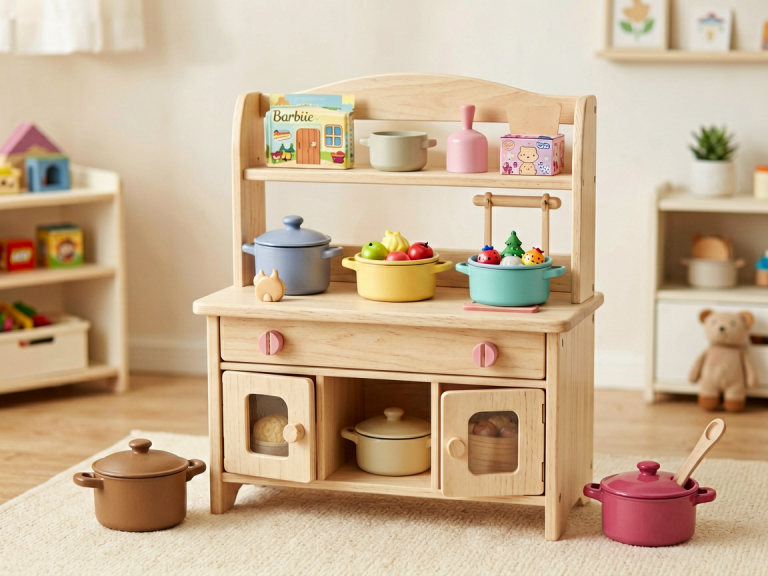
Crucially, the best role‑play toys for independent play are those that are minimal and generic. A simple wooden play stove with wooden food items encourages more original invention than an electronic “talking” kitchen that dictates recipes. Dollhouses with blank rooms and a family of plain figures invite the child to create their own stories, whereas a licensed character playset with a fixed storyline (e.g., a castle from a movie) can actually limit imaginative scope.
To support independent role‑play, create a low‑mess, accessible storage system so the child can set up and dismantle their play world without adult help. A cardboard box labeled “costumes” or a shelf with see‑through bins for miniature animals empowers the child to be the master of their own theater.
—
Puzzles and Problem‑Solving Games: The Joy of Solo Achievement
Puzzles—jigsaw puzzles, logic puzzles, mazes, tangrams, pattern blocks, and single‑player strategy games—are often thought of as “quiet time” activities, but they deserve recognition as sophisticated tools for independent play. Unlike open‑ended toys, puzzles have a defined goal: place the piece correctly, solve the riddle, or match the pattern. This goal structure provides a natural stopping point that can feel deeply satisfying for a young child.
The secret to using puzzles for independent play is to match difficulty carefully. A puzzle that is too easy will be abandoned; one that is too hard will cause frustration that typically ends with a call for help. Choose puzzles that require just enough effort that the child can succeed after several attempts. This “just‑right challenge” creates a feedback loop of effort and reward that strengthens the child’s confidence in their own problem‑solving abilities.
Additionally, many logic and maze‑style puzzles require no adult feedback. The child can check their own progress—if the maze ends at a dead end, they try another route; if the puzzle piece doesn’t fit, they rotate it. This self‑correction is a crucial metacognitive skill. Over time, children become less reliant on external validation and more willing to take thoughtful risks.
To encourage sustained independent puzzle play, set up a dedicated puzzle station with a flat surface and good lighting. Rotate puzzles every week or two to maintain novelty, but keep a few well‑loved standbys available for comfort. Some children will happily spend an hour alone at a puzzle table, returning to the same challenge day after day until mastery is achieved.
—
Nature‑Based and Loose Parts: The Ultimate Open Invitation
Perhaps the most powerful category of toys for independent play is not found in a store at all: loose parts from nature and the home. Stones, pinecones, sticks, acorns, leaves, shells, fabric scraps, cardboard tubes, bottle caps, buttons, and ribbons are often called “loose parts” in early childhood education. When combined, they become the ultimate open‑ended play system.
Loose parts are the original toy. A pile of river stones, a basket of corks, and a piece of blue cloth can become a fairy village, a spaceship control panel, a soup, or a monster’s treasure. There are no instructions, no batteries, no right answers. The child must impose order on chaos, and in doing so, exercises creativity, classification, and symbolic thinking.
Nature‑based loose parts are especially valuable because they engage multiple senses and connect children to the physical world. A child collecting sticks in the yard is making choices: which stick is strong enough to be a bridge? Which leaf will make a roof? These decisions are entirely self‑directed. The adult’s role is simply to provide a safe space and perhaps a container—a bucket, a tray, a low shelf—where the child can store and return to their collection.
One caution: loose‑part play can lead to mess, and mess can tempt adults to intervene. To protect independent play, set clear boundaries: “The blocks stay on the tarp,” or “The stones go back in the basket after play.” Then, allow the child to take full ownership of the chaos and the cleanup. The process of sorting, returning, and reimagining is itself part of the independent play cycle.
—
Conclusion: The Gift of Time and Space
Toys that build independent play are not necessarily expensive or high‑tech. They are simple, open, and forgiving. They ask the child to be the source of the story, the structure, and the solution. A set of wooden blocks, a bag of seashells, a puzzle with a missing piece, a dollhouse with bare rooms—these humble objects can sustain hours of solitary engagement that builds self‑confidence, focus, and a lifelong love of learning.
Ultimately, the most important ingredient for independent play is not any single toy, but the adult’s willingness to step back. Provide the materials, arrange a safe and inviting space, and then resist the urge to teach, correct, or entertain. Trust the child. In the quiet concentration of a child deeply absorbed in their own world, you will see the foundation of independence being laid, one playful discovery at a time.