From Simple to Complex: The Art of Toy Progression for Independent Play
Introduction: The Quiet Power of Independent Play
In a world saturated with flashing screens, talking dolls, and app-controlled robots, the concept of independent play has become both a cherished ideal and an elusive goal for many parents. Independent play—the ability of a child to engage with toys or activities without constant adult direction or intervention—is not merely a convenience for caregivers; it is a foundational pillar of cognitive development, emotional regulation, problem-solving skills, and creativity. Yet fostering this capacity requires more than leaving a child alone with a pile of toys. It demands a thoughtful, deliberate *toy progression*—a carefully curated sequence of playthings that evolve in complexity and challenge as the child grows. This article explores the theory and practice of toy progression for independent play, offering a framework for parents, educators, and toy designers to support children in becoming confident, self-directed explorers.
Why Toy Progression Matters: Meeting the Child Where They Are
The Developmental Landscape
Children are not miniature adults. Their cognitive, physical, and emotional capacities change dramatically in the first decade of life. Jean Piaget’s stages of cognitive development remind us that a toddler in the sensorimotor stage experiences the world through touch, taste, and manipulation, while a preschooler in the preoperational stage thrives on symbolic play and imagination. A toy that challenges a three-year-old may frustrate an eighteen-month-old, and one that engages a five-year-old may bore a seven-year-old. Toy progression respects these developmental milestones by offering tasks that are neither too easy (leading to boredom and disengagement) nor too hard (leading to frustration and dependence on adult help). This sweet spot, often called the “zone of proximal development” by Lev Vygotsky, is where independent play flourishes: the child can succeed with just enough struggle to feel a sense of mastery.
The Pitfalls of Static Toy Collections
Many households accumulate toys in an ad hoc manner—hand-me-downs, birthday gifts, impulse buys. The result is often a chaotic mix of items that do not form a coherent progression. A toddler may have a set of advanced magnetic tiles that require fine motor control beyond their years, while a four-year-old may still be relying on infant rattles that offer no cognitive challenge. Without intentional progression, children may either rely heavily on adults to demonstrate or assist, or they may abandon the toy altogether. Independent play thrives when the toy itself becomes a self-teaching tool—one that scaffolds the child’s growing abilities.
The Architecture of Toy Progression: Key Principles
1. Open-Endedness Before Closed-Endedness
Open-ended toys—such as blocks, loose parts, clay, and sand—allow for multiple outcomes and encourage creativity. They form the foundation of any progression because they adapt to the child’s developmental level. A one-year-old stacks two wooden blocks; a three-year-old builds a tower with a door; a five-year-old constructs a castle with a drawbridge. The same set of blocks serves years of independent play. Closed-ended toys, like puzzles or matching games, have a single correct solution and are better introduced once the child has mastered open-ended exploration. The progression moves from open-ended to progressively more structured activities, ensuring that children first develop the confidence to experiment freely.
2. Gradual Increase in Complexity and Challenge
Toy progression should follow a ladder of increasing difficulty, but each rung must be reachable. For example, consider the evolution of building toys:
- Stage 1 (6–12 months): Large, soft blocks for grasping and knocking down.
- Stage 2 (12–18 months): Slightly smaller blocks for stacking two or three high.
- Stage 3 (18–24 months): Interlocking blocks (e.g., Duplo) that require intentional alignment.
- Stage 4 (2–3 years): Simple construction sets with a few pieces that fit in specific ways.
- Stage 5 (3–5 years): More complex sets with wheels, connectors, and thematic elements (e.g., sets for building a vehicle).
- Stage 6 (5+ years): Advanced sets with instructions and multiple building options, plus free-building possibilities.
Each stage builds on skills acquired in the previous one, and the child can play independently because the toy’s design inherently guides the next step without adult intervention.
3. Self-Correcting and Feedback Mechanisms
To reduce dependence on adult help, toys should provide clear feedback. A puzzle piece that doesn’t fit is its own error signal. A set of nesting cups that stack only one way teaches trial and error. Montessori materials, such as the cylinder blocks in which each cylinder fits only its own hole, are exemplary self-correcting toys. When a child can see the mistake and fix it alone, the toy becomes a tutor. This principle is central to independent play: the child learns to persist, adjust, and eventually succeed without calling for assistance.
4. Gradual Withdrawal of Adult Scaffolding
Toy progression is not only about the toys themselves but also about the changing role of the adult. In the earliest stages, a parent might sit nearby, modeling how to bang a rattle or roll a ball. As the child becomes capable, the adult steps back, offering only occasional encouragement. The toy itself should eventually take over the “teaching” role. For instance, a simple shape sorter initially requires the adult to demonstrate matching. Later, a more advanced shape sorter with multiple layers and a clear latch mechanism still challenges the child but removes the need for adult intervention. The ultimate goal is a toy that the child can approach, explore, and master entirely on their own.
A Stage-by-Stage Guide to Toy Progression
Infancy (0–12 Months): Sensory Exploration and Cause-Effect
At this stage, independent play lasts only minutes, but it is crucial. Toys should be safe, mouthable, and responsive to the infant’s actions. Progressive ideas:
- Newborn to 3 months: High-contrast black-and-white cards, soft rattles that make gentle sounds.
- 3–6 months: Textured teethers, crinkle toys, a simple activity gym with hanging objects to bat.
- 6–9 months: Stacking rings (with a fixed base to avoid frustration), soft blocks, toys that light up or play music when touched.
- 9–12 months: Shape sorters with large, rounded pieces; nesting cups; push-and-pull toys. The key is that each toy offers a single action—grasping, shaking, dropping—and provides immediate feedback.
Toddlerhood (12–36 Months): From Manipulation to Imagination
Toddlers crave control and enjoy repeating actions until they master them. Toy progression here should emphasize fine motor skills, early problem-solving, and pretend play.
- 12–18 months: Simple wooden puzzles with a single piece per shape; large peg boards; stacking cups of varying sizes.
- 18–24 months: Two- or three-piece animal puzzles; train tracks that snap together; a child-safe tool set (e.g., a wooden hammer and peg bench).
- 24–30 months: Realistic toy animals and vehicles for pretend play; simple matching games (e.g., pairing socks or colors); a set of large magnetic tiles.
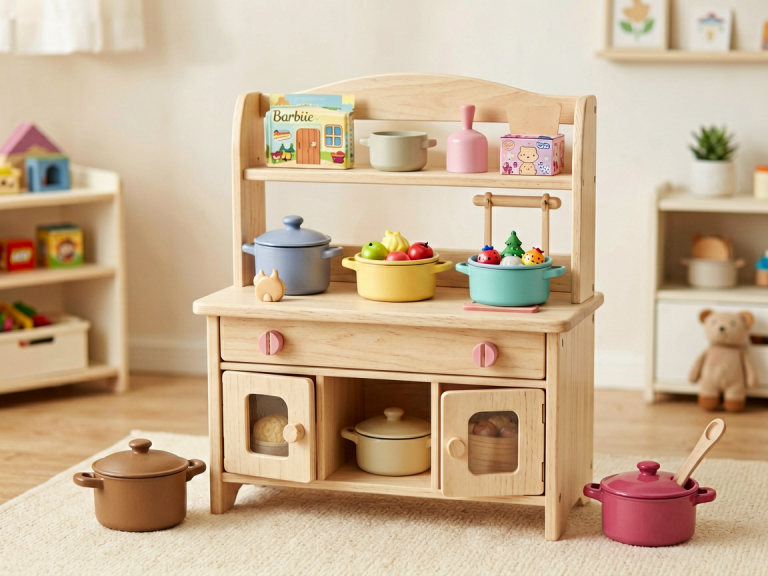
- 30–36 months: More complex puzzles (6–12 pieces); building sets like Duplo; a play kitchen with utensils; dress-up clothes for role play. During this period, open-ended toys like play dough and sand become invaluable because they can be used in countless ways.
Preschool (3–5 Years): Symbolic Play and Structured Problem-Solving
Preschoolers are natural theorists and storytellers. Their independent play often involves elaborate narratives and rule-making. Toy progression should offer both raw materials for creativity and logical challenges.
- 3–4 years: Wooden train sets with bridges and tunnels; standard building blocks (not just Duplo); simple board games with no reading required (e.g., Candy Land); magnetic storyboards; threading beads to make patterns.
- 4–5 years: More complex puzzles (20–50 pieces); early construction sets like K’Nex or LEGO Junior; memory games; simple science kits (e.g., magnifying glass, bug catcher); art supplies (scissors, glue, paper) for independent crafting.
- 5 years: Beginner board games that require counting and strategy (e.g., Hoot Owl Hoot); pattern blocks and tangrams; a simple marble run; a pegboard with elastic bands for geometric designs. The progression here moves from symbolic representation to logical sequencing and spatial reasoning.
School Age (5+ Years): Refinement and Systems Thinking
Older children can handle multi-step processes, rule-based games, and abstract problem-solving. Independent play becomes more sustained and complex.
- 5–7 years: LEGO sets with detailed instructions; strategy games like checkers; complex building sets (e.g., magnetic rods and balls); beginner coding toys (e.g., simple robot bees with arrow-based programming); jigsaw puzzles with 100+ pieces.
- 7–9 years: Model kits that require following diagrams; advanced board games (e.g., Settlers of Catan Junior); science experiments (e.g., crystal growing); craft kits with multiple steps (e.g., weaving, sewing).
- 9+ years: The progression naturally extends into hobbies—musical instruments, coding languages, advanced construction like robotics kits, and even designing their own games. At this stage, the toy progression is less about individual toys and more about the child’s ability to use tools to create their own systems of play.
Practical Strategies for Curating a Toy Progression at Home
Rotate, Don’t Overwhelm
A common mistake is providing too many toys at once, which disperses attention and undermines independent play. Instead, rotate toys in and out of circulation, keeping only a small, carefully chosen set available. This allows each toy to be explored deeply and prevents the child from being overwhelmed by choice. The toy progression should be seen as a long-term pathway: you don’t need to own every stage at once. Buy or borrow toys that match your child’s current developmental level, and retire or pass on those that have been outgrown.
Observe Before You Act
The best guide for toy progression is the child themselves. Watch how they play: Do they abandon a toy after five seconds? They may need a simpler version. Do they repeatedly ask for help with a certain step? The toy may be too advanced, or they may be ready for a small challenge. Do they repeat the same activity with increasing precision? They may be ready for the next level. Independent play flourishes when the adult trusts the child’s pace and resists the urge to “teach” prematurely.
Embrace the Power of the “Just Right” Challenge
The Montessori approach famously uses materials that are designed to isolate a single concept (e.g., the Pink Tower for visual discrimination of size). While you don’t need a full Montessori curriculum, the principle applies: a toy that offers one clear challenge—and one way to solve it—is often more effective than an all-singing, all-dancing electronic toy. Progressive difficulty should be embedded within a single toy line (e.g., a brand of puzzles that increases piece count) or through complementary toys that build on each other.
Conclusion: The Lifelong Gift of Independent Play
Toy progression for independent play is not about buying the latest educational gadget or constructing a perfectly sequenced curriculum. It is about respecting the child’s innate drive to learn and master their environment. When we select toys that grow with the child—starting with simple sensory feedback, moving through manipulative and symbolic play, and culminating in abstract systems thinking—we offer them a scaffolded path toward self-reliance. Independent play, nurtured through thoughtful toy progression, does not end in childhood. It becomes a habit of mind: the ability to face a new challenge, break it down into manageable steps, persist through failure, and celebrate one’s own success. In a world that constantly seeks to entertain and distract, the gift of being able to play alone, with pride and curiosity, is perhaps the most valuable legacy we can give.