Unlocking Imagination: The Best Toys for Creativity in 3-Year-Olds
Introduction: Why Creativity Matters at Age Three
At three years old, a child’s world is expanding at a breathtaking pace. They are no longer toddlers who simply explore with their mouths and hands; they have become little architects of fantasy, eager to question, imitate, and invent. This is the golden age of imaginative play, when the brain forms billions of neural connections every day. The right toys can nurture this natural creativity, helping children develop problem-solving skills, emotional intelligence, and cognitive flexibility. But not all toys are equal. Many flashy, battery-operated gadgets promise educational benefits but actually limit a child’s active engagement. So what are the best toys for creativity for three-year-olds? They are the ones that invite open-ended play, require the child to be the driver of the story, and adapt to ever-changing ideas. In this article, we will explore seven categories of toys that truly spark the imagination, with detailed explanations of why each one works and how to use them effectively.
The Foundation of Creative Play: Unstructured and Open-Ended Materials
Before diving into specific toy categories, it is essential to understand the concept of “open-ended” play. An open-ended toy has no single correct way to use it; it can be transformed into anything the child dreams up. For example, a simple set of wooden blocks can become a castle, a spaceship, or a bridge—it depends entirely on the child’s imagination. In contrast, a toy that only does one specific thing, like a plastic fire truck that makes siren noises when you press a button, offers little creative opportunity. Research in child development consistently shows that unstructured play with open-ended materials fosters executive function, persistence, and divergent thinking—the ability to generate multiple solutions to a problem. Therefore, the best creative toys for three-year-olds are those that are simple, versatile, and child-led. Parents often worry that a “simple” toy will bore a child, but the opposite is true: a child returns again and again to a toy that can become something new each time.
Building Blocks and Construction Sets: The Architects of Imagination
Perhaps no toy category better embodies creative potential than building blocks. For a three-year-old, standard wooden unit blocks (such as those made by companies like Melissa & Doug or Hape) are a perfect starting point. They come in various shapes—rectangles, squares, triangles, arches—and the child learns through trial and error how to balance, stack, and create stable structures. More importantly, blocks encourage spatial reasoning, geometry understanding, and storytelling. A child might build a house for their stuffed animals, then a garage for their cars, then a rocket ship. The act of constructing something from raw parts is deeply satisfying and inherently creative.
Beyond classic wooden blocks, large interlocking plastic bricks (like Duplo, the younger sibling of Lego) also work well. The larger size is safe and easy for small hands to manipulate. Duplo sets often come with special pieces such as wheels, windows, and people, which can inspire more complex narratives. However, parents should resist the urge to buy sets that dictate a single model (e.g., “build a police station exactly like the picture”). Instead, buy bulk sets of basic bricks and encourage free building. A great tip: keep the instruction manuals hidden, and let the child build whatever comes to mind. You might be surprised to see a “fire station” that looks nothing like a fire station but has a wonderfully creative explanation.
Another excellent construction toy for three-year-olds is magnetic tiles (e.g., Magna-Tiles or PicassoTiles). These translucent, magnetic squares and triangles snap together easily, allowing children to build 3D structures like houses, towers, and even vehicles. The magnets provide a satisfying click and reduce the frustration of pieces falling apart—a common issue with blocks for younger builders. Magnetic tiles also teach basic principles of magnetism, geometry, and symmetry. One of the best features is that children can combine tiles with other toys, such as small dolls or plastic animals, to create elaborate scenes.
Art Supplies: The Voice of Unbounded Expression
Three-year-olds are natural artists. They love to scribble, smear, and mix colors with no regard for realistic representation—and that is precisely the point. Art supplies for this age group should be safe, washable, and designed for maximal exploration. The absolute essentials include:
- Washable tempera paints in primary colors plus white and black. Let the child mix colors on a paper plate; this teaches color theory through hands-on experimentation. Finger painting is especially valuable because it engages the sense of touch and encourages large motor movements.
- Crayons and markers that are thick and easy to grip. Avoid those that require precision; the goal is free expression, not staying inside lines. Provide a large sheet of paper (or even a roll of butcher paper covering the table) so the child can draw without boundaries.
- Play-Doh or modeling clay. This is a toy that never gets old. A three-year-old can roll, pinch, flatten, and cut the dough into endless shapes. Add simple tools like plastic rolling pins, cookie cutters, and a plastic knife. The creation can be a snake, a pancake, a “cake” for a birthday party, or a monster. The open-ended nature of modeling clay is superb for developing fine motor strength and imagination.
- Stickers and collage materials. Children love to peel and stick. Provide a variety of simple stickers (stars, animals, shapes) along with glue sticks and pieces of colorful paper, fabric scraps, or natural items like leaves. Creating a “masterpiece” by sticking things onto a paper gives a three-year-old a sense of control and accomplishment.
One often overlooked art toy is a simple easel with a chalkboard on one side and a magnetic board or paper roll on the other. An easel encourages standing, which is good for gross motor development, and it gives the child a large vertical surface to work on. Many children feel more inspired when they can step back and see their work from a distance.
Pretend Play and Role-Playing Toys: The Stage for Storytelling
Pretend play is the heart of creativity at age three. Children begin to imitate the adult world and invent parallel universes where they are the doctor, the chef, the parent, or the superhero. Toys that facilitate this kind of role-playing are invaluable. Key options include:
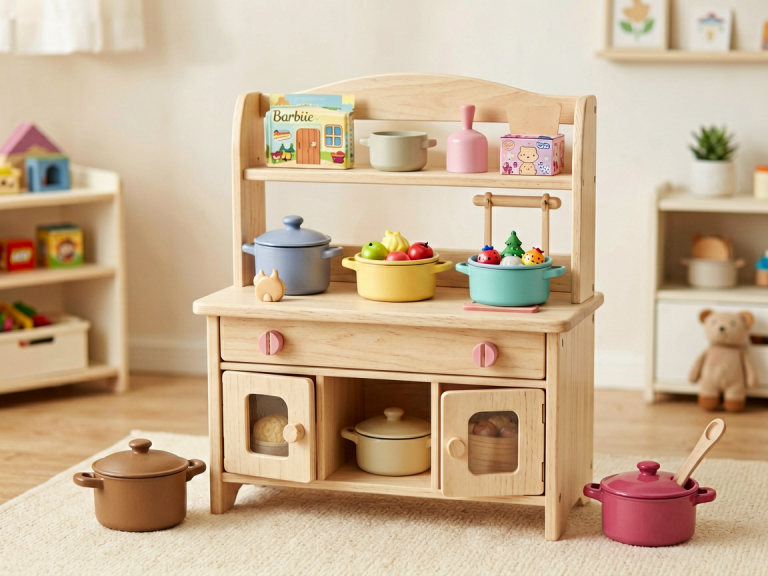
- Kitchen sets and play food. A child-sized kitchen with a stove, sink, and cupboards can lead to hours of “cooking” and “serving.” Add empty food containers (rinsed clean) or wooden/plastic play food. The child will follow your example but will soon create their own recipes and scenarios. They might make you a pretend pizza that is also a volcano.
- Dress-up clothes and accessories. A box of old hats, scarves, costumes, and shoes is a gold mine for creative play. A simple red cape can turn a child into a superhero; a silly hat can make them a queen or a clown. There is no need for expensive licensed costumes; the more generic, the more imaginative the use. A set of animal masks or a simple doctor’s kit also works wonders.
- Dolls and stuffed animals. These “real” companions are not just toys; they are actors in the child’s internal theater. A three-year-old will talk to a doll, feed it, put it to bed, and scold it. This is a way of processing emotions and practicing social interactions. Look for dolls that are simple, soft, and gender-neutral if you wish, but any beloved stuffed animal will do. Adding a small dollhouse (or even a cardboard box decorated as a house) can extend the play.
- Vehicles and construction sets for pretend play. Toy trucks, trains, and planes are not just for pushing around. A three-year-old will invent stories: the truck is going to the store to get food, or the train is taking people to the beach. The best vehicle toys are those that can carry other items—a dump truck that actually holds blocks, or a train with magnetic cars that can carry little animals.
Musical Instruments and Sound Exploration: Rhythms of the Mind
Creativity is not limited to visual arts; music is a powerful avenue for self-expression. Three-year-olds are highly sensitive to rhythm and sound. Simple, high-quality musical instruments allow them to experiment with cause and effect, pattern recognition, and emotional expression. Top choices include:
- A child-sized xylophone or glockenspiel. The colors and the pure tones are inviting. Even without knowing any musical theory, a child can create pleasant sounds just by striking the keys. The xylophone teaches about pitch (high and low) and sequence.
- Shakers, maracas, and egg shakers. These are easy to hold and produce immediate gratification. Children love to shake them in time to songs or to create their own beats. You can even make shakers at home by filling sealed plastic containers with rice or beans.
- Hand drums or a small djembe. A drum lets a child explore volume and rhythm in a physical way. They can pat the beat slowly or quickly, loudly or softly. This is fantastic for developing motor control and an intuitive sense of timing.
- Rain sticks and wind chimes. These create soothing, unpredictable sounds that calm a child and capture their attention. A rain stick, when turned over, produces a sound like falling rain. The child can learn to control the speed of the sound by tilting the stick.
It is important to note that electronic, battery-operated music players are not as creative as actual instruments. A toy that plays pre-recorded songs is passive; a real instrument demands the child’s active participation. Do not worry about the noise—it is a sign of learning.
Nature and Sensory Toys: The World as a Playground
The outdoors is one of the best “toy stores” for a three-year-old. But even indoors, toys that mimic or incorporate natural elements can spark profound creativity. Nature toys encourage observation, classification, and open-ended play. Consider:
- A collection of natural treasures: pinecones, smooth stones, shells, acorns, and large leaves (supervised to avoid choking hazards). A child can sort them by color, size, or texture. They can stack stones, arrange leaves in patterns, or use pinecones as “trees” in a block village. These objects require the child to use their imagination because they are not pre-defined as a specific toy.
- Wooden puzzles and shape sorters made from natural materials. Wood has a warm, grounding feel. Puzzles teach problem-solving and spatial awareness, and the best ones have multiple ways to solve them or are designed as simple patterns (like a wooden owl that breaks into quadrants) rather than a fixed picture.
- Sensory bins. A simple plastic bin filled with dry rice, sand, or kinetic sand is a must-have creative toy. Add scoops, funnels, small cups, and plastic animals. A child can pour, dig, bury, and dig up again. Sensory play is calming, helps develop fine motor skills, and allows for endless imaginative scenarios—like making a “dinosaur excavation” or a “secret treasure hunt.” Water play (with appropriate supervision) is another fantastic sensory experience.
- A gardening set. Even if you don’t have a garden, a three-year-old can “plant” pretend flowers in a pot with kinetic sand or soil. Child-sized gardening tools (trowels, rakes, watering cans) let them imitate the real activity. This teaches care for living things and the joy of nurturing.
Conclusion: Choosing Less to Gain More
When selecting toys for a three-year-old, remember that the best creative toys are often the simplest. A cardboard box can be a castle, a car, or a cave. A set of wooden blocks can build worlds. Art supplies offer a blank canvas for pure imagination. The key is to resist the allure of electronic toys that do the thinking for the child. Instead, invest in open-ended materials that require the child’s active participation, decision-making, and storytelling. Observe your child: notice what they return to again and again. That is their creative passion. Provide a safe, supportive environment with a variety of these seven categories, and you will see their imagination flourish in ways that are both surprising and delightful. After all, creativity is not about the toy—it is about the child’s mind transforming the toy into something new. And that transformation is the greatest gift we can give our three-year-olds.