Unlocking Words: The Best Learning Toys for Language Development in Children
Introduction
Language is the cornerstone of human connection, cognitive growth, and academic success. From a baby’s first coo to a preschooler’s complex sentences, every stage of language development is a miracle of neural wiring and social interaction. Yet parents and educators often wonder: How can we nurture this natural process in a world full of screens and passive entertainment? The answer lies in the thoughtful selection of learning toys. Far from being mere distractions, the best learning toys for language development actively engage children in listening, speaking, vocabulary building, and storytelling. They turn play into a rich linguistic environment. In this article, we will explore the science behind language acquisition, highlight specific toys for different age groups, and provide a framework for choosing toys that spark meaningful verbal exchanges. Whether you are a parent, a teacher, or a caregiver, these recommendations will help you transform playtime into a powerful language lesson.
The Importance of Play in Language Acquisition
Before diving into specific toys, it is essential to understand why play is so effective for language development. During the first few years of life, a child’s brain is exceptionally plastic, forming up to one million neural connections per second. Language learning is not a passive process; it requires active listening, imitation, and experimentation. Play provides a low-stakes, joyful context where children can practice sounds, words, and sentence structures without fear of judgment. Toys that encourage turn-taking, imitation, and narrative building mimic the conversational patterns that underpin real-world communication. Moreover, when parents or caregivers engage with children during play—labeling objects, asking open-ended questions, and expanding on a child’s utterances—they create what linguists call “scaffolding,” which boosts language growth exponentially. The best learning toys are those that invite this kind of rich, interactive dialogue. They are not necessarily the most expensive or flashy; rather, they are open-ended, durable, and designed to spark curiosity and conversation.
Best Learning Toys for Infants and Toddlers (0–2 Years)
Language development begins long before a child speaks their first word. Infants are attuned to the rhythms, tones, and phonemes of their native language from birth. For this age group, the best toys are those that stimulate auditory perception, facial recognition, and early vocalizations.
- Soft Picture Books and Cloth Books: High-contrast images, simple illustrations of everyday objects (animals, fruits, family members), and textured pages encourage infants to look, touch, and listen as a caregiver narrates. The repetitive nature of reading the same book aloud helps build receptive vocabulary. For example, a cloth book with crinkly pages and a mirror also introduces cause-and-effect and self-awareness, both of which are precursors to verbal expression.
- Rattles and Musical Toys: Toys that produce gentle sounds—shakers, bells, or simple xylophones—encourage babies to turn their heads, track sound, and eventually imitate the noises. When an adult shakes a rattle and says, “Shake, shake, shake!” the baby begins to associate the sound with the word. This auditory-motor pairing is foundational for later word production.
- Stacking Rings and Simple Shape Sorters: While seemingly motor-focused, these toys promote language when adults describe the actions: “Red ring on top,” “Circle goes in the round hole,” “You did it!” The repetition of shape names, colors, and prepositions (on, in, under) expands vocabulary. Toddlers also learn to request (“More,” “Again”) and to label objects during play.
- Talking Plush Toys or Electronic Storybooks: For older toddlers (12–24 months), interactive toys that play simple songs or repeat phrases can be beneficial—but only if used alongside adult interaction. The key is to choose toys that pause and prompt a response, such as “Can you say ‘moo’?” rather than those that simply play a continuous stream of sound. The best electronic toys are those that mimic conversational turn-taking.
Best Learning Toys for Preschoolers (3–5 Years)
The preschool years are a golden age of vocabulary explosion, grammar development, and emerging literacy. Children at this stage begin to understand stories, ask “why” questions, and engage in longer conversations. The ideal toys for this group encourage imaginative play, narrative sequencing, and phonetic awareness.
- Storytelling Dice and Picture Cards: Sets of illustrated dice or cards (e.g., with animals, objects, or emotions) prompt children to create their own stories. Rolling two dice and connecting the images (“The giraffe found a magic key…”) exercises narrative structure, sequencing, and descriptive language. These toys are highly open-ended and can be used repeatedly with different themes.
- Alphabet Puzzles and Magnetic Letters: As children become interested in letters and sounds, hands-on manipulatives are far more effective than flashcards. Wooden alphabet puzzles with chunky pieces that fit into corresponding cutouts help children associate letter shapes with sounds. Magnetic letters on a refrigerator or whiteboard allow for spelling simple words like “cat” or “dog” while the adult sounds out the phonemes. Many experts recommend pairing these with a “letter of the day” routine.
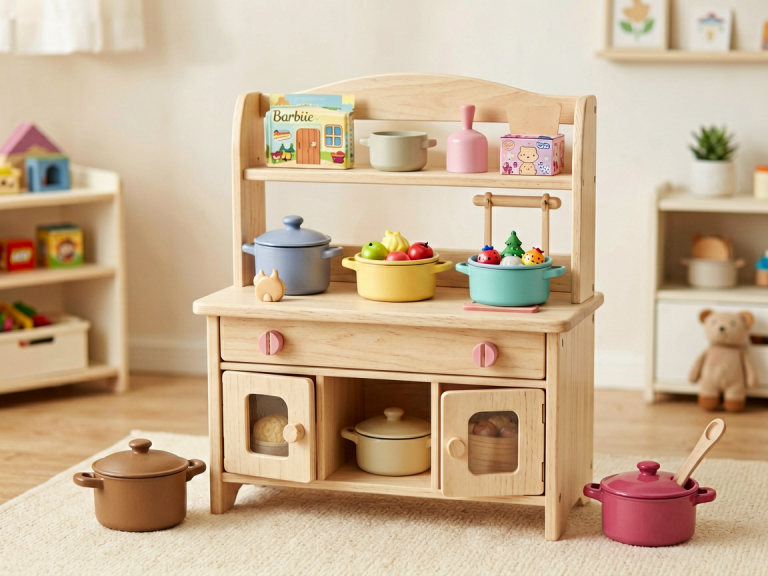
- Pretend Play Sets: Dollhouses, kitchen sets, doctor kits, and tool benches are language gold mines. When a child pretends to cook a meal or examine a stuffed animal, they naturally use vocabulary related to roles, actions, and objects (“I need a spoon,” “The baby has a fever”). They also practice social language like inviting, negotiating, and explaining. The most effective sets include diverse pieces (multiple animal figures, varied foods) to expand the range of vocabulary.
- Rhyming Games and Sound Bingo: Phonological awareness—the ability to hear and manipulate sounds—is a strong predictor of reading success. Games like “Rhyme Time” (where children match words that sound alike) or “Sound Bingo” (where they cover pictures that start with a specified sound) make learning playful. Many commercial options are available, but DIY versions using household objects work just as well.
- Interactive Picture Books with Flaps and Textures: While not a toy in the traditional sense, lift-the-flap books and touch-and-feel books remain excellent for preschoolers. They encourage prediction (“What’s under the flap?”), labeling, and turn-taking. Books with repetitive phrases allow children to “read along” and build confidence.
Best Learning Toys for School-Age Children (6+ Years)
Once children enter formal schooling, language development shifts toward reading comprehension, writing, and more complex syntax. However, play remains crucial for reinforcing these skills in a low-pressure way.
- Board Games That Require Verbal Communication: Games such as “Story Cubes” (the classic Rory’s Story Cubes), “Dixit,” or “Scattergories” challenge children to describe images, tell collaborative stories, or think of words fitting a category. These games build vocabulary, quick thinking, and expressive language. Cooperative games like “Outfoxed” require children to discuss clues and solve mysteries together, fostering both language and social skills.
- Construction Kits with Instruction Cards: Building sets such as LEGO, magnetic tiles, or K’Nex come with step-by-step picture instructions. While following them, children must decode visual sequences and often verbalize their plan. More advanced sets include written instructions, providing a natural bridge to reading. When children build and then describe their creations, they practice descriptive and procedural language.
- Word Games and Crossword Puzzles for Kids: Age-appropriate crossword puzzles, word searches, and Scrabble Junior help with spelling, word recognition, and vocabulary expansion. Digital apps can be useful, but physical puzzles encourage handwriting and a slower, more deliberate cognitive process. Parents can also create custom word games around a child’s interests (e.g., dinosaur names, space terms).
- Finger Puppets and Puppet Theaters: Puppetry is a powerful tool for language development because it gives children permission to take on different voices, emotions, and personalities. A simple set of finger puppets (animals, people, or fantasy characters) allows children to create dialogues and scenes. This develops narrative skills, perspective-taking, and fluency. Puppet shows performed for an audience also build confidence.
- Journaling Kits with Prompts: For older children (ages 8+), a blank journal with fun writing prompts (“If you could be any animal for a day…”) or a “story starter” card deck encourages written language. Combining writing with drawing can make it less intimidating. Parents can then read the entries aloud and discuss them, reinforcing the connection between written and spoken language.
Key Features to Look for in Language-Development Toys
With the overwhelming variety of toys on the market, it is helpful to have a checklist of features that maximize language learning potential. First, seek open-endedness—toys that can be used in multiple ways, such as blocks, play dough, or magnetic tiles, encourage creativity and longer periods of verbal engagement. Second, prioritize interactivity that invites conversation. A toy that simply blinks or sings does not foster dialogue; instead, look for toys that require a child to respond, ask questions, or invent scenarios. Third, choose toys that align with the child’s current language stage. A toy too advanced may frustrate, while one too easy may bore. Fourth, consider durability and safety, as children often mouth toys during the early language years. Fifth, look for toys that promote parent–child interaction. Studies consistently show that language growth is strongest when an adult is actively involved in play, using rich vocabulary, asking questions, and providing feedback. Finally, avoid toys that are overly prescriptive or that “teach” in a drill-like manner. The best learning happens when children are having fun and feel intrinsically motivated to communicate.
Conclusion
The best learning toys for language development are not magic bullets, but rather tools that invite conversation, imagination, and joy. From a soft cloth book that coaxes a baby’s first babble to a storytelling game that unlocks a first grader’s narrative flair, each carefully chosen toy can become a gateway to richer verbal expression. However, the toy itself is only half the equation. The other half—the loving adult who kneels down, looks into the child’s eyes, and says, “Tell me more about that”—is irreplaceable. By combining thoughtful toy selection with genuine human interaction, we can create an environment where words flourish. So the next time you are faced with a shelf of plastic and screens, remember: the most powerful language tool is not a device, but a playmate with a curious mind and a willing heart. Choose toys that spark stories, and watch your child’s world expand one word at a time.