The Power of Pretend: Role Play Activities for Babies and Their Developmental Benefits
Introduction: Why Role Play Matters Even Before Words
When parents hear the term "role play," they often think of preschoolers pretending to be firefighters or princesses, weaving elaborate narratives with their toys. But what about babies—those tiny humans who cannot yet speak in full sentences, who are still mastering the art of crawling or walking? Can role play activities for babies exist? The answer is a resounding yes, and they are far more important than most caregivers realize.
Role play for babies is not about complex scripts or imaginary worlds. It is about imitation, sensory exploration, and the earliest forms of symbolic thinking. From the moment a baby watches you stir a spoon in a cup and then attempts to copy that motion with a toy spoon, they are engaging in the foundational steps of pretend play. These activities are not merely cute—they are critical for cognitive development, social-emotional learning, language acquisition, and motor skill refinement. In this article, we will explore a wide range of age-appropriate role play activities for babies, organize them by developmental stage, and explain the science behind why each activity matters. By the end, you will have a practical toolkit to nurture your baby's imagination from the very beginning.
Section 1: Understanding the Developmental Window for Role Play in Infancy
1.1 The Emergence of Imitation (0–6 Months)
Role play does not start suddenly at twelve months. It begins with the simplest form of mimicry. Newborns are wired to imitate facial expressions—sticking out a tongue, opening a mouth wide. By two to three months, babies begin to watch your actions with focused attention. When you hold a rattle and shake it, they may try to wave their arms in response. This is not yet true pretend play, but it is the neural groundwork.
At this stage, role play activities for babies are essentially "mirroring games." You can hold a soft toy and make it "kiss" the baby's cheek, then pause and let the baby reach for it. You can pretend to feed a doll by bringing an empty spoon to its mouth, making exaggerated chewing sounds. Even though your baby cannot yet coordinate the motion, they are absorbing the idea that objects can represent other objects—a building block of symbolic thought.
1.2 From Imitation to Intention (6–12 Months)
Between six and twelve months, a remarkable shift occurs. Babies begin to understand that actions have purposes. They will watch you comb your hair and then grab the comb to swipe at their own head (often missing, but the intent is there). They will pick up a toy phone and hold it to their ear, babbling as if in deep conversation. This is the dawn of true role play.
During this period, babies also develop object permanence—the understanding that things exist even when out of sight. This allows them to engage in "peek-a-boo" variations that involve toys. For example, you can hide a stuffed bear under a blanket and then have the bear "pop" out to say hello. The baby learns that the bear has a role (the hider, the greeter) and that their own actions (pulling the blanket) can influence that role.
1.3 The Symbolic Leap (12–24 Months)
By the first birthday, many babies are walking and have a growing vocabulary. Their role play becomes more deliberate. They might pretend to drink from an empty cup, offer a pretend cookie to a parent, or put a doll to bed with a blanket. These actions are not random; they are the baby’s way of processing daily routines. Through repetition, they gain mastery over their world.
Now is the time to introduce more structured role play activities for babies. But structure here means providing the props and space, not directing the script. A baby may decide that a block is a piece of cake, or that a cardboard box is a car. Your job is to follow their lead.
Section 2: Practical Role Play Activities for Babies by Age Group
2.1 Activities for Newborns to Six Months: Sensory Mirroring
The Face Game
Sit facing your baby at close range. Make an exaggerated happy face (big smile, wide eyes) and wait. Your baby may smile back. Then make a surprised face (raised eyebrows, open mouth). Over time, your baby will start to anticipate and respond with different expressions. This is the earliest form of role play—you are playing "the expressive person," and your baby is playing "the responder."
The Talking Toy
Choose a hand puppet or a soft animal. Bring it close to your baby’s face and speak in a different pitch. "Hello, little one! I am Mr. Bunny. Do you want to touch my ears?" Gently rub the puppet against the baby's hand. This activity introduces the concept that an object can be a character with a voice and personality.
The Feeding Pretend
While breastfeeding or bottle-feeding, you can hold a doll and mimic the feeding motion. "Look, dolly is having milk too. Yum yum!" Your baby may not understand the words, but they will observe the parallel activity. For older newborns (around 4–6 months), you can let them hold a small, clean bottle or spoon and guide their hand to the doll’s mouth.
2.2 Activities for Six to Twelve Months: Functional Pretend
The Cleaning Helper
Babies love to mimic household chores. Give your baby a soft, clean cloth and show them how you wipe the table. Then let them "wipe" their own highchair tray, or a toy. This is role play as "the cleaner." It builds motor skills and a sense of participation in family life.
The Phone Call
Use a toy phone or even a wooden block as a phone. Hold it to your ear and say, "Ring ring! Hello? Yes, I’m talking to Grandma. Bye bye!" Then hand the "phone" to your baby. They will likely put it to their ear and babble. This is a classic role play activity for babies that mimics one of the most common adult behaviors they observe.
The Animal Sounds Game
Show your baby a toy cow and say, "Moo." Then hide it behind your back and bring out a toy duck: "Quack." Let your baby hold each animal and try to copy the sound. This is role play where the baby "becomes" the animal for a moment. Even if they only make a breathy noise, they are engaging in vocal pretend.
The Tea Party (Simplified)
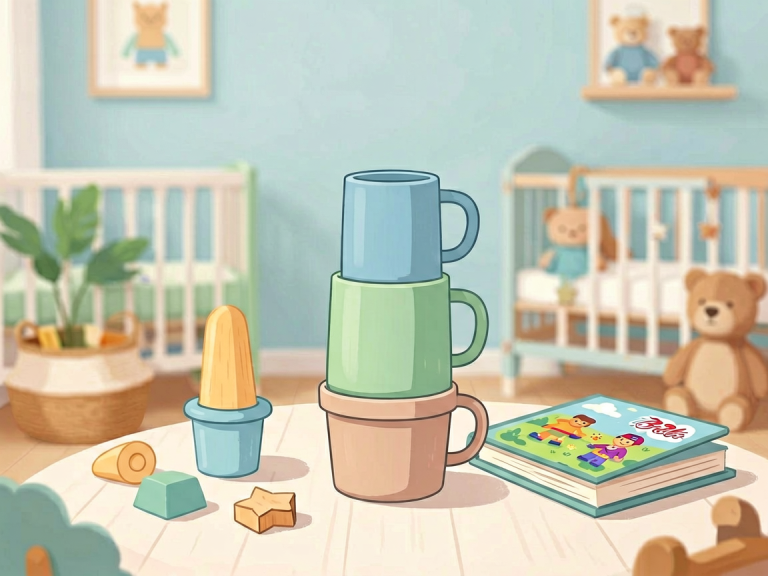
Set out a few plastic cups and a teapot. Pour imaginary tea (empty or with a tiny bit of water) into your cup and take a sip with an exaggerated "Ahh." Then offer the cup to your baby. They may try to sip or pour the contents. This activity teaches turn-taking and the social rituals of sharing.
2.3 Activities for Twelve to Twenty-Four Months: Storytelling and Character Play
The Bedtime Routine for Dolls
Provide a doll or stuffed animal, a small blanket, and a tiny pillow. Show your baby how to tuck the doll in, pat its back, and say "shh shh." Then let your baby take over. They may put the doll to bed repeatedly, which reinforces their own bedtime routine and gives them a sense of control.
The Grocery Shopping Game
Give your baby a small basket or bag and some play food items (or safe real items like an apple and a box of crackers). Walk around the room "shopping" together. "We need some carrots. Can you put them in the basket?" At the checkout, pretend to pay with a toy card or play money. This role play activity for babies builds vocabulary, categorization, and social interaction.
The Doctor's Visit
Using a toy stethoscope (or just a scarf as a pretend one), listen to your baby’s heartbeat. Then let them listen to a doll’s heartbeat. Show them how to put a bandage on the doll’s arm. This helps demystify medical visits and reduces anxiety.
The Kitchen Cook
Provide plastic bowls, spoons, and empty food containers. Pretend to stir a pot. "I’m making soup! What should we add? Some leaves? A pebble?" Your baby will likely mimic stirring and pouring. This activity supports fine motor coordination and imaginative thinking.
Section 3: The Science Behind Role Play Activities for Babies
3.1 Brain Development and Executive Function
When a baby engages in role play, multiple regions of the brain are activated. The prefrontal cortex, responsible for planning and impulse control, begins to practice "holding a scenario in mind." For example, a baby who pretends to feed a doll must remember that the doll is hungry, that the spoon is a tool, and that the action of moving the spoon to the doll’s mouth is a pretend feeding. This is an early workout for executive function skills that predict later academic success.
Additionally, role play strengthens neural connections related to cause and effect. When a baby puts a toy phone to their ear and you respond as if they are talking, they learn that their actions can elicit specific responses. This feedback loop encourages experimentation.
3.2 Language Acquisition Through Context
Role play activities for babies are a goldmine for language development. During pretend play, adults naturally use a richer vocabulary and more complex sentence structures. "Let's put the bear in the bathtub. Oh, he's splashing!" The baby hears verbs, prepositions, and nouns in a meaningful context. They also learn the pragmatics of conversation—listening, taking turns, and responding.
Moreover, when a baby initiates a pretend action (e.g., holding up a toy cup) and the adult responds verbally, the baby begins to associate their own actions with words. This is the foundation of symbolic communication.
3.3 Emotional Regulation and Empathy
Role play allows babies to practice emotional scenarios in a safe environment. When they pretend that a doll is sad and they hug it, they are rehearsing empathy. When they act out a tantrum with a toy character, they are externalizing feelings they may not yet have words for. This is especially important between 12 and 24 months, when babies begin to experience frustration, anger, and separation anxiety.
Furthermore, role play activities for babies help them make sense of their daily experiences. A baby who has just visited the doctor may replay the check-up with a doll, thereby processing the event and reducing fear.
Section 4: How to Set Up the Environment for Baby Role Play
4.1 Choose Open-Ended Toys
The best props for baby role play are not the most complicated ones. A simple wooden block can become a phone, a piece of cake, or a car. Cardboard boxes, fabric scraps, plastic bowls, and empty containers are far more valuable than electronic toys that do all the work. Open-ended toys encourage creativity and problem-solving.
4.2 Follow the Baby’s Lead
Resist the urge to direct the play. If your baby picks up a spoon and starts banging it on the table instead of pretending to eat, that’s fine. They may be exploring sound, not role play. Your role is to observe and occasionally model an action, then step back. Over-directing can stifle initiative.
4.3 Keep It Short and Sweet
Babies have short attention spans. A role play session might last only two to five minutes. That is perfectly normal. The goal is not to sustain a long narrative but to create a brief, joyful moment of shared imagination.
4.4 Incorporate Everyday Routines
Role play does not have to be a separate activity. You can weave it into diaper changes, bath time, and meals. For instance, during diaper changes, you can pretend the diaper is a hat and put it on your own head (baby laughs). Then put it on the baby’s tummy and say, "Where did the diaper go?" This lighthearted play reduces resistance and strengthens your bond.
Conclusion: The Lifelong Gift of Early Pretend
Role play activities for babies are not frivolous pastimes. They are the first steps on a long journey of creativity, empathy, and cognitive flexibility. When you make silly faces at your two-month-old, you are planting seeds of social connection. When you hand your ten-month-old a toy phone and babble along, you are teaching the structure of dialogue. When your toddler pretends to cook you a meal of invisible soup, they are learning to care for others.
As a parent or caregiver, you do not need expensive toys or elaborate plans. You simply need to be present, to model a bit of foolishness, and to respond warmly to your baby’s attempts at make-believe. Every time you pick up a stuffed animal and make it speak, you are telling your baby: *This world is full of possibilities. You can create, imagine, and explore. And I am right here with you.*
So go ahead—pick up that block, call it a sandwich, and take a pretend bite. Your baby is watching, learning, and about to join you in the most important game they will ever play.