The Power of Play: Selecting Toys to Foster Language Development in One-Year-Olds
Introduction
The first year of a child’s life is a whirlwind of rapid growth, but perhaps no area is as fascinating and transformative as language development. By 12 months, most infants have moved beyond cooing and babbling to produce their first meaningful words, understand simple commands, and engage in back-and-forth vocal play. However, language acquisition is not an automatic process; it is deeply influenced by the environment, interactions, and—surprisingly—the toys that surround them. While many parents focus on educational apps or flash cards, research consistently shows that the most effective tools for building language in one-year-olds are simple, sensory-rich, and interactive toys. This article explores the science behind this connection, categorizes the best toys for language growth, and provides actionable guidance for parents and caregivers who want to turn playtime into a rich linguistic experience.
The Critical Window of Language Acquisition
Before diving into specific toys, it is essential to understand why the period around 12 months is so pivotal. Neuroscientists refer to the first three years of life as a “sensitive period” for language, during which the brain’s neural circuits for speech and comprehension are most malleable. At one year old, a child’s brain is forming approximately 1 million new neural connections per second. Every sound, gesture, and word they hear shapes these connections.
Language development at this stage progresses through several key milestones: receptive language (understanding what is said) expands rapidly, while expressive language (speaking) emerges haltingly. A one-year-old might understand 50 words but only say 5 to 10. The gap between understanding and producing language is where the right toys can make a significant difference. Toys that encourage imitation, cause-and-effect learning, and social interaction help bridge this gap by providing repetitive, contextual cues that strengthen the brain’s language maps.
Key Features of Language-Building Toys
Not all toys are created equal when it comes to language development. To be effective, a toy for a one-year-old should possess several core characteristics:
- Interactive and Responsive
A toy that responds to a child’s action—whether by making a sound, lighting up, or moving—teaches the fundamental concept that communication has consequences. For example, a ball that plays a melody when rolled or a push-button toy that says “moo” when pressed reinforces the link between cause and effect, a precursor to understanding how words produce reactions.
- Repetitive and Predictable
One-year-olds thrive on repetition. Toys that repeat the same phrase, song, or sound when activated help children internalize patterns of language. This repetition also builds memory and anticipation, which are crucial for vocabulary acquisition.
- Sensory-Rich
Language is not just auditory; it is multimodal. Toys that engage multiple senses—touch, sight, sound, and even smell—create a richer learning environment. A plush block with a crinkly texture that also makes a rustling sound when squeezed, for instance, links the tactile sensation to an auditory cue, strengthening neural associations.
- Encourages Social Interaction
The most language-promoting toys are those that require a partner. Simple items like a ball for rolling back and forth, a toy phone, or a set of nesting cups naturally invite parents to narrate actions (“Roll the ball to Mommy!”, “You put the cup inside!”). This back-and-forth exchange is the foundation of conversational skills.
- Age-Appropriate Complexity
Toys that are too simple (e.g., a single rattle) may bore a one-year-old quickly, while those that are too complex (e.g., a multi-step puzzle) can cause frustration. The sweet spot includes toys that offer just enough challenge to keep the child engaged—like shape sorters with a few large pieces, or stackable rings that require trial and error.
Top Toy Categories and Their Roles
Based on these criteria, several categories of toys stand out as particularly effective for building language in one-year-olds. Each category supports different aspects of linguistic development.
1. Musical Instruments and Sound-Making Toys
From small drums to xylophones and shakers, musical toys are language powerhouses. They introduce rhythm, pitch, and volume, which are fundamental to speech prosody. When a child beats a drum and the parent chants “boom, boom, boom,” the child learns to associate a sound with a word. Moreover, many musical toys for one-year-olds come with buttons that play nursery rhymes or animal sounds. Repeating these sounds helps children practice phonemes—the smallest units of sound that form words. A study published in the journal *Infant Behavior and Development* found that infants who engaged with sound-producing toys for just 10 minutes a day showed faster progress in babbling complexity compared to a control group.
2. Board Books with Textures, Flaps, and Sound Modules
Books are arguably the most direct language-building toys, but for one-year-olds, the format matters enormously. Thick board books with tabs, flaps, and touch-and-feel elements (like “Pat the Bunny” or “Dear Zoo”) hold a child’s attention while exposing them to new vocabulary. The interactive elements encourage the parent to point, name objects, and ask questions (“Where’s the puppy? Can you find its tail?”). Sound module books that play a recorded voice reading the story or making animal calls add an auditory model that children can mimic. A study at the University of Washington’s Institute for Learning & Brain Sciences demonstrated that children who were read to from interactive books had a 30% higher vocabulary at 18 months than those who only viewed static books.
3. Cause-and-Effect Toys
These toys are designed so that a specific action reliably produces a predictable result. Classic examples include pop-up toys (where pressing a button makes a character spring out), hammering toys (where hitting a peg makes it drop through a hole), and simple shape sorters. The language payoff comes from the natural narration that parents provide. For instance, while a child tries to fit a square block into a hole, the parent can say, “Turn it… push… there it goes! Square!” The child learns the words *turn*, *push*, *square*, and *go* in context. Over time, the child begins to anticipate the words and even attempts to say them before the action.
4. Pretend Play Sets
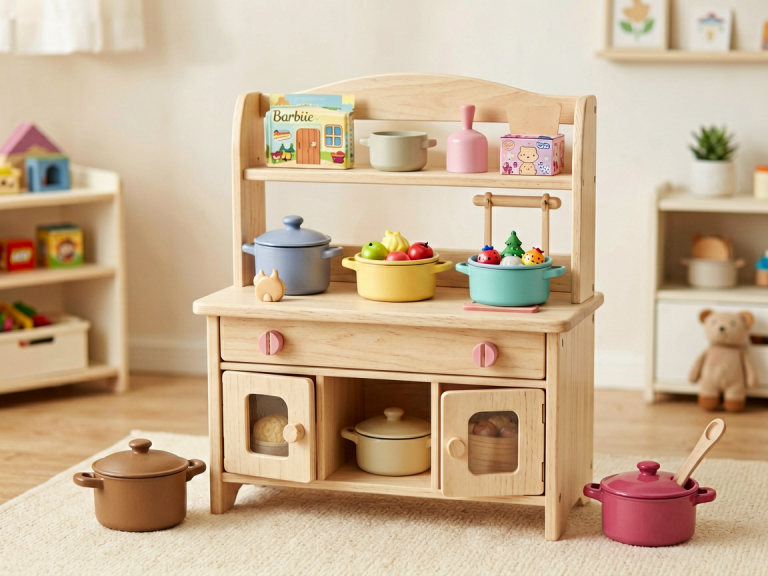
Even at one year old, children begin to engage in rudimentary pretend play. Toy telephones, plastic cups and plates, baby dolls, and play food are excellent investments. When a child picks up a toy phone and babbles into it, they are practicing the rhythm and social turn-taking of conversation—even if the words aren’t real. Parents can model appropriate language: “Hello! Who’s calling? Is it Grandma? Yes, we’re having fun!” Dolls and stuffed animals provide opportunities for caretaking language (“Give teddy a kiss. Teddy is sleepy. Let’s say ‘night-night’”). This type of play builds both vocabulary and the pragmatic rules of communication, such as taking turns and using tones.
5. Building and Stacking Toys
Blocks, stacking rings, and nesting cups may seem purely motor-skill toys, but they are rich in linguistic potential. As a child stacks a block, the parent can use spatial language (“on top,” “under,” “next to,” “big,” “small”), verbs (“build,” “fall,” “balance”), and sequencing words (“first,” “then,” “now”). Research from the Harvard Center on the Developing Child shows that children whose parents use a high number of spatial words during block play score higher on later language and math assessments. The repetitive motion of stacking and knocking down also allows for charming rituals like saying “Uh-oh! All fall down!” which becomes a favorite phrase to imitate.
Practical Tips for Parents
Selecting the right toys is only half the battle—how they are used matters even more. Here are evidence-based strategies to maximize language development during play:
- Narrate Everything
Describe what the toy is doing, what the child is doing, and what you are doing. Instead of simply handing a toy, say, “Here is the red ball. Do you want to roll it? Ready, set, GO!” The constant stream of language builds vocabulary and teaches sentence structure.
- Use the “Serve and Return” Model
This concept, popularized by Harvard’s Center on the Developing Child, emphasizes back-and-forth interaction. When your child makes a sound or points at a toy, respond as if it were a conversational turn. If they say “ba” while looking at a ball, you can say, “Yes, that’s a ball! B-A-L-L. Can you say ball?” This reinforces the child’s attempt and expands it into a correct model.
- Limit Passive Toys
Toys that just light up or play music on their own (e.g., a dancer that performs when a button is pressed but does not require interaction) often lead to passive viewing. While they can be fun, they should not dominate playtime. Aim for at least 80% of a child’s toy collection to be active toys that require the child’s physical or vocal participation.
- Rotate Toys Regularly
One-year-olds have short attention spans but also crave novelty. Keeping toys in a rotation (e.g., putting half away and swapping them every two weeks) maintains interest and allows the child to focus deeply on a smaller set of items. This deep play is when most language learning occurs.
- Incorporate Songs and Rhymes
Many toys can be paired with simple songs. For example, while playing with stacking rings, sing a slow version of “The Wheels on the Bus.” The rhythmic, predictable lyrics help children memorize word patterns. Over time, they will start to fill in missing words or hum along.
Conclusion
Language development does not happen in a vacuum, nor is it solely the product of direct instruction. For a one-year-old, the most powerful classroom is the playroom, and the most effective teachers are the toys that spark curiosity, interaction, and joyful repetition. By thoughtfully selecting toys that are responsive, sensory-rich, and socially engaging, and by using them in ways that encourage back-and-forth conversation, parents and caregivers can lay a robust foundation for a child’s lifelong communication skills. Remember: the goal is not to “drill” language but to create a world where words naturally arise from every rattle, book, and block. In that world, a one-year-old does not just play—they learn to speak.
*Word count: approximately 1,280 words*