The Best Toy Path for Early Reading: A Developmental Journey from Play to Literacy
Early reading is not a destination reached by a single flashcard or a digital app. It is a gradual, sensory-rich journey that begins in infancy and blossoms through playful interactions. The most effective way to foster early literacy is not to force letters onto a toddler, but to follow a carefully curated “toy path”—a sequence of developmentally appropriate playthings that build the foundational skills of reading: phonological awareness, print awareness, vocabulary, narrative comprehension, and a genuine love for stories. This article maps out the best toy path for early reading, from birth to school age, explaining why each stage matters and which toys deliver the most meaningful results.
Stage 1: Sensory Exploration (0–12 Months) – The Roots of Comprehension
Before a child can read a single word, she must understand that objects have names, that sounds carry meaning, and that books are a source of pleasure. In the first year, toys should stimulate the senses and encourage shared attention between caregiver and baby.
Recommended toys: High-contrast soft books (black-and-white patterns), crinkle fabric books, teething books with different textures, and simple cloth books with large, realistic images of faces or animals.
Why these work: Newborns see best in high contrast, and the tactile variety—crinkles, squeakers, soft fur—keeps them engaged during lap reading. When a caregiver points to a picture of a dog and says “dog,” the baby’s brain begins forming a neural link between the sound and the image. This is the earliest form of “word-to-world” mapping. Avoid electronic toys with flashing lights at this stage; they overstimulate and disrupt the quiet, back-and-forth interaction that builds language.
Parent tip: Let the baby chew, grasp, and bat at the book. The goal is not to “read” but to associate books with warmth, comfort, and your voice. This emotional bond is the single strongest predictor of later reading motivation.
Stage 2: Cause and Effect & Interactive Books (12–24 Months) – The First Sparks of Story
As toddlers begin to walk and talk, they crave control over their environment. Toys that let them press a button to hear a sound, lift a flap to reveal a hidden picture, or match a shape to a hole directly support pre-reading skills: sequencing, prediction, and vocabulary expansion.
Recommended toys: Lift-the-flap board books (e.g., *Where’s Spot?*), sound books with realistic animal or vehicle noises, simple wooden puzzles with images of everyday objects, and “first words” flash cards (used as toys, not drills).
Why these work: Lift-the-flap books teach the concept of “peekaboo” as a narrative device—something hidden that is revealed. This is a precursor to plot twists and surprise endings. Sound books build one-to-one correspondence between a symbol (a picture of a cow) and its associated sound (“moo”). Puzzles strengthen visual discrimination, the ability to notice differences between shapes and lines, which later helps distinguish “b” from “d.” Avoid any toy that requires the child to sit still for long periods; at this age, learning happens in motion.
Parent tip: When reading a lift-the-flap book, pause before lifting the flap and say, “What do you think is hiding?” This encourages prediction, a core reading comprehension skill.
Stage 3: Narrative Beginnings (2–3 Years) – From Single Words to Simple Stories
Around age two, children start stringing two-word phrases together (“more milk,” “big truck”). This is the perfect moment to introduce toys that explicitly support story sequencing and role-play. The brain’s narrative circuitry is just beginning to wire up; toys that allow a child to “act out” a story turn abstract language into concrete experience.
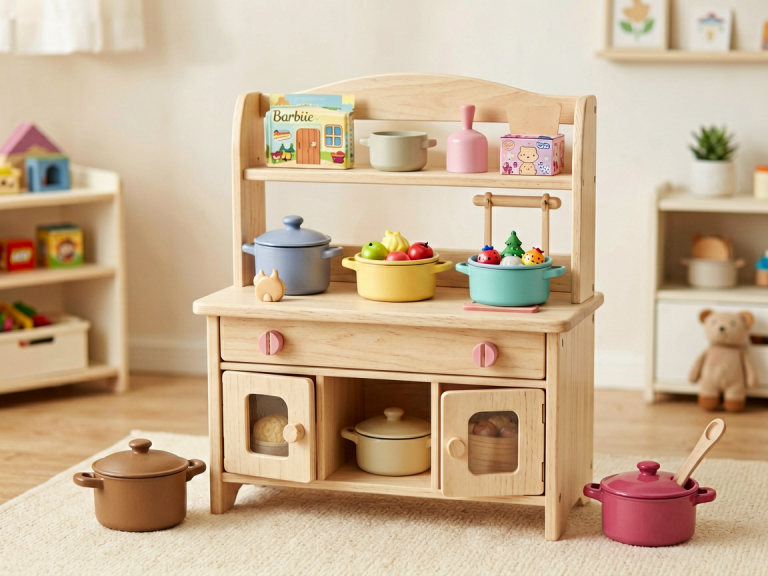
Recommended toys: Simple wooden animal sets (e.g., a farm set with a barn, animals, and a fence), toy food and kitchen sets, magnetic storyboards (with felt or magnetic pieces representing characters and settings), and picture books with very simple, repetitive storylines (like *Brown Bear, Brown Bear, What Do You See?*).
Why these work: When a toddler moves a toy cow into the barn and says “Cow sleep,” she is creating a narrative—a beginning (the cow goes in), a middle (sleeping), and an end (waking up). This story grammar is exactly what she will later apply to written stories. Magnetic storyboards allow limitless retelling; the child can rearrange pieces and create new versions of *Goldilocks*, building flexibility in comprehension. Avoid toys that are overly prescriptive (like those that only allow one “correct” story). The child should be the author.
Parent tip: Ask open-ended questions during play: “What happens next?” “Why is the pig sad?” These questions strengthen inferential thinking, a skill that separates good readers from great ones.
Stage 4: Phonics and Word Recognition (3–4 Years) – Alphabet Play as a Game
Now the child is ready to meet letters—not as abstract shapes to be memorized, but as playful tools for cracking the code of written language. The key is to embed phonics into games, never drills. The best toys at this stage treat letters like puzzle pieces, building words through trial and error.
Recommended toys: Magnetic alphabet letters (with a metal baking sheet as a board), alphabet puzzles (where each letter fits into a cutout that matches its shape), simple “word builder” toys that snap together consonants and vowels, and chunky letter stamps or foam bath letters. Also: classic matching games where a picture card (cat) is paired with the word card (cat).
Why these work: Magnetic letters allow children to physically manipulate letters—touching, moving, arranging. Research shows that multisensory learning (seeing, hearing, and moving) boosts letter-sound retention far more than flashcards. Matching picture to word builds the concept of “decoding”: a string of symbols stands for a real object. At this stage, avoid toys that bombard with too many letters at once. Focus on the sounds that matter most in the child’s environment (the first letter of her name, “M” for “Mom,” “D” for “Dad”).
Parent tip: Play “letter hunt” around the house. “Let’s find something that starts with B!” Then match the object to the magnetic letter. Keep it short—five minutes of joyful play beats twenty minutes of forced practice.
Stage 5: Independent Reading Preparation (4–5 Years) – Blending, Sight Words, and Confidence
Children at this age are often eager to “read by myself.” The best toys bridge the gap between oral language and the written page, providing just enough support to prevent frustration while still encouraging effort. This is the stage where phonemic awareness—the ability to hear and manipulate sounds in words—matures.
Recommended toys: Simple phonics-based board games (e.g., *Zingo! Word Builder*, *The Sneaky, Snacky Squirrel Game* for letter recognition), “sight word” bingo or jumping games (write sight words on paper plates and lay them on the floor), electronic reading pens that scan a book and read words aloud (like LeapFrog’s Tag system), and word-building toy sets with interlocking letter blocks (like *Magna-Tiles* letters or *Little Pim* word cards).
Why these work: Board games teach turn-taking and social reading, but more importantly they force repeated exposure to high-frequency words in a low-stress context. Electronic reading pens allow a child to touch a word and hear it pronounced instantly—this scaffolds independent reading by providing immediate feedback. Interlocking letter blocks encourage playful spelling: “I made ‘CAT’… now I’ll change the ‘C’ to ‘B’ and make ‘BAT’.” This kind of manipulation is the foundation of phonics mastery.
Parent tip: Don’t correct every mistake. If your child reads “house” for “home,” praise the meaning-making. Correct only when the error changes the meaning completely. Over-correction kills joy.
Stage 6: Building Comprehension and Love for Stories (5–6 Years) – Story Creation and Critical Thinking
By kindergarten, most children can decode simple words. The challenge now is comprehension: understanding character motivation, plot sequence, cause and effect, and inferring meaning beyond the text. Toys that encourage story creation and role-play are the most powerful tools for deep reading.
Recommended toys: Storytelling cards (like *Story Cubes* or *Rory’s Story Cubes*), puppet theaters with finger puppets representing story characters, blank books with markers for the child to write and illustrate her own story, and board games that require reading instructions (like *Outfoxed!*, a cooperative mystery game with clues). Also: “library” pretend play sets with a cash register, book stamps, and a “checkout” system.
Why these work: Story Cubes require a child to connect random images into a logical narrative, strengthening sequencing and creativity. Puppet theaters allow children to retell familiar stories in their own words, which deepens comprehension (they must recall plot points and dialogue). Creating their own books gives children ownership of the reading process—they realize that stories come from people, and they can be story people too. Board games with reading promote purposeful reading: if you don’t read the clue, you can’t solve the mystery.
Parent tip: After reading a picture book together, use Story Cubes to create a “new adventure” for the main character. Ask, “What if the wolf met a dragon?” This kind of imaginative extension is the highest level of comprehension.
Conclusion: The Path is Playful, Not Prescriptive
The best toy path for early reading is not a rigid checklist but a philosophy: meet the child where she is, respect her developmental stage, and surround her with rich, responsive, open-ended playthings. From a crinkly cloth book in the newborn months to a puppet theater in kindergarten, each toy builds a specific brick in the literacy foundation. But the mortar that holds these bricks together is the responsive, joyful interaction between child and adult. No toy, no matter how expensive or “smart,” can replace the sound of a parent’s voice saying, “What happens next?” or the shared laughter over a silly rhyme. So choose toys that invite conversation, that slow down time, that make a child say, “Again, again!” That is the true path to a lifetime of reading.