The Best Toys for Critical Thinking for 3-Year-Olds: Nurturing Young Minds Through Play
Introduction: Why Critical Thinking Begins at Three
At three years old, a child’s brain is undergoing an extraordinary transformation. Neural connections are being forged at a rate that will never be replicated in later life. This is the age when curiosity explodes, when “why” becomes a favorite word, and when children begin to make sense of the world not just through observation but through experimentation. The toys we introduce during this critical window are not mere distractions—they are the scaffolding upon which cognitive abilities, including critical thinking, are built.
Critical thinking is often misunderstood as a skill reserved for older children or adults. In reality, its foundations are laid in toddlerhood. A three-year-old who learns to compare shapes, solve simple puzzles, or figure out how to make a block tower stand without falling is already engaging in the same mental processes that later enable complex problem-solving, logical reasoning, and creative innovation. The key is to choose toys that challenge without frustrating, that invite exploration without prescribing outcomes. Below, I present a curated selection of the best toys for fostering critical thinking in three-year-olds, each chosen for its ability to spark curiosity, encourage experimentation, and build foundational reasoning skills.
1. Open-Ended Building Blocks: The Architects of Thought
Why They Work
Building blocks are the quintessential critical thinking toy for a reason. Unlike toys with a single intended use, blocks invite endless possibilities. A set of simple wooden or magnetic blocks can become a castle, a bridge, a spaceship, or a zoo enclosure. The child must constantly evaluate: Will this block fit here? Does this structure need a wider base? Why did my tower fall when I added that piece on top?
Specific Choices for Three-Year-Olds
For this age group, choose blocks that are large enough to be safe and easy to grasp but varied in shape, size, and color. Wooden unit blocks (like those from Melissa & Doug or Hape) are excellent because they introduce concepts of balance, symmetry, and spatial relationships. Alternatively, magnetic tiles (such as Magna-Tiles or Picasso Tiles) offer the added satisfaction of clicking together, which helps younger children feel a sense of accomplishment while they experiment with geometry and cause-and-effect.
How They Develop Critical Thinking
When a child builds a tower that repeatedly collapses, they begin to hypothesize: “Maybe I need a bigger block at the bottom.” This is the essence of the scientific method—observation, hypothesis, experiment, and conclusion. By rearranging blocks, stacking them in different orders, or testing the stability of various configurations, three-year-olds are practicing trial-and-error reasoning, learning to predict outcomes, and developing persistence in the face of failure. These are the very same skills that later help children approach math problems, science experiments, and life challenges with confidence.
2. Shape Sorters and Puzzle Games: Pattern Recognition Early
Why They Work
Shape sorters might seem simplistic, but they are actually sophisticated tools for critical thinking. They require a child to observe, compare, and match—often using multiple attributes such as shape, size, color, and orientation. Puzzles take this a step further by asking the child to see how parts fit into a whole, a fundamental cognitive skill.
Specific Choices for Three-Year-Olds
Opt for puzzles with larger pieces that have distinct edges and familiar images—animals, vehicles, or everyday objects. Chunky wooden puzzles with knobs are ideal for fine motor development while demanding logical placement. For shape sorters, look for those with more than just basic circles, squares, and triangles; some include stars, hexagons, or irregular shapes that challenge the child’s perceptual abilities. Products from brands like PlanToys, Melissa & Doug, or The Learning Journey offer excellent options.
How They Develop Critical Thinking
A child attempting to insert a star-shaped block into a square hole is engaging in deductive reasoning: “This doesn’t fit here. What shape is this? Let me try the star hole.” They learn to categorize, compare attributes, and use feedback to adjust their strategy. Puzzles also teach sequencing and foresight—the child must mentally rotate pieces, anticipate where they go, and plan the order of placement. Over time, these activities strengthen working memory, attention to detail, and the ability to think ahead, all of which are core components of critical thinking.
3. Simple Matching and Memory Games: Cognitive Flexibility in Action
Why They Work
Matching games, such as card pairs or lotto boards, require children to hold information in mind while scanning for patterns. Memory games add the challenge of recalling the location of hidden images, which demands focused attention and strategic thinking.
Specific Choices for Three-Year-Olds
Choose games with large, sturdy cards and clear, engaging images. A simple “find the pair” game with 12 to 16 cards is sufficient; avoid sets with too many pieces to prevent overwhelm. Look for themes that interest your child—animals, fruits, colors, or characters from favorite books. Brands like Eeboo, Orchard Toys, and HABA produce high-quality, child-safe memory games designed for this age.
How They Develop Critical Thinking
When playing memory games, a three-year-old must develop a strategy: “I saw a red bird under this card; now I saw another red bird over there—maybe they match.” This involves pattern recognition, spatial memory, and logical deduction. Matching games also encourage categorization—grouping similar items—and help children understand the concept of equivalence. These skills are directly linked to mathematical thinking and the ability to recognize relationships in data later in life.
4. Cause-and-Effect Toys: The Birth of Logical Reasoning
Why They Work
Toys that demonstrate clear cause-and-effect relationships are invaluable for teaching logical reasoning. A ball rolling down a ramp, a lever that lifts a platform, or a button that triggers a sound—these simple mechanisms let children predict and control outcomes.
Specific Choices for Three-Year-Olds
Look for marble runs (with large, safety-track pieces), wooden hammer-and-peg sets, or simple gear toys. The “Battat Wooden Marble Run” is a classic choice, as it allows children to build tracks and watch the marble travel, teaching gravity, trajectory, and spatial planning. Alternatively, “Gears! Gears! Gears!” sets from Learning Resources introduce basic engineering concepts. For a low-tech option, a simple cardboard ramp and a few cars can provide hours of experimental play.
How They Develop Critical Thinking
A child placing a marble at the top of a track must ask: “Will it go straight or turn? What happens if I put the block here?” They learn to anticipate outcomes based on previous observations. When the marble gets stuck, they have to diagnose the problem: “The track is too steep, or the curve is too tight?” This is problem-solving in its purest form. By experimenting with different configurations, children begin to understand that actions have consequences—a foundational concept for all higher-order thinking.
5. Pretend Play and Role-Playing Sets: Thinking from Another Perspective
Why They Work
Critical thinking is not only about logic and problem-solving; it also involves empathy, perspective-taking, and flexible thinking. Pretend play allows three-year-olds to step into someone else’s shoes, imagine scenarios, and negotiate rules.
Specific Choices for Three-Year-Olds
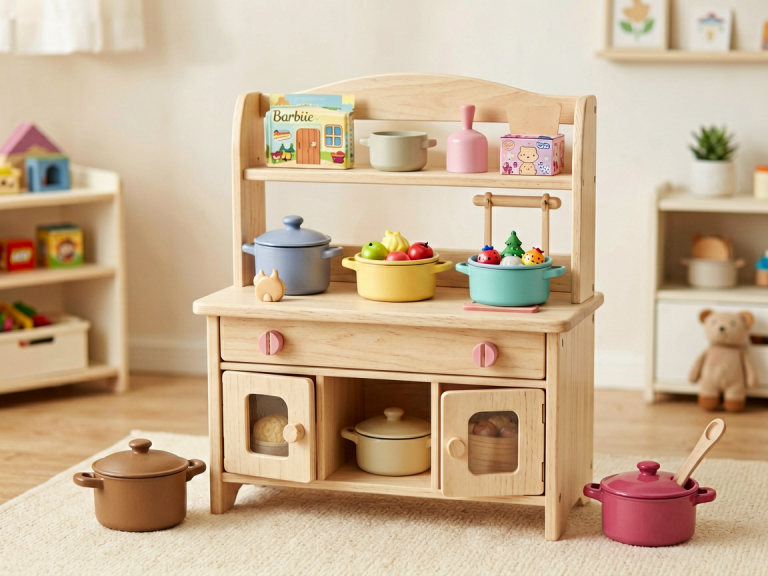
Simple play sets—such as a kitchen, doctor’s kit, tool bench, or animal farm—are ideal. The key is to avoid overly detailed sets that dictate every action. Instead, choose open-ended props: wooden fruits, a stethoscope, a set of plastic tools, or a collection of animal figures. Brands like PlanToys, Green Toys, and Melissa & Doug offer high-quality, safe options.
How They Develop Critical Thinking
When pretending to cook a meal, a child must sequence actions: “First I wash the apple, then I cut it, then I put it in the pot.” This requires logical ordering. When playing doctor, they must diagnose a problem: “My teddy has a fever—what do I do?” This involves recalling past experiences and applying them to a new context. Furthermore, pretend play often requires collaboration with peers or adults, which builds social reasoning, negotiation, and the ability to see events from multiple perspectives. All of these are essential for complex critical thinking in real-world situations.
6. Art and Construction Toys: Creative Problem-Solving
Why They Work
Creative expression is a form of critical thinking. When a child chooses colors, decides where to place a sticker, or figures out how to make a clay animal stand up, they are making decisions, solving problems, and evaluating results.
Specific Choices for Three-Year-Olds
Large crayons, washable markers, play dough, and child-safe scissors are excellent. Modeling clay sets with simple tools (rollers, cutters) encourage experimentation with texture and form. Sticker books with reusable stickers allow for repeated repositioning, which trains the eye and the brain to compare options. For construction, consider large interlocking plastic bricks (like Duplo, not Lego) that require fine motor coordination but are easy to snap together.
How They Develop Critical Thinking
While drawing, a child might think: “I want to draw a cat. The cat has a round head. How do I make the ears? I’ll add triangles.” This is problem-solving in real time. With play dough, they learn about proportion and stability: “This ball is too heavy for this thin leg—it falls over. I need to make the leg thicker.” These small, repeated experiments teach children to adjust their methods based on feedback, which is the heart of critical thinking. Moreover, art encourages divergent thinking—the ability to generate multiple solutions to a single problem—which is crucial for innovation.
Conclusion: Play Is the Work of Childhood
The best toys for critical thinking are those that do not do the thinking for the child. They are the open-ended blocks that topple, the puzzles that challenge, and the pretend worlds that invite storytelling. They require effort, patience, and imagination, but they reward with deep cognitive growth. For a three-year-old, every block placed, every puzzle piece matched, and every role acted out is a tiny exercise in reasoning, analysis, and decision-making.
When selecting toys, remember that simplicity often trumps complexity. A cardboard box can be more valuable than a battery-operated robot because it transforms limitlessly based on the child’s ideas. Similarly, a set of wooden blocks may seem old-fashioned, but it offers a learning experience that no flashy screen can replicate. The goal is not to rush cognitive development but to provide rich, engaging environments where critical thinking can flourish naturally.
Finally, parents and caregivers should remember that the most powerful “toy” of all is a responsive adult who asks questions, encourages exploration, and celebrates mistakes as learning opportunities. By choosing the right toys and engaging in meaningful play together, we give three-year-olds the tools they need to become curious, thoughtful, and resilient thinkers—ready for the challenges of the world.