best toys for problem solving for 3-year-olds
The Best Problem-Solving Toys for 3-Year-Olds: Building Young Minds Through Play
Introduction
At the age of three, children are natural explorers. Their brains are rapidly developing, and they begin to understand cause and effect, spatial relationships, and the simple logic behind how things work. This is the perfect stage to introduce toys that intentionally encourage problem-solving. Unlike passive entertainment, problem-solving toys ask children to think, test, adjust, and try again. They foster persistence, creativity, and cognitive flexibility—skills that are far more valuable than any single piece of knowledge.
But with shelves overflowing with colorful plastic options, how do parents choose the right ones? The best toys for 3-year-olds are not the flashiest or the most expensive. They are the ones that offer open-ended possibilities, require hands-on manipulation, and challenge a child just enough to be interesting without causing frustration. Safety, durability, and age-appropriateness are also critical at this stage, as three-year-olds still mouth objects and need large, non-toxic pieces.
This article explores the top categories of problem-solving toys for 3-year-olds, explaining why each type works and how to maximize their learning potential during playtime. Whether you are a parent, a teacher, or a gift-giver, you will find concrete recommendations backed by developmental science.
—
## Building Blocks and Construction Sets
Few toys are as timeless or as powerful for problem-solving as a simple set of building blocks. For a three-year-old, stacking, balancing, and connecting pieces is a fundamental exercise in physics and engineering. When a tower falls, the child must figure out why—was the base too narrow? Were the blocks too uneven? Each collapse is a natural experiment that teaches cause and effect.
Construction sets designed for this age, such as large interlocking bricks (e.g., Duplo) or wooden unit blocks, allow children to create structures that require planning. For example, if a child wants to build a bridge for a toy car, she must first decide how to support the road above the gap. She may try placing two blocks close together, then realize the car cannot pass through. Through trial and error, she learns about stability, symmetry, and balance.
Parents can enhance the problem-solving element by posing challenges: “Can you build a tower taller than your teddy bear?” or “How can you make a ramp for this ball?” These prompts push the child to think beyond simple stacking and into purposeful design. The open-ended nature of blocks means that no two play sessions are alike, ensuring continuous cognitive growth.
—
## Puzzles and Shape Sorters
Puzzles are classic problem-solving tools because they demand visual-spatial reasoning and logical deduction. For a three-year-old, the best puzzles have large, chunky pieces with clear images—often of animals, vehicles, or familiar objects. A 4-to-8-piece peg puzzle is ideal, as it requires matching shapes to outlines and rotating pieces to fit.
When a child tries to place a puzzle piece the wrong way, she experiences a moment of “this doesn’t work.” She must then try a different orientation, compare the shape with the hole, and persist until it clicks. This process develops what psychologists call “executive function”—the ability to hold a goal in mind while testing strategies.
Shape sorters also belong in this category. A classic shape sorter box with cubes, triangles, and stars forces a child to identify the geometric attributes of each piece. At first, she might try to force a square into a circular hole. After several failures, she begins to systematically test each hole, learning to visually scan and match properties. Some modern shape sorters add a twist, such as requiring the child to press a button or lift a latch to open the lid, adding a sequential problem-solving step.
—
## Matching and Sorting Games
Three-year-olds are just beginning to understand categories and attributes like color, size, and pattern. Matching and sorting games turn these abstract concepts into concrete, hands-on challenges. A simple set of colored bears or counting animals that can be sorted into bowls by color is a wonderful starter. The child must decide: “Does this red bear go with the red bowl or the blue one?” This requires observation and decision-making.
More advanced sorting games ask children to match pictures to corresponding shadow outlines, or to pair objects that go together (e.g., a toy hammer with a nail, or a key with a lock). These activities build logical reasoning: “This key has a round head, so maybe it fits the round lock.”
Another excellent problem-solving toy in this category is the “what comes next?” pattern board. For instance, a wooden board with a sequence of red-blue-red-blue, and the child must pick the correct next piece to continue the pattern. This early exposure to sequencing lays the groundwork for mathematical thinking. Because these games often allow self-correction (the pieces only fit correctly), they provide immediate feedback without adult intervention.
—
## Simple Mazes and Track Sets
Mazes and track sets introduce directional thinking and sequential planning. A three-year-old may start with a simple wooden maze where a magnetic wand moves a ball along a path. To get the ball from start to finish, the child must plan the route, avoid dead ends, and adjust her hand movements accordingly. This is a brilliant exercise in fine motor control and forward thinking.
Track sets, such as wooden car ramps or marble runs designed for small hands, take problem-solving to the next level. Unlike a pre-assembled toy, these kits require the child to decide how to place the pieces so that a ball or car travels from top to bottom successfully. If a marble falls off the track, the child must analyze: “Was the turn too sharp? Is there a gap?” She then experiments with repositioning the pieces.
The beauty of track sets is that they are highly visual and rewarding. The child sees immediate cause-and-effect: when she changes the track, the ball takes a different path. Some track sets include obstacles like bells or flags that the ball must knock over, adding extra layers of planning. Over time, children learn to predict outcomes and develop the patience to refine their designs.
—
## Pretend Play and Tool Sets
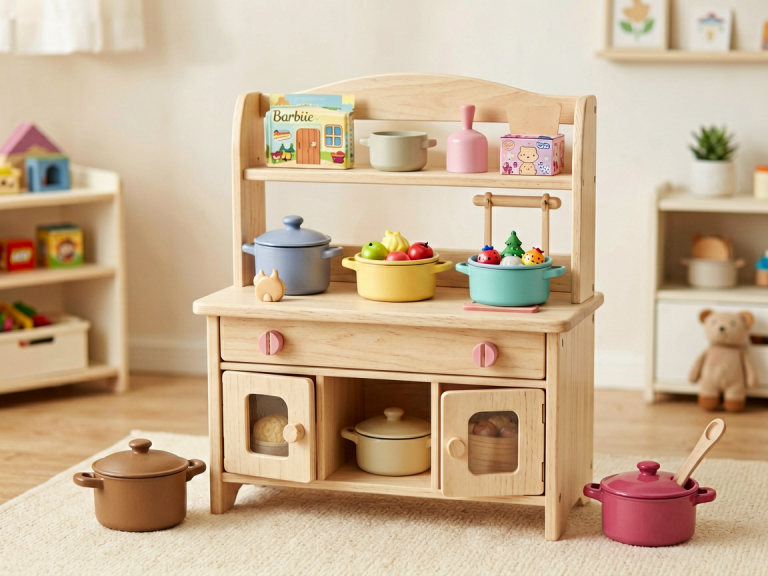
It might not be obvious at first, but pretend play is one of the richest problem-solving activities for a three-year-old. When a child pretends to cook in a play kitchen, she must solve a series of miniature problems: “I need to make soup. What pot should I use? How do I stir without spilling? How do I set the table for two people?” These everyday scenarios require sequencing, resource management, and social negotiation if playing with others.
Tool sets—such as a child-safe wooden hammer, screwdriver, and wrench—are especially valuable for problem-solving. A child trying to “fix” a toy car with a pretend toolbox must figure out which tool is appropriate for each task. “Does this screw need the screwdriver or the wrench?” This type of imaginative play also strengthens language skills as the child narrates her actions.
Parents can enhance the problem-solving aspect by introducing simple constraints. For example: “We only have one banana for the picnic. How can we cut it so everyone gets a piece?” Or, “The doll’s chair is broken. Can you find a way to fix it with your tools?” These open-ended challenges encourage divergent thinking—the ability to come up with multiple solutions.
—
## Cause-and-Effect and Mechanical Toys
Three-year-olds are fascinated by mechanisms—buttons that make things pop up, levers that lift objects, and gears that turn other gears. Toys that rely on simple machines, such as a classic “banging bench” where the child hammers pegs that then flip over, or a gear puzzle where turning one gear spins another, teach the basics of mechanical problem-solving.
One of the best examples is a ball drop tower: the child places a ball at the top of a ramp, watches it roll down, and it triggers a bell or a spinning wheel. To understand the cause-and-effect chain, the child may try different starting positions or different balls to see what changes. This is early scientific reasoning.
Similarly, a pop-up toy where pressing a shape makes an animal pop out of a corresponding hole requires the child to connect two actions: press the square button to open the square door. Over time, children learn to predict which button opens which door, building memory and logical associations. Because the result is immediate and amusing, these toys keep children engaged in repeated experimentation.
—
## Social and Cooperative Problem-Solving Games
While many problem-solving toys are solo activities, group play introduces a whole new dimension: negotiation, turn-taking, and joint planning. At age three, children are beginning to engage in parallel and cooperative play. Simple board games designed for preschoolers—such as “Hoot Owl Hoot!” or “The Sneaky, Snacky Squirrel Game!”—require players to work together or take turns to achieve a goal.
For example, in a cooperative game, all players try to help the owls fly home before the sun rises. Children must decide collectively which owl to move, which card to play, and how to overcome obstacles. This type of structured play teaches step-by-step reasoning while also developing social skills.
Even without a formal board game, parents can set up collaborative problem-solving challenges. “Can you and your friend build a castle together?” or “Who can find a way to roll the ball into the cup without touching it?” These tasks require children to communicate their ideas, listen to others, and combine their efforts—all essential problem-solving skills that extend far beyond the toy box.
—
## Choosing the Right Toy: Practical Tips for Parents
Not every toy labeled “educational” delivers genuine problem-solving opportunities. When selecting toys for a 3-year-old, look for these qualities:
- Open-endedness: Toys like blocks, clay, or sand can be used in countless ways. They encourage multiple solutions rather than a single correct answer.
- Challenging but not frustrating: The toy should require effort but be achievable with persistence. If a child gives up after one try, it may be too hard; if she solves it instantly every time, it is too easy.
- Self-correcting features: Puzzles and shape sorters that only fit one way teach independent error checking. The child learns from failure without an adult stepping in.
- Real-world connection: Toys that mimic adult tools (kitchens, toolboxes, doctor kits) help children solve problems they observe in daily life.
- Safety and durability: For three-year-olds, avoid small parts that pose choking hazards. Look for rounded edges, non-toxic materials, and sturdy construction that survives rough handling.
Finally, remember that the best problem-solving toy is often one that involves you. When a parent sits alongside a child and asks thoughtful questions—“What do you think will happen if we move this block?” or “Why do you think the ball stopped there?”—the learning deepens exponentially. The toy is the tool, but the conversation is the teacher.
—
Conclusion
Problem-solving is not a skill that can be drilled into a three-year-old; it is a natural, joyful process that unfolds through play. The best toys for this age are those that invite experimentation, tolerate mistakes, and reward persistence. From stacking blocks to sorting colors, from building marble runs to fixing a pretend flat tire, each play session wires the young brain to think flexibly and creatively.
By choosing toys that challenge rather than entertain passively, parents give their children a gift that lasts a lifetime: the confidence to face problems head-on, the curiosity to explore multiple solutions, and the resilience to try again after a failure. So the next time you consider a gift for a three-year-old, skip the flashing lights and battery-operated noise. Instead, reach for a set of wooden blocks, a chunky puzzle, or a simple magnetic maze. Watch closely—you will see a young problem-solver being born.