Building Blocks of Attention: Play Activities That Foster Focus in Babies
—
Introduction: The Quiet Superpower of Early Focus
In the bustling world of infant development, parents often celebrate first smiles, first steps, and first words. Yet one of the most foundational skills—the ability to focus—is quietly being built from the very first months of life. Focus, or sustained attention, is not something babies are born with in full measure. It is a muscle that develops through repeated, gentle exercise. And the most natural gym for that muscle? Play.
For babies, play is not merely entertainment; it is the primary vehicle for learning about cause and effect, pattern recognition, and the rewarding feeling of engaging with the world. When we design play activities that intentionally nurture focus, we are giving babies a gift that will support every future academic, social, and emotional endeavor. This essay explores a range of play activities, tailored to different stages of infancy, that are proven to help little ones strengthen their concentration—one joyful moment at a time.
—
1. Sensory Treasure Hunts: Engaging the Newborn’s Eyes and Ears
From birth to around three months, a baby’s focus is fleeting—often lasting only a few seconds. Yet even these brief windows are precious. Activity: High-Contrast Card Exploration. Newborns are naturally drawn to black-and-white patterns because their color vision is still developing. Hold a high-contrast card (e.g., bold stripes, checkerboards, or simple faces) about 8–12 inches from your baby’s face. Slowly move it from side to side, then pause. Watch as your baby’s eyes lock onto the pattern, tracking it for several seconds. This simple game trains the visual system to anchor attention. For auditory focus, Activity: Gentle Sound Boxes. Use a small, soft rattle or a container filled with dried beans. Shake it softly near one ear, then the other, pausing between each shake. The baby’s head may turn, and you will see a brief stillness—a sign of concentrated listening. These early activities are not about duration but about the spark of engagement.
Why it works: High-contrast visuals and isolated sounds eliminate competing stimuli, allowing the baby’s immature nervous system to practice holding a single point of focus. The adult’s calm presence and the predictable rhythm of the activity also create a safe loop of attention and reward.
—
2. Cause-and-Effect Play: Scaffolding Focus Through Surprise
Between three and six months, babies begin to understand that their actions can produce interesting results. This is a golden age for building focus because curiosity acts as a natural motivator. Activity: Tissue Box Pull. Take a small box (a clean tissue box works well) and stuff it with colorful scarves or pieces of fabric, leaving one end hanging out. Show your baby how to pull the fabric. When they grasp and tug, the fabric emerges in a satisfying cascade. Repeat. Each pull requires the baby to visually track the fabric, coordinate hand-eye movement, and anticipate the result. The task demands two to three minutes of focused attention—a marathon for a four-month-old. Activity: Drop-and-Listen. Gather a set of lightweight, safe objects (e.g., a wooden block, a plastic cup, a soft ball). Sit your baby in a high chair or supported position. Drop one object into a metal bowl or onto a hard floor. The sound is magnified. Then hand the object back to your baby and encourage them to drop it themselves. Each repetition reinforces the connection between their release and the resulting clatter. Babies often repeat this action dozens of times, their eyes fixed on the object, their ears tuned to the sound. This is focus in action.
Why it works: Cause-and-effect activities provide immediate feedback. The baby learns that sustained attention—watching, releasing, listening—yields a predictable and enjoyable outcome. The brain’s reward system releases dopamine, encouraging the baby to repeat the cycle and lengthen their concentration span.
—
3. Mirror Play: The Fascination of Self and Sustained Gaze
Around six to nine months, babies become increasingly interested in faces—especially their own. Activity: Mirror Gazing. Place a unbreakable mirror securely on the floor or against a wall. Lie your baby on their tummy in front of it or sit them up with support. At first, they may simply gaze at the reflection, occasionally reaching out to touch it. Point to their nose, then to the mirror’s reflection, saying “That’s you!” This activity naturally encourages prolonged visual focus because the face is dynamic yet familiar. Babies often spend several minutes tracking their own movements—opening their mouth, making faces, watching the reflection mimic them. To extend the focus, Activity: Mirror and Toy. Hold a small toy near the mirror so your baby sees both the real toy and its reflection. Move the toy slowly. Your baby’s gaze will shift between the two images, building the skill of comparing and contrasting—a higher-order focus.
Why it works: Self-recognition is a powerful motivator. Combined with the mirror’s immediate visual feedback, babies engage in sustained attention without external prompting. The activity also trains the brain to ignore distractions (like the adult’s voice off to the side) and lock onto the reflection.
—
4. Object Permanence Games: Patience and Memory as Focus Tools
From about seven to twelve months, babies develop object permanence—the understanding that objects continue to exist even when out of sight. This cognitive leap is perfect for focus-building because the baby must hold a mental image in mind. Activity: Peek-a-Boo with a Twist. Instead of the classic face-peek, hide a favorite toy under a small blanket or scarf. Make sure part of the toy is still slightly visible, then ask, “Where did it go?” Encourage your baby to pull the blanket off. Celebrate the discovery. Gradually increase the difficulty by hiding the toy completely. Your baby will need to recall the toy’s location and concentrate on the process of uncovering it. Activity: Cup and Ball. Use three opaque cups and a small ball. Place the ball under one cup, then slowly slide the cups around. Your baby must track the ball with their eyes and then reach for the correct cup. This game demands intense visual focus and memory. Even if they choose incorrectly, the act of lifting the cup and seeing the empty spot reinforces attention on the next attempt.
Why it works: Object permanence games require the baby to sustain attention not only on what is visible but also on what is mentally represented. This dual demand—external attention plus internal recall—is an advanced form of focus that strengthens the prefrontal cortex.
—
5. Water and Pouring Play: Calm, Concentrated Sensory Flow
For older babies (nine months and up), water play is a near-magical focus builder. Activity: Simple Water Transfer. Fill a shallow basin with a few inches of lukewarm water. Provide two large cups and a small ladle or a sponge. Show your baby how to scoop water from one cup and pour it into the other. The sound, the movement, and the cool sensation combine to create a hypnotic, focused state. Babies can sit at this activity for ten minutes or more, their eyes glued to the stream of water, their hand movements deliberate and slow. Activity: Floating and Sinking. Drop several safe objects into the water—a plastic boat, a rubber duck, a small stone. Encourage your baby to pick them out. Each retrieval requires careful hand-eye coordination and visual tracking. The slow, repetitive nature of water play naturally slows down the baby’s pace, promoting a meditative-like attention.
Why it works: Water is inherently calming and provides clear, immediate cause-and-effect feedback. The lack of loud noises or rapid changes allows the baby to enter a “flow state,” where attention becomes effortless. Water play also engages multiple senses simultaneously, which can help regulate a baby’s arousal level and extend focus.
—
6. Stacking and Nesting: Patience, Plan, and Precision
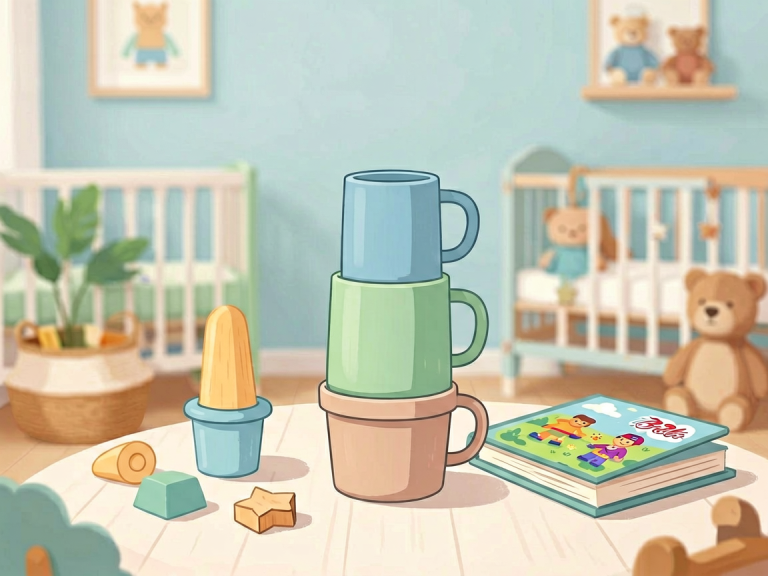
Stacking toys, such as nesting cups or soft blocks, are classics for a reason. Activity: Tower Building. Provide four to six lightweight, colorful blocks. Sit across from your baby and build a small tower yourself, then knock it down with a dramatic “boom!” Encourage your baby to try. At first, they may simply knock down your towers, but soon they will attempt to place one block on top of another. This requires intense visual focus (lining up the block), motor planning (controlling the release), and impulse control (not knocking it over prematurely). Activity: Nesting Cups. Take a set of colorful cups that fit inside each other. Scatter them on the floor. Show your baby how to fit the smallest cup into the next size, then into the next. Each successful nesting requires trial and error, and the baby must concentrate on the relative sizes. This activity can occupy a ten-month-old for up to fifteen minutes.
Why it works: Stacking and nesting require the baby to hold a goal in mind (the tower shape, the nested set) while executing precise movements. The visual discrepancy between a cup that is too big and the correct size forces the baby to compare, adjust, and try again—each attempt sharpening their focus.
—
7. The Adult’s Role: The Gentle Dance of Attention
No activity works in a vacuum. The most powerful tool for building a baby’s focus is the caregiver’s own attention. When you sit on the floor, make eye contact, narrate what your baby is doing (“You have the red cup! Now you are putting the block on top…”), and resist the urge to interrupt or add new toys, you create a container of calm. Babies sense when a caregiver is distracted; conversely, they mirror your focused presence. Practical tips: Keep play sessions short (5–10 minutes for young babies, up to 20 minutes for older ones). Follow your baby’s lead—if they lose interest, stop. Forcing focus backfires. Instead, end the activity before boredom sets in, leaving your baby wanting more. Also, reduce environmental clutter: one or two toys at a time, a quiet room, and no screens in the background. Simplicity is the mother of focus.
—
Conclusion: Every Small Gaze, a Seed for Tomorrow
Building focus in babies is not about drilling them or achieving long, adult-like concentration. It is about creating small, generous moments where the world narrows to a single fascinating object—a scarf appearing from a box, a face in the mirror, water dripping from a cup. Each time a baby’s eyes lock onto a sight, their hands reach with intention, and their brain holds a thought for a few seconds longer, a neural pathway is strengthened. These pathways become the foundation for reading, problem-solving, and deep learning in the years ahead.
The play activities described above are not chores; they are invitations. Invitations to slow down, to marvel at the ordinary, and to join your baby in the sacred act of paying attention. As you engage in these games, you are not just teaching your baby to focus—you are learning to focus together. And that shared attention is one of the greatest gifts you can give. So choose a high-contrast card, pour a cup of water, or sit before a mirror. Watch. Wait. Your baby’s focus is already beginning to bloom.