Building Blocks of the Mind: Play Activities for Babies to Cultivate Problem-Solving Skills
Introduction
Problem-solving is not a skill reserved for adults solving complex equations or engineers designing bridges. It begins in infancy, when a baby first reaches for a dangling toy, attempts to fit a square block into a round hole, or figures out how to make a rattle produce sound. These early moments of trial and error are the foundation of cognitive development, and they are most powerfully nurtured through play. For parents and caregivers, understanding how to design intentional play activities that challenge a baby’s emerging problem-solving abilities can transform everyday moments into rich learning opportunities. This article explores a range of age-appropriate play activities, from sensory exploration to cause-and-effect games, that help babies build critical thinking, persistence, and creativity—all while having fun.
The Importance of Problem-Solving in Infancy
Before diving into specific activities, it is essential to understand why problem-solving matters for babies. From a developmental perspective, the first three years of life are a period of explosive brain growth, during which neural connections are formed at an astonishing rate. Problem-solving experiences stimulate the prefrontal cortex, the part of the brain responsible for executive functions such as planning, decision-making, and self-control. When a baby encounters a challenge—like retrieving a toy that has rolled under the couch—they engage in a cycle of observation, prediction, action, and adjustment. This process strengthens cognitive flexibility and resilience. Moreover, successful problem-solving boosts a baby’s sense of agency and self-confidence, encouraging them to take on increasingly complex tasks. Play, therefore, is not merely entertainment; it is the primary vehicle through which babies learn to understand and interact with their world.
Sensory Play: Exploring Cause and Effect
Sensory play is one of the earliest and most effective ways to introduce problem-solving to babies. For infants aged 4 to 9 months, simple activities that engage multiple senses help them grasp the concept of cause and effect—a cornerstone of problem-solving.
*Treasure Baskets with Textured Objects*
Fill a shallow basket with safe, everyday items of varying textures, shapes, and sizes: a wooden spoon, a silky scarf, a crinkly paper, a rubber teether, and a soft fabric ball. Place the basket near a seated baby and allow them to explore freely. At first, the baby may simply grasp and mouth objects. Over time, they will begin to experiment: What happens when I drop the spoon? Does it make a different sound than the scarf? Can I pick up the ball if it rolls away? These tiny experiments teach the baby that their actions produce predictable outcomes. To extend the challenge, partially hide a favorite object under a cloth within the basket. The baby must figure out how to remove the cloth to retrieve the toy—a simple but powerful problem-solving task.
*Water Play with Cups and Sponges*
For babies who can sit securely (around 6–9 months), water play offers endless opportunities for discovery. Provide two shallow containers—one empty, one with a small amount of water—along with a sponge and a few plastic cups. Show the baby how to squeeze the sponge to release water, then let them try. The baby will soon realize that dipping the sponge into the water and then squeezing it over the empty cup transfers the liquid. This activity involves sequencing, motor planning, and understanding volume. As the baby grows, you can introduce more variables, such as using a funnel or a sieve, prompting them to figure out why water flows differently through different objects.
Object Permanence Games: The Hidden Toy Challenge
Object permanence—the understanding that objects continue to exist even when out of sight—is a critical cognitive milestone that typically emerges between 8 and 12 months. Games that reinforce this concept are excellent for building problem-solving skills because they require the baby to mentally represent an unseen object and plan a retrieval strategy.
*Peek-a-Boo with a Twist*
Classic peek-a-boo is a good start, but a more structured version enhances problem-solving. Use a lightweight scarf or a small blanket. Sit face-to-face with your baby and slowly hide a small, brightly colored toy under the blanket while the baby is watching. Pause and ask, “Where did it go?” Encourage the baby to pull the blanket away. If they struggle, you can lift a corner to give a hint. Gradually increase the difficulty by hiding the toy behind multiples barriers (e.g., under a blanket inside a box) or by using two identical blankets and shifting the toy from one to the other. The baby must remember the toy’s location and adapt their search strategy, engaging working memory and logical reasoning.
*The Cup Game*
Place three small plastic cups upside-down on a table within the baby’s reach. While the baby watches, hide a small toy under one cup. Then gently shuffle the cups. Ask the baby to find the toy. At first, the baby may simply lift the cup they saw you hide it under. As they develop, they will learn to track the movement of the cup and deduce the new location. This game challenges visual tracking, memory, and deductive reasoning—all essential components of problem-solving.
Cause-and-Effect Activities: Building Strategic Thinking
Cause-and-effect reasoning is at the heart of problem-solving: understanding that one action leads to a specific result, and adjusting actions to achieve desired outcomes. For babies, these activities should be concrete, repetitive, and rewarding.
*Push-Button Toys and Pop-Up Boxes*
Commercial toys such as pop-up boxes (where pressing a button makes an animal pop up) are excellent, but you can create your own version. Use a small cardboard box with flaps. Cut a hole large enough for a baby’s hand, and inside place a bell or a rattle attached to a string. Show the baby how pulling the string makes the bell ring. Then let them experiment. The baby must figure out that the string needs to be pulled in a particular direction. Over time, you can add a second string that produces a different sound, forcing the baby to compare and choose which action yields the desired result. This develops decision-making and systematic testing.
*Rolling Balls Down Ramps*
For babies around 10–15 months, a simple ramp—a piece of cardboard propped up on a stack of books—provides endless problem-solving. Offer the baby several small balls of different sizes and weights. Let them place a ball at the top of the ramp and watch it roll down. Then ask, “What happens if we change the slope?” Adjust the ramp’s angle and let the baby try again. They will begin to notice that a steeper ramp makes the ball roll faster, or that a heavier ball might not roll as far. To further challenge them, add a bucket at the bottom; the baby must figure out how to position the ramp so the ball lands inside. This activity integrates spatial reasoning, hypothesis testing, and fine motor control.
Building and Stacking: Spatial Problem-Solving
Block play is a classic activity for developing problem-solving because it involves planning, balance, and error correction. Even before a baby can stack blocks, they can engage in simple building experiences.
*Soft Block Towers*
For babies 6–9 months, use lightweight foam or fabric blocks. Sit with the baby on the floor and build a small tower of three blocks. Encourage the baby to knock it down—this is actually the first step in understanding structure. Once they enjoy knocking, show them how to stack one block on top of another. The baby will likely try to place a block haphazardly, and it will topple. This is a perfect problem-solving moment. Prompt them: “Where should we put the block so it stays?” Gradually, they will learn to align the block and apply gentle pressure. As they progress, introduce blocks of different shapes—cylinders, triangles, and rectangles—forcing them to figure out which shapes can be stacked stably.
*Nesting Cups and Stacking Rings*
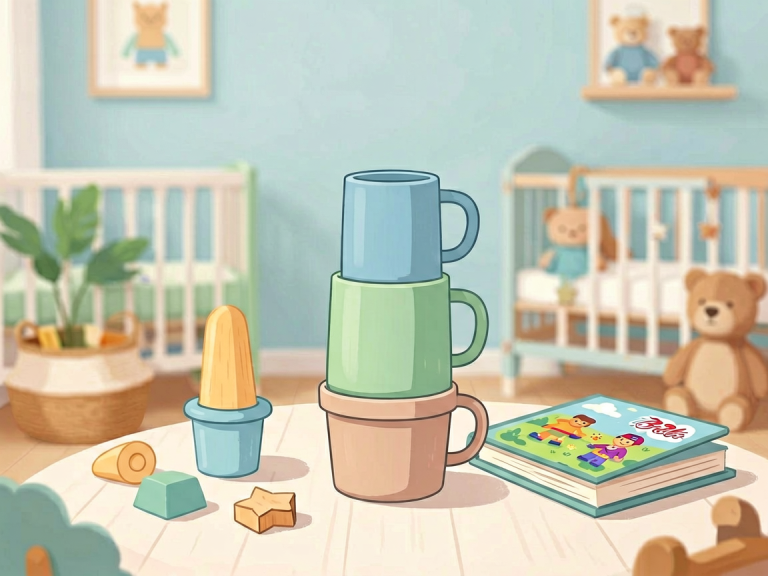
Nesting cups (a set of cups that fit inside each other) and stacking rings (rings of decreasing size on a central pole) are quintessential problem-solving toys. For a baby around 12 months, present a set of cups in a random order. Let them try to stack them. They will quickly learn that a large cup cannot sit on top of a small cup. Through trial and error, they will sort the cups by size. Similarly, with stacking rings, the baby must figure out that the largest ring must go on the base first, then the next, and so on. To make it more complex, mix up two sets of different colors and sizes, challenging the baby to both size and color-match. This develops logical sequencing, visual discrimination, and patience.
Social Problem-Solving: Cooperative Play with Others
Problem-solving is not only about objects; it also involves navigating social interactions. Even young babies can begin to learn turn-taking and negotiation through guided play.
*Parallel Play with Shared Materials*
Set up two identical sets of toys (e.g., two stacking ring towers). Sit beside your baby with your own set. Build your tower while the baby builds theirs. Occasionally, “accidentally” take one of the baby’s rings, then pause and show a confused expression. The baby may reach for it back or vocalize. Guide them: “You want your ring? Let’s trade. Give me the red one, and I’ll give yours back.” This basic exchange teaches negotiation and compromise—key problem-solving skills for social contexts. As the baby gets older (around 18 months), you can initiate simple games where you take turns hiding a toy and finding it together, encouraging collaborative searching.
*Mimicking Daily Routines with Dolls*
For babies nearing 18 months, pretend play with a doll or stuffed animal can introduce sequential problem-solving. Give the baby a small doll and a blanket. Say, “The baby is cold. What should we do?” The baby might try to cover the doll. Then say, “But the blanket is too small—her feet are still showing.” Watch the baby adjust the blanket or choose a larger one. This activity requires the baby to identify a problem (cold doll), consider possible solutions (cover with blanket), and evaluate effectiveness (feet uncovered). It develops empathy alongside analytical thinking.
Adapting Activities to Different Developmental Stages
It is crucial to match the activity’s complexity to the baby’s current abilities. A challenge that is too easy leads to boredom; one that is too hard causes frustration. Here are general guidelines:
- 4–6 months: Focus on sensory exploration and simple cause-and-effect (e.g., shaking a rattle, pulling a string to activate a mobile).
- 7–10 months: Introduce object permanence games (hiding toys under cloths) and simple stacking (one block on top of another).
- 11–14 months: Incorporate more complex cause-and-effect (e.g., pressing buttons to make sounds) and nesting cups/stacking rings.
- 15–18 months: Encourage multi-step problem-solving (e.g., retrieving a toy from inside a box by first opening a latch) and social cooperation during play.
- 18–24 months: Use pretend-play scenarios that require planning and sequencing, such as “feeding” a doll with a spoon and cup.
Observe your baby’s cues: if they become frustrated, offer a gentle hint or simplify the task. If they master an activity quickly, add a new element to extend the challenge.
Conclusion
Play activities for babies to build problem-solving are not about “teaching” in a formal sense but about creating an environment that invites exploration, experimentation, and discovery. Every time a baby struggles to fit a puzzle piece, tries to reach a toy from a different angle, or negotiates with a playmate for a turn, their brain is wiring new neural pathways for flexible thinking. As caregivers, our role is to provide safe, stimulating materials, offer encouragement without over-helping, and celebrate the process—mistakes included. By doing so, we lay the foundation for a lifetime of curious, resilient problem-solving. The next time you see your baby drop a spoon repeatedly from their high chair, remember: they are not being messy; they are conducting a scientific experiment on gravity. Embrace the mess, and let the learning begin.
(*Word count: approximately 1,150*)