Building Blocks of Speech: How Toys Foster Language Development in Toddlers
Language development during the toddler years—roughly between ages one and three—is one of the most remarkable and rapid transformations in human life. Within just a few months, a child progresses from babbling and pointing to uttering single words, then two-word phrases, and eventually full sentences. While genetics and a nurturing environment play crucial roles, the toys and play materials that surround a toddler can significantly shape the pace and richness of this linguistic journey. Toys are not merely diversions; they are cognitive catalysts that provide a context for learning sounds, vocabulary, grammar, and social communication. This article explores the specific ways in which thoughtfully chosen toys can support and accelerate language development in toddlers, offering practical insights for parents, caregivers, and educators.
The Power of Interactive and Responsive Toys
One of the most effective categories of toys for language development includes those that encourage interaction and provide immediate feedback. Unlike passive items such as static stuffed animals or simple blocks, interactive toys—like electronic learning pads, talking storybooks, or cause-and-effect toys—create a dialogue-like loop. When a toddler presses a button and hears the word “apple” pronounced clearly, or when a toy dog says “woof” after being patted, the child begins to associate actions with sounds and meaning. This form of active engagement strengthens neural pathways related to auditory processing and word recognition.
Importantly, the responsiveness of these toys mimics the back-and-forth nature of real conversation. For instance, a toy that asks a question like “Can you find the red ball?” and then praises the child for pressing the correct picture encourages the toddler to listen, process the verbal cue, and respond—a foundational skill for discourse. However, experts caution that electronic toys should not replace human interaction; rather, they work best as supplements that reinforce vocabulary learned through everyday conversations with caregivers. When a parent uses the toy alongside the child—pointing, naming, and expanding on the toy’s output—“Battery-operated words become embedded in a rich social context that deepens understanding,” as noted by early childhood specialists.
The Role of Repetition and Familiarity in Vocabulary Acquisition
Repetition is the bedrock of toddler language learning, and certain toys are designed to capitalize on this principle. Board books with rhyming verses, musical toys that play the same simple songs, and shape sorters with consistent labels (e.g., “circle,” “square”) allow toddlers to encounter the same words multiple times in predictable contexts. This repetition helps solidify neural connections and enables children to move from passive recognition to active production of those words.
Take, for example, a set of animal figurines accompanied by a matching picture book. When a caregiver repeatedly says, “This is a cow. The cow says ‘moo’,” while the toddler handles the plastic cow, the child’s brain links the tactile, visual, and auditory cues. Over time, the toddler will not only identify the cow but also attempt to say “moo” or “cow.” Toys that allow for such multisensory repetition are especially powerful because they appeal to different learning modalities—visual, auditory, and kinesthetic. Moreover, the familiarity of these toys provides a sense of security that reduces anxiety, making the child more open to trying new sounds and words. A toddler who has played with the same set of farm animals daily will eventually feel confident enough to label them spontaneously during a separate play session, demonstrating true linguistic acquisition rather than mere mimicry.
Encouraging Turn-Taking and Conversational Skills
Language is fundamentally a social tool, and toys that promote turn-taking can teach toddlers the rhythm and reciprocity of conversation. Simple items such as toy telephones, puppets, and board games designed for very young children (e.g., matching or memory games) create natural opportunities for a back-and-forth exchange. When a caregiver holds a puppet and says, “Hello, Tommy! What did you do today?” and then waits for the toddler to respond—even with a babble or a gesture—the child learns that communication involves alternating roles of speaker and listener.
Puppets, in particular, are remarkable for building conversational skills. A child can project their own voice onto the puppet, practicing dialogues that might feel too intimidating in direct face-to-face interaction. A puppet can ask questions like “What’s your favorite color?” and the toddler can reply, thereby rehearsing the structure of a question-answer sequence. Similarly, toy telephones encourage children to imitate the intonation patterns they hear from adults: the rising pitch of a question, the pause after a statement, the excited tone of a greeting. These subtle aspects of prosody are critical for social communication and are best learned through playful imitation. By engaging in these structured yet playful exchanges, toddlers internalize the turn-taking protocol that underlies all human conversation.
Expanding Vocabulary Through Themed Play Sets
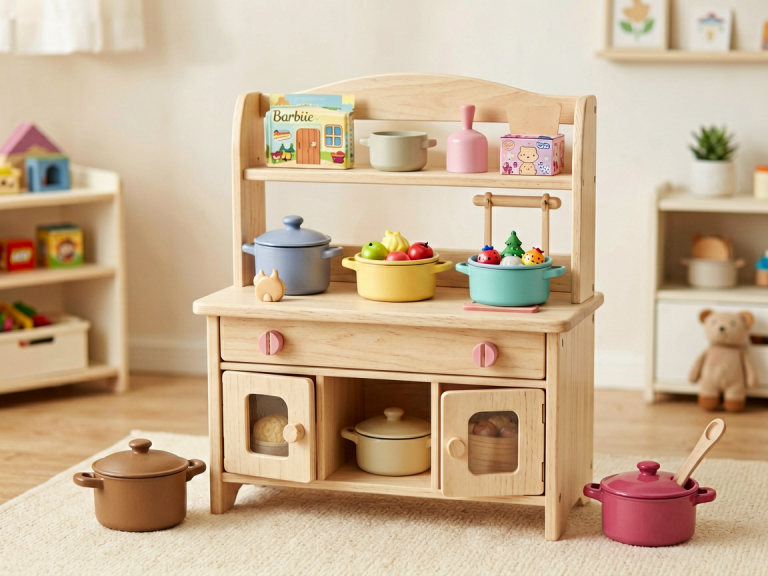
Language is not learned in isolation; it is rooted in context. Themed play sets—such as a mini kitchen complete with plastic fruits, utensils, and a stove, or a doctor’s kit with a stethoscope and bandages—immerse toddlers in role-play scenarios that naturally demand a wide range of words. As a child pretends to cook a meal, they encounter nouns (“pot,” “spoon,” “tomato”), verbs (“pour,” “stir,” “eat”), adjectives (“hot,” “sweet,” “big”), and functional phrases (“more rice,” “all done”). These play sets turn abstract vocabulary into tangible, meaningful actions.
The effectiveness of themed toys lies in their ability to mirror real-life routines. A toddler who sees a parent washing dishes at home can recreate that activity with a play sink and plastic dishes, labeling the actions with the words they have heard. This kind of symbolic play also enhances narrative skills: a child might string together a series of actions, saying “I cut the apple. Now I bake it. Yummy!” This early storytelling—even if fragmented—builds the grammatical and sequential thinking necessary for more complex sentences later. Moreover, when parents actively participate in the play, they can model more advanced language by expanding on the child’s utterances. If the toddler says “apple,” the parent can respond, “Yes, that’s a big red apple. Let’s put it in the bowl.” This “expansion” technique, widely recommended by speech-language pathologists, seamlessly introduces new vocabulary and syntax within a motivating play context.
Choosing the Right Toys for Different Developmental Stages
Not all toys are equally beneficial at every age. A toy that fascinates a 12-month-old may bore a 30-month-old, and vice versa. Understanding the developmental trajectory of language can guide toy selection. For toddlers aged 12–18 months, the focus should be on cause-and-effect toys that produce clear sounds, such as rattles, tambourines, and simple pop-up toys. These help babies connect their movements to auditory feedback, building early sound production and listening skills. Board books with high-contrast pictures and single words per page are also ideal, as they introduce the concept of labeling.
For toddlers aged 18–24 months, toys that encourage two-word combinations are valuable. Simple puzzles with picture names, stacking cups with numbers or colors, and musical instruments that require following simple verbal directions (e.g., “shake the bell”) support the transition from single words to short phrases. Around age two to three, children benefit greatly from narrative-driven toys: play sets with multiple pieces that allow for scenes (e.g., a farm with animals, a garage with cars) and dress-up costumes that inspire imaginative dialogue. At this stage, toys that include simple questions or story prompts (such as a magnetic whiteboard with character magnets) can stimulate more elaborate verbal expression.
It is also crucial to consider the quality of language exposure offered by a toy. Toys that produce full sentences in clear, natural speech are generally preferable to those that only produce isolated sounds or random noises. Open-ended toys that can be used in multiple ways—such as blocks, clay, or art supplies—allow children to create their own narratives, which in turn generates authentic, child-led language. When a toddler builds a tower and says “My tower is tall! It will fall down!” they are practicing self-generated commentary, which is far more valuable for language development than merely repeating a toy’s pre-programmed phrase.
The Critical Role of Parental Involvement
Ultimately, the most powerful “toy” for language development is an engaged adult. No toy, no matter how sophisticated, can replace the nuanced, responsive, and emotionally rich interaction that happens when a caregiver plays with a child. A talking doll cannot look into a toddler’s eyes, follow their gaze, or adjust its speech to match the child’s interest. Therefore, the intentional use of toys should always be paired with active adult involvement. Parents should talk about what they see the child doing, ask open-ended questions (e.g., “What will the doll do next?”), and listen attentively to the child’s vocalizations—even the garbled ones—and respond meaningfully.
Time and again, research has shown that the quantity and quality of words a child hears in their early years directly correlates with later academic and social success. Toys serve as a vehicle for this rich language input. A simple wooden train set, for example, can become a source of dozens of new words: “choo-choo,” “engine,” “track,” “bridge,” “passenger,” “stop,” “go.” But without an adult narrating, pointing, and conversing, many of those words may remain unspoken. By combining thoughtful toy selection with warm, interactive play, caregivers can create an environment in which language blossoms naturally, joyfully, and powerfully.
In conclusion, toys for toddlers are far more than entertainment. They are tools that scaffold language development by providing repetition, encouraging interaction, expanding vocabulary in context, and modeling conversational structure. Whether a child is pressing a button to hear a new sound, role-playing as a doctor, or building a block tower while chattering away, every playful moment holds the potential to build the architecture of language. With the right toys and a loving adult by their side, toddlers can turn mere play into a foundation for a lifetime of communication.